
PEX Plumbing Pros and Cons: Is PEX a Good Choice for Your Home?
Quick Answer
PEX plumbing has real advantages: it’s flexible, lightweight, resistant to corrosion, and generally faster and less labor-intensive to install than rigid pipe. Those benefits make it a popular choice for residential water-supply lines, remodels, and whole-house repipes.
But PEX also has real limitations. It’s sensitive to UV light, can be damaged by rodents or sharp tools, has temperature and pressure limits that vary by product, and depends on using the correct fittings and installation methods. It’s not automatically the best pipe for every situation.
Whether PEX is a good choice for your home depends on where it’s being installed, which product and fitting system you use, how it’s installed, and what your local plumbing code allows not on PEX as a material alone.
What Determines Whether PEX Is a Good Choice
PEX performs well in some conditions and poorly in others, just like copper, CPVC, and PVC. The right question isn’t “is PEX good or bad” — it’s “is PEX a good fit for this specific application.” That depends on:
- Where the tubing will run (inside walls vs. exposed to sunlight)
- The specific PEX product’s temperature and pressure rating
- The fitting and connection system used
- Installation quality and support spacing
- Local plumbing code requirements
- Your priorities — cost, speed, durability, or long-term maintenance
This article walks through the honest trade-offs so you can make that call for your own project.
PEX Plumbing Pros and Cons at a Glance
| Pros | Cons |
|---|---|
| Flexible — routes around obstacles | Degrades with prolonged UV/sunlight exposure |
| Lightweight, easier to handle | Can be cut or punctured by tools, nails, or screws |
| Faster to install than rigid pipe in many layouts | Vulnerable to rodent chewing where exposed |
| Fewer fittings needed in some layouts | Requires fittings matched to the specific tubing system |
| Resists mineral scale and corrosion | Temperature and pressure ratings vary by product |
| Handles some freeze expansion better than rigid pipe | Not freeze-proof — can still crack or fail |
| No soldering required for most systems | Installation errors can cause leaks or reduced flow |
| Good for tight framing and remodel work | Not approved for every application under every code |
| Often lower installed labor cost | Harder to recycle than copper |
| Lower thermal conductivity than copper (less heat loss) | Specialized crimp/expansion tools needed for some systems |
What Is PEX Plumbing?
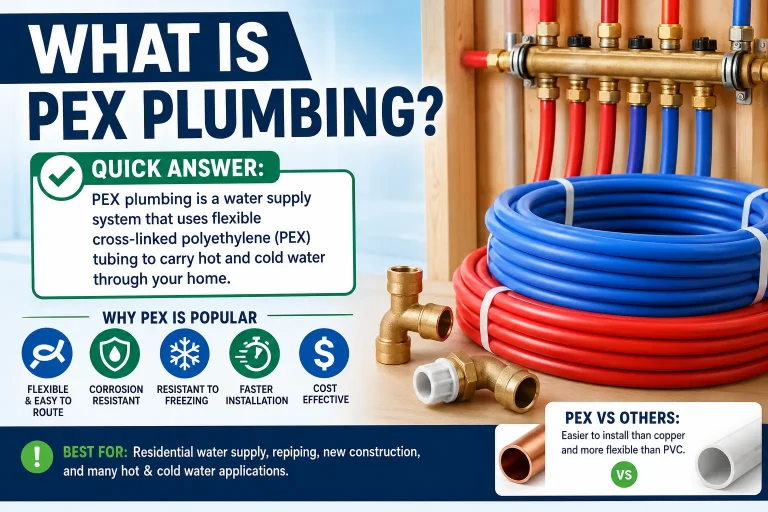
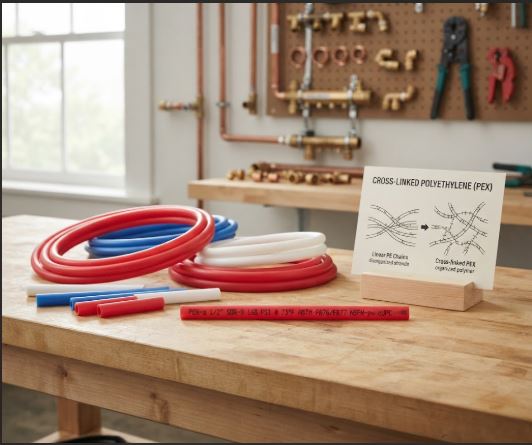
PEX stands for cross-linked polyethylene. It’s a flexible plastic tubing used for hot- and cold-water distribution in homes, replacing some of the rigid copper and CPVC pipe used in older construction.
PEX comes in three manufacturing classifications — PEX-A, PEX-B, and PEX-C — which differ in how the cross-linking process is done, not in a simple “better vs. worse” ranking. Product approval, pressure rating, and intended application (potable water vs. radiant heat, for example) all matter more than the letter alone.
For a deeper look at the material itself, see our guide to what PEX plumbing is.

Advantages of PEX Plumbing
1. Flexibility
What it is: PEX tubing bends around corners and obstacles instead of requiring rigid, angled joints.
Why it matters: Installers can snake tubing through wall cavities, floor joists, and tight framing without cutting as many holes or using as many elbow fittings.
Where it helps most: Remodels and repipes in older homes where framing wasn’t designed with modern plumbing runs in mind.
Important limitation: PEX still has a minimum bend radius specific to the product. Bending it too sharply can kink the tubing and restrict flow, so installers need to follow the manufacturer’s bend-radius specs and use support brackets where required.
2. Faster Installation
What it is: PEX generally installs faster than copper because there’s no soldering, less pipe-cutting precision required, and fewer joints in many layouts.
Why it matters: Faster installation often means lower labor costs on a repipe or new construction project.
Where it helps most: Whole-house repipes, where labor is usually the largest cost component.
Important limitation: Installation speed only pays off if the work is done correctly. A fast, sloppy PEX installation with poor fitting choices or insufficient support can cost more in repairs than it saved in labor.
3. Fewer Fittings in Many Layouts
What it is: Because PEX bends, a single run can sometimes replace several rigid pipe segments and elbow fittings.
Why it matters: Fewer fittings mean fewer potential leak points in the system.
Where it helps most: Long supply runs from a manifold to a fixture, especially in home-run (manifold) PEX systems.
Important limitation: This depends on layout. In some retrofit situations, PEX still needs multiple fittings to navigate framing, so the fitting-count advantage isn’t guaranteed everywhere.
4. Corrosion Resistance
What it is: PEX doesn’t corrode the way copper can in aggressive water conditions.
Why it matters: Homes with acidic water, high mineral content, or electrolysis issues sometimes see pinhole leaks in copper pipe over time. PEX isn’t subject to that specific failure mode.
Where it helps most: Areas with corrosive water chemistry or homes that have experienced repeated copper pipe leaks.
Important limitation: Corrosion resistance doesn’t mean PEX has no vulnerabilities — it simply has different ones, including UV exposure and physical damage, covered below.
5. Freeze/Thaw Resilience
What it is: PEX can expand slightly when the water inside freezes, which gives it more tolerance for freeze events than rigid copper or CPVC.
Why it matters: In marginal freeze conditions, PEX is less likely to split than rigid pipe.
Where it helps most: Unheated crawlspaces or attics in mild-freeze climates where a brief cold snap is possible.
Important limitation: PEX is not freeze-proof. Sustained freezing can still cause fitting failure or tubing damage, and freeze tolerance should never be treated as a substitute for proper insulation or heat tape in cold climates.
6. Lightweight Construction
What it is: PEX weighs significantly less than copper pipe of comparable size.
Why it matters: It’s easier to transport, handle, and install, particularly in tight or overhead spaces.
Where it helps most: Attic runs, crawlspace work, and DIY-scale projects where handling rigid pipe is physically difficult.
Important limitation: Ease of handling doesn’t reduce the need for proper support spacing — unsupported PEX can sag over time.
7. Well-Suited to Remodeling and Repiping
What it is: PEX’s flexibility and speed make it a common choice when opening walls to replace old plumbing.
Why it matters: Repipe projects benefit from fewer access points and faster completion, which reduces disruption to the home.
Where it helps most: Whole-house repipes replacing failing galvanized or corroded copper supply lines.
Important limitation: Suitability still depends on local code approval for the specific application and on selecting a fitting system rated for the project’s pressure and temperature needs.
8. Lower Thermal Conductivity Than Copper
What it is: PEX transfers heat more slowly than copper.
Why it matters: Hot water lines may lose less heat in transit, and cold lines are somewhat less prone to condensation-related issues.
Where it helps most: Long hot-water runs to distant fixtures.
Important limitation: This is a modest efficiency factor, not a dramatic energy-saving feature. Insulating hot water lines still matters regardless of pipe material.
9. No Soldering, No Open Flame
What it is: Most PEX connection systems don’t require a torch.
Why it matters: This reduces fire risk during installation, which matters in older homes with dry framing, insulation, or nearby combustibles.
Where it helps most: Tight, enclosed spaces where using a torch would be risky or require extra fire-watch precautions.
Important limitation: Some transition fittings connecting PEX to existing copper may still involve soldering on the copper side.
10. Potentially Quieter Operation
What it is: Flexible tubing can dampen some vibration and water hammer noise compared to rigid pipe.
Why it matters: Homeowners sometimes report less banging or ticking in PEX systems.
Where it helps most: Systems with proper support brackets and, where needed, water hammer arrestors.
Important limitation: Noise reduction depends heavily on installation quality, water pressure, and whether arrestors are used — it’s not an automatic feature of the tubing itself.
Disadvantages of PEX Plumbing
1. UV Exposure
What it is: PEX tubing degrades with prolonged exposure to sunlight and UV light.
Why it matters: Extended UV exposure can make tubing brittle over time, reducing its service life.
How serious it is: This is a real, well-documented limitation — not exaggerated. It’s a primary reason PEX isn’t typically approved for permanent outdoor exposure.
Where it becomes relevant: Uninsulated attics with skylight exposure, outdoor runs, or storage where tubing sits in direct sun before installation.
How to reduce the risk: Keep tubing indoors or in UV-rated packaging before installation, and follow the manufacturer’s maximum allowable UV exposure time during construction. Route permanent exposed runs through conduit or another shielded method.
2. Physical Damage
What it is: PEX can be cut, punctured, or nicked by nails, screws, or sharp tools.
Why it matters: A puncture creates a leak point, sometimes inside a finished wall where it’s hard to detect early.
How serious it is: Moderate — this is largely preventable with proper protection during and after installation.
Where it becomes relevant: Framing with tubing routed close to the wall surface, where drywall screws or trim nails could reach it.
How to reduce the risk: Use nail plates where tubing passes through studs near the surface, and follow standard setback distances from framing edges.
3. Rodent Damage
What it is: Mice and rats can chew through PEX tubing in accessible areas.
Why it matters: Chewed tubing leaks, and the damage may not be visible until water shows up.
How serious it is: This is a genuine risk in exposed crawlspaces and attics, but not typically an issue for tubing run inside finished walls.
Where it becomes relevant: Crawlspaces, attics, or utility areas with known rodent activity.
How to reduce the risk: Seal entry points, use rodent deterrents, and consider protective sleeving in known problem areas.
4. Temperature Limitations
What it is: Every PEX product has a maximum rated operating temperature, which varies by manufacturer and product line.
Why it matters: Exceeding the rated temperature can shorten tubing life or cause failure.
How serious it is: This is manageable as long as the product is matched to the application — check the manufacturer’s specification sheet for the specific tubing being used.
Where it becomes relevant: Connections near water heaters or boilers, and high-temperature applications like some radiant heat systems.
How to reduce the risk: Confirm the tubing’s rated temperature matches or exceeds the system’s maximum operating temperature before installation.
5. Pressure Limitations
What it is: PEX pressure ratings also vary by product and typically decrease as temperature increases.
Why it matters: A tubing-and-fitting system needs to handle both your home’s static water pressure and any pressure spikes.
How serious it is: Manageable with correct product selection, but it does mean “PEX” isn’t a single spec — you need the datasheet for the exact product.
Where it becomes relevant: Homes with high municipal water pressure or systems without a pressure-reducing valve.
How to reduce the risk: Check incoming water pressure and choose tubing and fittings rated appropriately; install a pressure-reducing valve if pressure is high.
6. Fitting Compatibility
What it is: Not every PEX fitting works with every PEX tube.
Why it matters: Fittings are often designed for a specific tubing type, wall thickness, and connection method. Mixing incompatible components can cause leaks.
How serious it is: This is one of the more common sources of real-world PEX problems, and it’s entirely about the installer’s product selection, not a flaw in PEX as a material.
Where it becomes relevant: Any project mixing tubing and fittings from different manufacturers or product lines.
How to reduce the risk: Select a compatible tubing-and-fitting system from the start and follow the manufacturer’s approved installation instructions.
Plumber’s Tip: Don’t buy tubing first and assume the fittings will work later. Choose the connection system and tubing together as a matched set.
7. Installation Quality Matters
What it is: PEX is more forgiving than copper in some ways, but poor installation — inadequate support, wrong crimp/expansion tool calibration, missed bend-radius limits — still causes failures.
Why it matters: Many “PEX problems” reported by homeowners trace back to installation mistakes, not the material itself.
How serious it is: Significant — this is the difference between a PEX system that lasts decades and one with recurring leaks.
Where it becomes relevant: Any installation, but especially DIY projects without experience using crimp or expansion tools.
How to reduce the risk: Use calibrated tools, follow torque/crimp specifications, and consider a licensed plumber for whole-house work.
8. Connection-System Requirements
What it is: Crimp, clamp/cinch, expansion, and push-to-connect systems each require specific tools and, in some cases, specific expertise.
Why it matters: Expansion tools and crimp tools aren’t interchangeable, and each system has its own inspection method (go/no-go gauges for crimps, for example).
How serious it is: A practical, not catastrophic, limitation — but it does mean a real tool investment for DIYers.
Where it becomes relevant: Any homeowner considering a DIY PEX installation.
How to reduce the risk: Rent or buy the correct tool for your chosen system, and verify each connection using the manufacturer’s inspection method.
9. Possible Flow Restrictions From Fitting Design
What it is: Some fitting types reduce the interior diameter at the connection point more than others.
Why it matters: This can create minor flow restrictions at each fitting, depending on the system used.
How serious it is: Usually minor in a properly sized system, but worth considering in long runs with many fittings.
Where it becomes relevant: Systems with many fittings or undersized tubing for the fixture demand.
How to reduce the risk: Size tubing correctly for the application and consider expansion-style fittings, which tend to preserve more of the interior diameter, where appropriate for the project.
10. Recycling Limitations
What it is: PEX is more difficult to recycle than copper.
Why it matters: This is mostly relevant to environmental considerations rather than day-to-day performance.
How serious it is: A minor factor for most homeowners, but worth knowing if sustainability is a priority in material selection.
Where it becomes relevant: End-of-life disposal during a future repipe or renovation.
How to reduce the risk: Not generally something a homeowner needs to actively manage.
11. Exposed-Installation Limitations
What it is: PEX generally isn’t intended for permanent exposed use outdoors or in high-damage-risk areas.
Why it matters: Combines the UV and physical-damage issues above into a practical installation constraint.
How serious it is: Real, and it affects where PEX is an appropriate choice at all.
Where it becomes relevant: Outdoor hose bibs, exterior wall penetrations, or unprotected mechanical rooms.
How to reduce the risk: Use approved transition methods to a more damage-resistant material at exposed exterior points, or protect PEX with proper conduit or sleeving where code allows it.
12. Local Code and Application Restrictions
What it is: Plumbing code adoption and specific application approval for PEX vary by jurisdiction.
Why it matters: Some municipalities restrict certain applications or require specific product listings.
How serious it is: This is a compliance issue, not a performance one — but it’s essential to check before starting work.
Where it becomes relevant: Any permitted plumbing project.
How to reduce the risk: Check with your local building department or a licensed plumber before finalizing your material choice.
Where PEX Works Best
- Inside finished walls — protected from UV and most physical damage, ideal for PEX’s strengths.
- New residential construction — framing can be designed around PEX routing from the start.
- Remodeling projects — flexibility reduces the number of access holes needed.
- Whole-house repipes — faster installation and fewer fittings can reduce labor time and cost.
- Protected crawlspaces — works well when insulated and shielded from rodents and sunlight.
- Basement plumbing — typically indoor, climate-controlled, and low physical-damage risk.
- Long water-supply runs — flexibility avoids extra joints over distance.
- Tight framing and retrofit routing — snakes through spaces rigid pipe can’t easily reach.
Where Should You Avoid or Protect PEX?
“Avoid” doesn’t always mean PEX can never be used — often it means the installation needs extra protection or a different product choice.
- Prolonged direct sunlight: Route indoors, use UV-rated conduit, or switch materials for permanently exposed runs.
- Unprotected outdoor exposure: Use an approved transition fitting to a more damage-resistant material outside.
- High physical-damage-risk areas: Sleeve or shield tubing near mechanical equipment or storage areas.
- Rodent-prone exposed locations: Seal entry points and consider protective sleeving.
- Near excessive heat sources: Maintain manufacturer-specified clearance from water heaters, flues, and recessed lighting.
- Applications beyond the product’s rating: Match tubing and fittings to the system’s actual temperature and pressure.
- Where local code doesn’t permit the application: Confirm approval before installation — this varies by jurisdiction and use case.
Common PEX Plumbing Problems
| Problem | Common Cause | What to Do |
|---|---|---|
| Leaking fitting | Incompatible fitting/tubing, poor crimp/expansion, missed inspection | Verify compatibility, re-check connection with proper gauge/tool |
| Kinked tubing | Bent tighter than the rated bend radius | Replace the kinked section; use bend supports on tight turns |
| Sagging tubing | Insufficient support spacing | Add support brackets per manufacturer spec |
| UV damage | Extended sun exposure during storage or installation | Store indoors; shield any exposed runs |
| Physical damage | Nail/screw puncture, sharp tool contact | Use nail plates; keep proper setback from framing edges |
| Rodent damage | Exposed tubing in crawlspace/attic | Seal entry points; use protective sleeving |
| Low flow | Undersized tubing, restrictive fittings, or many bends | Size tubing to fixture demand; consider fitting type |
| Freeze-related damage | Inadequate insulation in cold areas | Insulate and heat-trace vulnerable runs |
| Incorrect connection | Mixed-brand components, wrong tool | Use a matched tubing-and-fitting system |
| Improper support | Skipped hangers/straps during installation | Follow manufacturer spacing requirements |
This table separates material limitations — things inherent to PEX, like UV sensitivity — from installation mistakes, which are avoidable with correct technique. Most real-world “PEX plumbing problems” homeowners encounter fall into the second category.
Does PEX Freeze and Burst?
Yes. PEX can freeze, but it generally tolerates freezing better than rigid pipe because it can expand somewhat as ice forms. That does not make it freeze-proof, and it should never be treated as a substitute for proper freeze protection.
In a freeze event, water expands regardless of pipe material. PEX’s ability to flex slightly reduces — but doesn’t eliminate — the risk of a split. Fittings, which are rigid, remain a common failure point even when the tubing itself survives.
For exposed or cold-climate installations:
- Insulate tubing in unheated spaces (crawlspaces, attics, garages)
- Use heat tape in known problem areas
- Avoid routing supply lines through unconditioned exterior walls where possible
- Don’t rely on PEX’s flexibility as your only freeze-protection strategy
Is PEX Safe for Drinking Water?
PEX tubing that is certified for potable water use is considered safe for drinking water distribution. The key phrase is “certified for potable water” — not all plastic tubing is intended for this use.
Look for PEX products listed to relevant standards (such as NSF/ANSI 61 for health effects and NSF/ANSI 14 for plastics piping system components) and approved for potable water applications. Manufacturer documentation should confirm this certification.
Some homeowners report a temporary taste or odor with new PEX systems, which is a documented but generally short-term issue tied to specific products and water conditions; flushing the system after installation is a common practice. Certified, listed PEX tubing is different from generic, non-potable-rated plastic tubing sometimes used for irrigation or other non-drinking applications — the two should not be confused.
How Long Does PEX Plumbing Last?

There’s no single guaranteed lifespan for PEX, because service life depends on multiple factors:
- Water temperature and pressure over time
- UV exposure during and after installation
- Local water chemistry
- Installation quality
- Specific product and manufacturer specifications
- Physical damage history
- Application (potable water vs. radiant heat, for example)
Some manufacturers and industry sources cite multi-decade service life estimates for properly installed, code-compliant PEX systems, but these are estimates based on testing and manufacturer specifications — not universal guarantees for every product or installation. For a specific lifespan expectation, check the warranty and technical documentation for the exact tubing you’re using.
Does PEX Affect Water Pressure?
No — PEX doesn’t increase your home’s incoming water pressure. Water pressure is set by your municipal supply or well system, not by the pipe material.
What PEX (and pipe material generally) can affect is flow — how much water moves through the system at a given pressure. Flow depends on:
- Pipe size and inside diameter
- Fitting design (some reduce interior diameter more than others)
- Total pipe length and number of bends
- Fixture demand
- Overall system design (trunk-and-branch vs. home-run/manifold)
Some PEX connection systems preserve more of the tubing’s interior diameter than others, which can matter in long runs with multiple fittings. But there’s no blanket rule that “PEX gives better water pressure” — it depends on sizing and design, same as any piping material.
PEX-A vs. PEX-B vs. PEX-C
PEX-A, PEX-B, and PEX-C refer to different cross-linking manufacturing methods, not a simple quality ranking.
- PEX-A is generally the most flexible and often works with expansion-style fittings, which tend to preserve interior diameter well.
- PEX-B is a common, widely used type, typically paired with crimp or clamp/cinch fittings, and is often less expensive.
- PEX-C is less common in whole-house systems and is manufactured with a different cross-linking process.
Cost, flexibility, and available fitting systems vary by type and manufacturer — PEX-A is not automatically “better” for every project, and product selection should be based on the specific application, budget, and available installation expertise. For a full comparison, see our guide to PEX-A vs PEX-B.
PEX Fittings and Connection Methods
Common PEX connection methods include:
- Crimp fittings — a copper ring is crimped over the tubing and fitting using a crimp tool, then checked with a go/no-go gauge.
- Clamp/cinch fittings — a stainless steel clamp is tightened with a cinch tool.
- Expansion fittings — the tubing is expanded and slid over a fitting, then allowed to shrink back for a tight seal (commonly used with PEX-A).
- Push-to-connect fittings — tubing is pushed into a fitting with an internal grab mechanism, requiring no tool for the connection itself.
Do not assume every PEX fitting works with every PEX tube. Fittings are rated for specific tubing types, sizes, and wall thicknesses. Always confirm manufacturer compatibility, use the approved connection method for that fitting, and follow the installation instructions exactly. For more detail on fitting types and selection, see our guide to PEX pipe fittings.
PEX vs. Copper vs. CPVC
| Factor | PEX | Copper | CPVC |
|---|---|---|---|
| Flexibility | High | None (rigid) | None (rigid) |
| Installation | Faster, fewer specialized skills | Slower, requires soldering | Requires solvent welding |
| Material cost | Generally lower | Generally higher | Generally lower |
| Corrosion resistance | Not subject to metal corrosion | Can corrode/pit over time | Not subject to metal corrosion |
| UV exposure | Sensitive — needs protection | Not UV-sensitive | Sensitive — needs protection |
| Freeze tolerance | More forgiving, not freeze-proof | Prone to splitting when frozen | Prone to cracking when frozen |
| Max temperature | Product-dependent | High | Lower than copper |
| Repair | Cut and re-fit section | Cut and solder | Cut and solvent-weld |
| Typical residential use | Supply lines, repipes, manifolds | Supply lines, water heaters | Hot/cold supply in some regions |
This is a snapshot, not a full comparison. For a deeper breakdown of when each material makes sense, see our full PEX vs copper guide.
Is PEX Good for a Whole-House Repipe?
PEX is a popular repipe choice for practical reasons:
- Flexibility reduces the number of access holes needed to route tubing through existing walls and framing.
- Fewer fittings in many layouts mean fewer potential leak points in a system that’s hard to inspect once walls are closed.
- Faster installation shortens the time your home is under construction and reduces labor cost, which is usually the largest expense in a repipe.
- Manifold (home-run) systems, common with PEX-A, allow individual shutoff of fixtures without affecting the rest of the house.
That said, installed cost — not tubing price alone — determines the real value. Total project cost includes fittings, tools, labor, wall access and repair, permits, and removal of old plumbing. A repipe quote should reflect all of these, not just material cost. Local code also determines which PEX products and applications are approved in your area, so check with a licensed local plumber before committing to a whole-house plan.
Is PEX Plumbing Worth It?
PEX is usually worth considering if:
- You’re installing or replacing indoor residential water-supply lines
- You’re remodeling and need flexible routing through existing framing
- You’re planning a whole-house repipe and want to reduce labor time
- Corrosion resistance is a priority based on your water chemistry
- Installation speed and cost matter to your project
Consider another material, or add protection, if:
- The run will have prolonged UV or outdoor exposure
- The location has a high risk of physical or mechanical damage
- The application involves unusual temperature or pressure demands beyond standard product ratings
- Local code restricts PEX for your specific use case
- You need a specific certification or listing that your chosen product doesn’t carry
Final Verdict
PEX is a strong option for most indoor residential water-supply applications — but it isn’t automatically the best material for every situation. Its performance depends on the specific product, the fitting system, the quality of installation, and whether it’s used within its rated conditions.
For most U.S. homeowners considering a repipe, remodel, or new water line, PEX is worth serious consideration. The right decision comes down to matching the product and installation method to your project’s actual conditions — indoor vs. exposed, temperature and pressure demands, local code, and budget — rather than assuming any single material is universally superior.
If you’re still weighing your options, our companion guide on is PEX plumbing a good choice and our breakdown of common problems and limitations of PEX plumbing go deeper into specific scenarios.