PEX Pipe Fittings: Types, Sizes, Connections & How to Choose
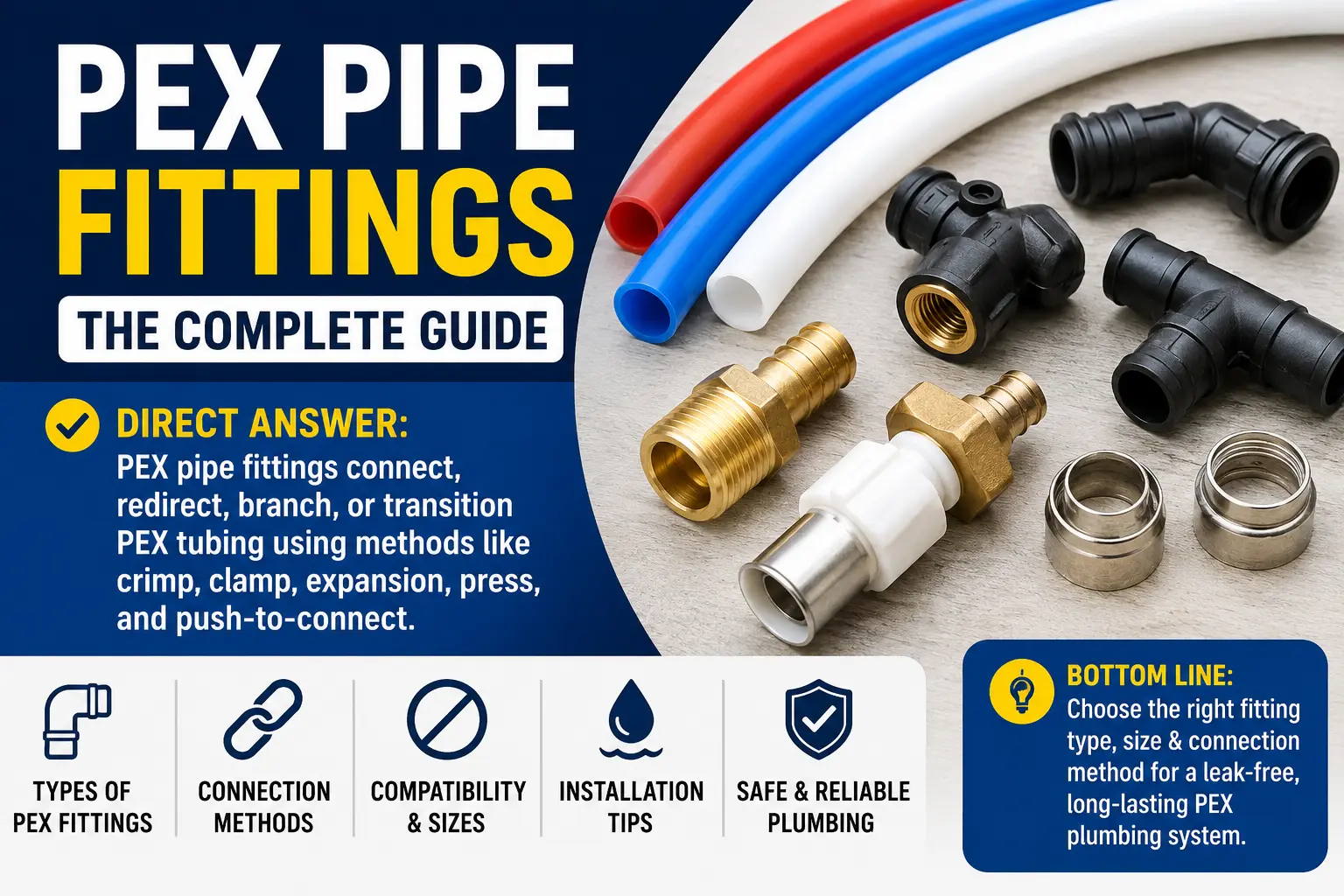
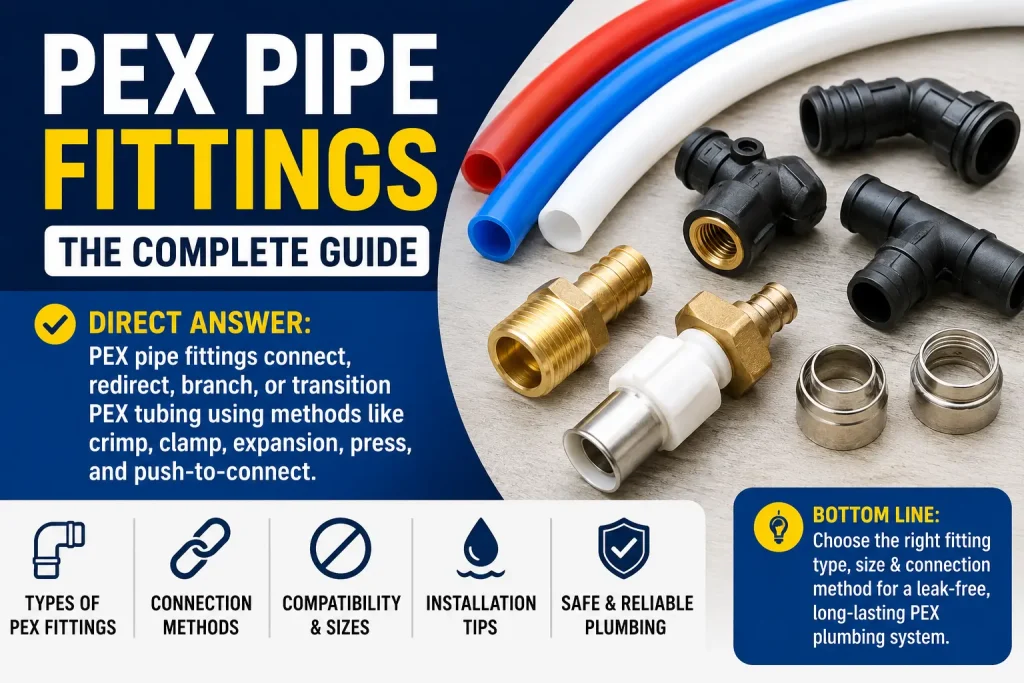
PEX pipe fittings connect, redirect, branch, or transition PEX tubing. Common types include elbows, tees, couplings, adapters, valves, and manifolds.
Common options include elbows, tees, couplings, adapters, valves, and manifolds, while connection methods include crimp, clamp, expansion, press, and push-to-connect systems.
The tricky part? Not every PEX fitting works with every tubing or connection system. Choosing the right fitting means checking the PEX type, fitting standard, size, connection method, application, and manufacturer instructions.
This guide breaks down the main types of PEX pipe fittings, how they connect, and what to consider before installing them.
What Are PEX Pipe Fittings?
PEX pipe fittings are components used to join PEX tubing to another section of tubing, a fixture, valve, manifold, or another type of pipe.
PEX itself is cross-linked polyethylene. In residential plumbing, it is commonly used for hot- and cold-water distribution because the tubing is flexible and can simplify installation compared with rigid piping systems.
The fitting creates the actual connection point in the system.
For example, you might use a coupling to join two pieces of PEX, an elbow to change direction, or an adapter to connect PEX to a threaded component.
The Plastics Pipe Institute’s 2026 PEX Plumbing Distribution Systems Design and Installation Guide covers PEX tubing, fittings, manifolds, joining methods, design, installation, and code considerations for residential, multifamily, and commercial plumbing systems.
PEX Fittings vs. PEX Connection Methods
Before looking at individual fittings, it helps to understand one distinction that often causes confusion.
A fitting type describes what the fitting does. A connection method describes how the fitting attaches to the tubing.
For example:
- Elbow = changes the direction of the pipe.
- Tee = creates a branch.
- Coupling = joins two sections of tubing.
- Adapter = creates a transition to another connection.
- Crimp = one way to attach a fitting to PEX.
- Expansion = another connection method.
- Push-to-connect = another way to make a connection.
So, an elbow and a crimp fitting aren’t necessarily competing categories. An elbow can use a particular connection system, such as crimp, depending on the product.
That simple distinction makes PEX fittings much easier to understand.
Also read: Pex a vs Pex b: Whats better?
Common Types of PEX Pipe Fittings
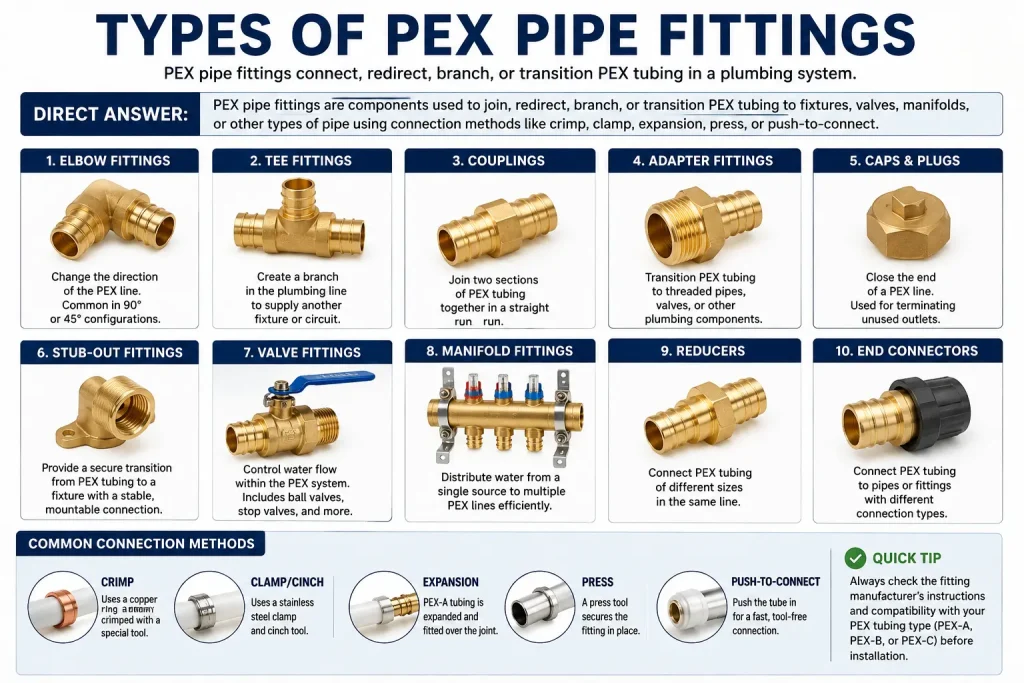
1. PEX Elbow Fittings
An elbow changes the direction of a PEX line.
A 90-degree elbow is common when a pipe needs to turn around a corner, while other configurations can serve different installation layouts.
Elbows can also be designed to transition to threaded connections or create a secure mounting point at a fixture.
2. PEX Tee Fittings
A tee creates a branch in a plumbing line.
For example, a main PEX line may use a tee to supply another fixture or branch circuit.
Tee fittings come in different configurations and sizes, so the correct product depends on the tubing arrangement and connection system.
3. PEX Couplings
A coupling joins two sections of PEX tubing.
It is particularly useful when extending a line or repairing a damaged section, provided the repair complies with applicable plumbing requirements and the manufacturer’s instructions.
4. PEX Adapter Fittings
Adapters create transitions between PEX and another connection type.
Depending on the design, an adapter can connect PEX to:
- Male threads
- Female threads
- Valves
- Fixtures
- Other approved piping systems
These fittings are especially useful when PEX needs to connect to an existing plumbing component.
5. PEX Caps and Plugs
Caps close the end of a PEX line.
They can be useful when terminating a branch or closing a line during a particular installation.
Always make sure the fitting is approved for the intended application.
6. PEX Stub-Out Fittings
Stub-out fittings help create a finished connection point where PEX meets a fixture.
They are commonly useful around sinks, toilets, and other plumbing fixtures where the flexible tubing needs to transition into a more conventional connection point.
7. PEX Manifold Fittings
A PEX manifold distributes water to multiple individual lines.
A manifold-based system can give each fixture its own supply line rather than relying on a long series of branches.
The current PPI PEX guide specifically includes manifolds as part of modern PEX plumbing-system design and installation.
Main PEX Connection Methods
The fitting itself is only half the story. You also need to know how the fitting connects to the tubing.
PEX Crimp Fittings
Crimp is one of the most widely used PEX connection methods.
A typical crimp connection uses a fitting, a copper crimp ring, and a properly sized crimping tool.
The ring compresses around the tubing and fitting to secure the connection.
Crimp systems are popular because the components are widely available and the method is familiar to many plumbers. Technical references identify ASTM F1807 for many brass crimp fittings and ASTM F2159 for certain plastic/polymer crimp fittings.
The tool and installation procedure matter. A poorly made crimp connection can create problems even when you selected the correct fitting.
PEX Clamp or Cinch Fittings
Clamp, often called cinch, is another mechanical connection method.
Instead of a copper crimp ring, the system uses a stainless-steel clamp and a cinch tool.
The basic idea is similar: the clamp compresses the tubing around the fitting.
PEX.net identifies clamp connections with ASTM F2098 clamps when used with applicable crimp-style fittings.
PEX Expansion Fittings
Expansion connections work differently.
The tubing is expanded with a specialized tool before the fitting is inserted. The tubing then contracts around the fitting.
This method is strongly associated with PEX-A systems because PEX-A has the characteristics required for this type of expansion connection.
For example, PEX.net identifies ASTM F1960 expansion systems as compatible with PEX-A tubing, while SharkBite’s current comparison also identifies its expansion system as PEX-A specific.
Don’t assume that an expansion fitting can simply be used with any PEX tubing you happen to have in the truck.
Push-to-Connect PEX Fittings
Push-to-connect fittings are designed for quick installation.
The tubing is cut square and pushed into the fitting until it reaches the required insertion depth. The fitting’s internal mechanism grips the tubing and creates the seal.
One major advantage is convenience because the connection does not require a traditional crimping or expansion tool.
Current manufacturer documentation describes push-to-connect systems as useful for repairs, remodels, transitions, and locations where working space or tool access is limited.
However, always check the specific fitting’s approved tubing types and installation instructions rather than assuming every push-fit product is identical.
PEX Press Fittings
Press systems use a specialized press tool to secure the connection.
They can provide fast and consistent installations, but the exact compatibility depends on the fitting and tubing system.
For example, PEX.net distinguishes between different manufacturers’ press products and their intended tubing applications.
That is an important lesson: “PEX press fitting” is not enough information to determine compatibility.
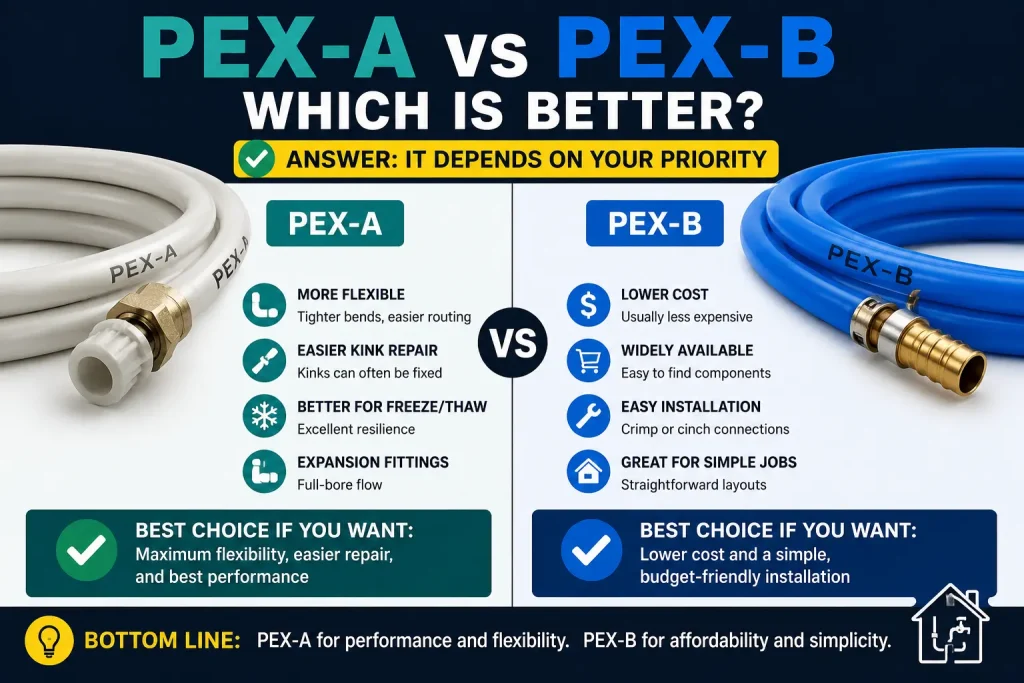
PEX-A, PEX-B, and PEX-C: Do the Fittings Interchange?
This is one of the most important questions when buying PEX pipe fittings.
PEX-A, PEX-B, and PEX-C refer to different manufacturing or cross-linking processes. The letters do not simply mean that one is a premium grade and another is a lower grade.
Viega explains that the three designations refer to peroxide, silane, and electron-beam cross-linking processes, respectively. PEX products must meet applicable performance standards regardless of the manufacturing method.
However, the connection system can have specific tubing requirements.
For example:
- Crimp systems can be used with multiple PEX tubing types when the specific products are approved for that application.
- Expansion systems are designed for compatible PEX-A tubing.
- Push-to-connect products may support multiple tubing types, but you should verify the individual product.
- Press systems can have manufacturer-specific compatibility requirements.
PEX.net’s fitting comparison demonstrates why checking the exact fitting system matters rather than assuming all PEX fittings are interchangeable.
Quick PEX Compatibility Guide
| Connection method | General compatibility |
|---|---|
| Crimp | Commonly compatible with PEX-A, PEX-B, and PEX-C when approved |
| Clamp/Cinch | Commonly used with compatible PEX tubing |
| Expansion | Primarily associated with PEX-A systems |
| Push-to-connect | Compatibility varies by product |
| Press | Compatibility varies by manufacturer/system |
| Compression | Commonly associated with specific transition or multilayer applications |
Always verify the fitting manufacturer’s compatibility information before installation.
What Sizes Do PEX Fittings Come In?
PEX fittings are available in various nominal sizes, with 1/2-inch, 3/4-inch, and 1-inch being common residential sizes.
Larger sizes are also available for applications that require them.
Don’t choose a fitting simply because it “looks about right.” Check the tubing’s marked size and the fitting specifications.
Also remember that fitting size, tubing dimensions, and the fitting’s internal flow area are related but not necessarily identical.
For a plumbing project, the correct size depends on the system design, fixture demand, tubing layout, and applicable code requirements.
Do PEX Fittings Restrict Water Flow?
Yes, the design of a connection can affect the available flow area.
Some fitting designs place a fitting insert inside the tubing, which can reduce the internal passage compared with the tubing itself. Expansion-style systems can have a larger internal passage because the tubing expands over the fitting.
SharkBite’s current technical comparison specifically notes the flow advantage associated with expansion-style fittings and contrasts the internal diameter of connection systems.
That doesn’t mean one connection method is automatically the best choice for every plumbing system.
The overall design matters, including:
- Tubing size
- Number of fittings
- Pipe length
- Pressure
- Fixture demand
- Fitting design
- System layout
In other words, don’t blame the elbow for every weak shower.
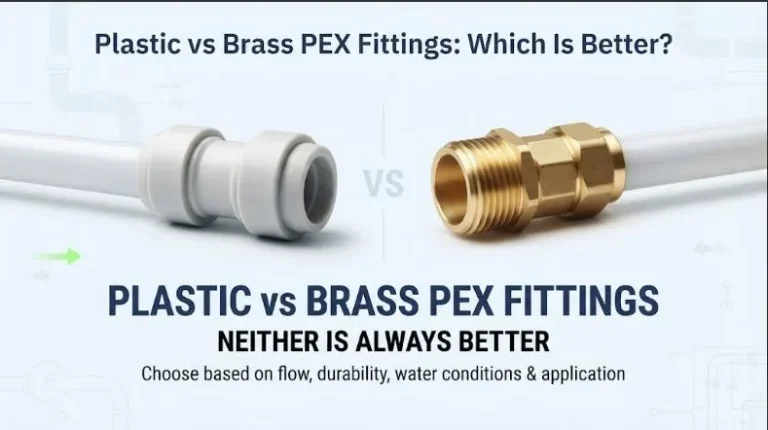
Brass vs. Polymer PEX Fittings
PEX fittings commonly come in brass and engineered polymer materials.
Brass fittings have a long history in plumbing applications and are widely available.
Polymer fittings can offer different weight, corrosion, and installation characteristics depending on the product.
There is no universal rule that says brass is always better or plastic is always better.
Instead, look at the fitting’s certification, intended application, connection system, temperature and pressure ratings, compatibility, and local requirements.
The PEX fitting technical comparison from PEX.net identifies both brass and polymer options across different connection systems.
Related Read: Is pex Plumbing bad?
How to Choose the Right PEX Pipe Fitting
Use this simple decision process.
Need to change direction?
Choose an appropriate elbow.
Need to branch a line?
Look for a tee.
Need to join two PEX tubes?
Use a compatible coupling.
Need to connect PEX to a threaded component?
Choose the appropriate threaded adapter.
Need to close a line?
Use a compatible cap or termination fitting.
Then choose the connection method.
Do you already have a crimp tool? A crimp system may make sense.
Are you installing PEX-A and using an expansion system? Choose the compatible expansion fittings and tools.
Need a quick repair where tool access is difficult? An approved push-to-connect product may be useful.
The important word here is compatible.
Don’t buy the fitting first and hope the tubing will cooperate later.
How to Install PEX Pipe Fittings
The exact procedure depends on the connection system, so follow the manufacturer’s instructions.
In general:
- Identify the PEX tubing type and size.
- Select a compatible fitting.
- Cut the tubing cleanly and square.
- Prepare the connection according to the fitting system.
- Insert or expand the tubing as required.
- Complete the crimp, clamp, press, or expansion connection.
- Inspect the connection.
- Pressure-test the system according to the applicable procedure.
- Check for leaks before putting the installation into normal service.
The 2026 PEX Plumbing Distribution Systems Design and Installation Guide provides detailed installation guidance and was developed through an industry consensus process involving PPI, PPFA, Home Innovation Research Labs, and representatives from PEX manufacturers, with support from IAPMO and ICC.
Common PEX Fitting Mistakes
A fitting doesn’t get a free pass just because PEX is considered easy to install.
Common mistakes include:
- Using the wrong fitting size
- Mixing incompatible connection systems
- Using the wrong tool
- Failing to cut the tubing square
- Not inserting tubing to the required depth
- Incorrectly positioning a crimp ring or clamp
- Using a damaged fitting
- Ignoring manufacturer instructions
- Forgetting to pressure-test the system
- Using a fitting outside its approved application
A few extra minutes checking the connection can save you from discovering a tiny leak after the wall is closed.
Why Is My PEX Fitting Leaking?
A leaking PEX connection can have several possible causes.
The connection may not have been installed correctly. The tubing may have been cut poorly or not inserted far enough. A crimp or clamp may not have been made correctly. The fitting or tubing may also be damaged or incompatible with the connection method.
For push-to-connect fittings, check the tubing cut, insertion depth, tubing condition, and manufacturer’s installation requirements.
For crimp systems, inspect the ring position and connection using the appropriate installation verification method.
Don’t simply tighten, squeeze, or “give it another turn” and hope for the best. Identify the connection system first, then follow the manufacturer’s repair or replacement procedure.
Are PEX Pipe Fittings Safe for Drinking Water?
PEX plumbing products intended for potable-water applications should carry the appropriate certifications and markings for that use.
The tubing and fitting are part of a system, so don’t judge suitability from the word “PEX” alone.
Check the product’s certification, intended application, markings, manufacturer documentation, and applicable plumbing requirements.
This is particularly important when choosing fittings for drinking-water systems.
Final Takeaway
Choosing PEX pipe fittings is easier once you separate what the fitting does from how the fitting connects. Start with the tubing type and size. Then choose the fitting shape you need, such as an elbow, tee, coupling, or adapter. After that, select a compatible connection system such as crimp, clamp, expansion, press, or push-to-connect.