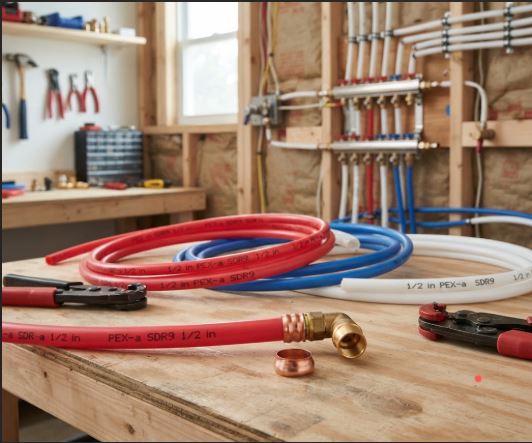

PEX vs Copper: Which Is Better for Home Plumbing?
PEX vs copper is one of the most common questions homeowners face when building, remodeling, or repiping a house. Both materials are widely used for residential water lines, but they have very different characteristics.
PEX is usually less expensive and easier to install, while copper offers excellent durability, high temperature resistance, and a long history of use in plumbing systems. The better choice depends on your budget, climate, water conditions, installation location, local plumbing code, and whether you are installing new plumbing or replacing an existing system.
For many whole-house repiping projects, PEX can offer a practical balance of cost, flexibility, and installation speed. Copper can still be an excellent choice when its durability, rigidity, UV resistance, or other project-specific advantages matter.
This guide compares PEX vs copper pipe in detail, including cost, lifespan, freezing, water quality, installation, repairs, water pressure, PEX types, copper types, and whole-house repiping.
PEX vs Copper at a Glance
| Feature | PEX | Copper |
|---|---|---|
| Material | Cross-linked polyethylene | Copper alloy |
| Flexibility | Excellent | Low |
| Installation | Generally easier | More labor-intensive |
| Material cost | Usually lower | Usually higher |
| Corrosion resistance | Excellent against typical corrosion | Can corrode under certain water conditions |
| Freeze resistance | More forgiving than rigid pipe | More vulnerable to freeze-related bursting |
| UV resistance | Limited; prolonged UV exposure must be avoided | Excellent |
| Heat resistance | Good within its rated limits | Excellent |
| Fittings | Crimp, clamp, expansion, and other approved systems | Solder, press, compression, and other approved systems |
| Repair | Relatively straightforward | Requires more tools and skill |
| Noise | Can reduce some plumbing noise | Can transmit more vibration and water noise |
| Rigidity | Flexible | Rigid |
| Recyclability | More difficult to recycle | Highly recyclable |
| Best suited for | Many residential repipes and new installations | Long-term, rigid plumbing installations and specific applications |
Bottom line: There is no universal winner. PEX is often the practical choice when installation cost, flexibility, and ease of installation are priorities. Copper remains a strong option when durability, rigidity, UV exposure, temperature performance, or project requirements favor it.
PEX vs Copper Pros and Cons
PEX Pros
- Flexible
- Lightweight
- Usually less expensive to install
- Easier to route through tight spaces
- Resistant to typical corrosion
- Generally more forgiving during freezing
- Requires no torch for many connection systems
- Easy to repair
- Useful for whole-house repiping
PEX Cons
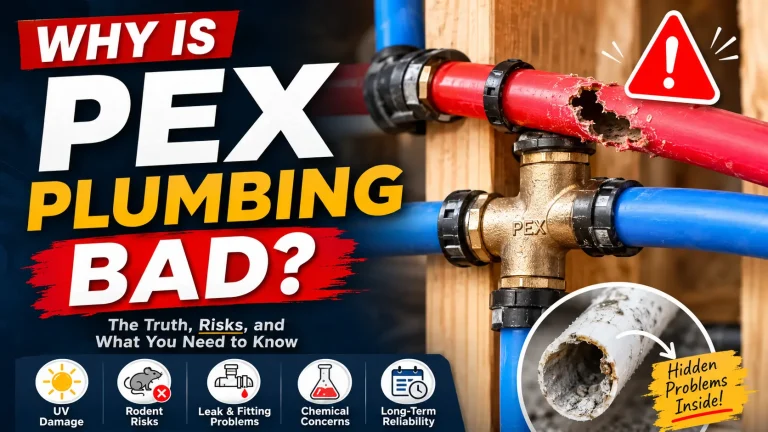
- Must be protected from prolonged UV exposure
- Can be damaged by rodents or physical impact
- Requires compatible fittings and tools
- Temperature and pressure ratings must be followed
- Not every PEX product or fitting is interchangeable
- More difficult to recycle than copper
Copper Pros
- Excellent durability
- Long history in residential plumbing
- Excellent temperature resistance
- Rigid and mechanically strong
- Excellent UV resistance
- Highly recyclable
- Suitable for many exposed applications
- Familiar to plumbers and inspectors
Copper Cons
- Usually more expensive to install
- More labor-intensive
- Rigid
- Can be damaged by freezing
- Can experience corrosion under certain water conditions
- Requires more skill for some joining methods
- Copper prices can significantly affect project cost
What Is PEX Plumbing?
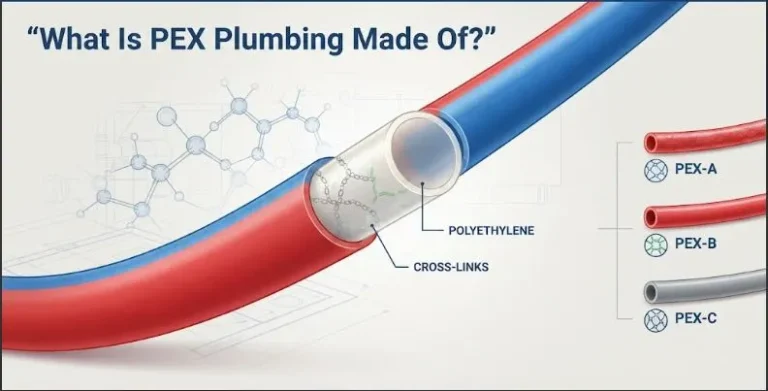
PEX stands for cross-linked polyethylene. It is a flexible plastic tubing material used for hot- and cold-water distribution in residential and commercial plumbing.
Unlike rigid copper pipe, PEX can bend around many obstacles. That allows plumbers to run longer sections of tubing with fewer connections in some layouts.
Current ASTM requirements for PEX tubing cover characteristics such as dimensions, pressure performance, temperature ratings, environmental stress cracking, oxidative stability, and UV resistance. ASTM F876-26 also recognizes PEX for applications including residential and commercial potable-water distribution when applicable code requirements are met.
PEX is available in several forms, including:
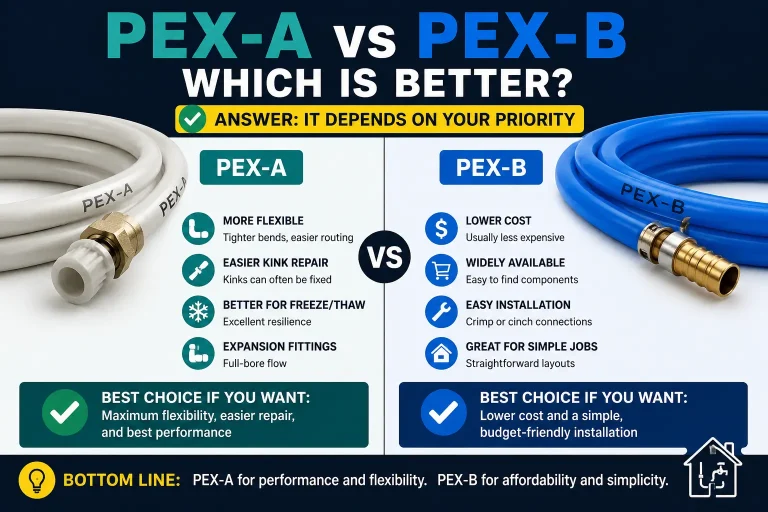
- PEX-A
- PEX-B
- PEX-C
These names describe different manufacturing methods and can affect tubing characteristics and compatible connection systems.
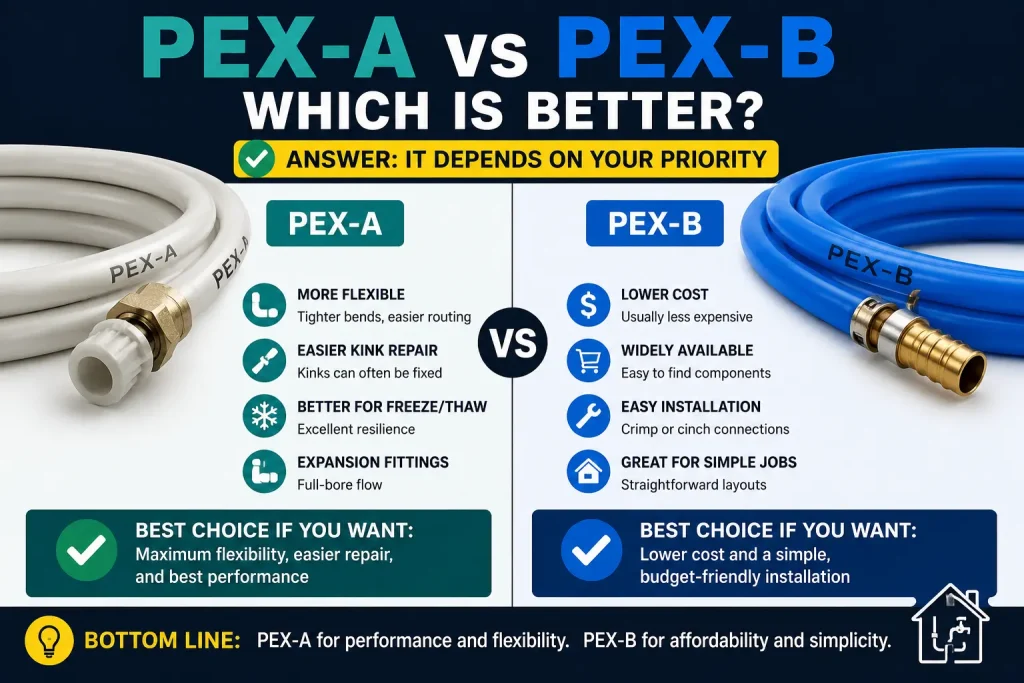
PEX-A
PEX-A is manufactured using the peroxide method.
It is generally known for its flexibility and ability to recover from some kinks when properly treated according to the manufacturer’s instructions. PEX-A is commonly used with expansion-style connection systems.
PEX-B
PEX-B is manufactured using the silane method.
It is widely available and is commonly used with crimp or clamp connection systems, depending on the product and applicable requirements.
PEX-C
PEX-C is manufactured using an irradiation process.
It is another approved form of PEX tubing when the specific product meets applicable standards and code requirements.
Important: PEX-A, PEX-B, and PEX-C should not be treated as completely interchangeable products. Always follow the tubing and fitting manufacturer’s instructions.
What Is Copper Plumbing?
Copper is a metal piping material that has been used in residential plumbing for decades.
Copper water tube is manufactured in different types and tempers for different applications. ASTM B88 covers seamless copper water tube for general plumbing and similar fluid-conveyance applications. The appropriate tube depends on pressure, service conditions, installation requirements, and local requirements.
Common copper types include:
- Type K
- Type L
- Type M
Type K Copper
Type K has the thickest wall of the common copper water-tube types.
It is often selected where additional wall thickness is required, including certain underground and service applications.
Type L Copper
Type L has a medium wall thickness and is widely used for residential and commercial water distribution.
Type M Copper
Type M has a thinner wall than Type L and may be used in certain residential applications where permitted.
The correct copper type should never be selected based only on price. Pressure, installation conditions, local code, and the intended application all matter.
PEX vs Copper: Key Differences
1. Cost
For many residential projects, PEX costs less to install than copper.
The difference is not simply the price of the tubing.
A plumbing project can include:
- Pipe or tubing
- Fittings
- Valves
- Labor
- Tools
- Access to walls and ceilings
- Drywall repairs
- Permits
- Inspections
- Disposal of old piping
PEX can reduce labor in some installations because it is lightweight and flexible. Copper requires cutting, fitting, and joining rigid sections of pipe.
Current consumer cost comparisons also generally show PEX as less expensive to install than copper, although actual project prices vary substantially by location and project complexity.

Which is cheaper: PEX or copper?
PEX is usually the less expensive option for residential water-line installation, particularly when labor and difficult access are involved.
However, a professional estimate should consider the complete installed system rather than comparing the price per foot of tubing alone.
2. Installation
PEX has a major advantage when the plumbing layout contains lots of corners and obstacles.
A plumber can bend PEX around many obstructions instead of cutting and joining multiple rigid sections.
Copper is rigid, so changing direction generally requires elbows or carefully planned bends.
Copper connections may be made using methods such as soldering, press connections, or compression fittings depending on the application and system.
PEX connection systems may include:
- Crimp fittings
- Clamp fittings
- Expansion fittings
- Push-to-connect fittings where approved
The connection method matters. A high-quality pipe installed with an incorrect or poorly made connection can still fail.
3. Flexibility
This is one of PEX’s biggest advantages.
PEX can bend around framing members and other obstacles, making it particularly useful during remodeling.
Copper cannot provide the same flexibility.
That difference becomes especially important when replacing old plumbing inside an existing house where opening walls and ceilings is expensive.
Winner for flexibility: PEX
4. Durability and Lifespan
Both PEX and copper can provide long service when correctly selected and installed.
However, neither material has one universal lifespan that applies to every installation.
Service life can be affected by:
- Water chemistry
- Temperature
- Pressure
- UV exposure
- Installation quality
- Mechanical damage
- Product quality
- Local environmental conditions
Some current consumer guides commonly cite approximately 25–50 years for PEX and 50–70 years for copper, but these figures should be treated as general estimates rather than guarantees.
The important question is not simply:
“Which pipe lasts longer?”
It is:
“Which material is appropriate for the conditions where it will be installed?”
5. Corrosion
PEX does not rust or corrode like a metal pipe.
That is one reason it can be attractive in water conditions that are hard on metal plumbing.
Copper is corrosion-resistant compared with many metals, but it is not immune to corrosion.
Water chemistry can contribute to copper corrosion under certain conditions.
Factors such as:
- pH
- water chemistry
- temperature
- flow conditions
- installation
- interaction with other plumbing materials
can influence corrosion behavior.
Therefore, saying “copper never corrodes” is incorrect.
Winner for corrosion resistance: PEX
6. Freezing
Freezing is one of the most important differences between flexible PEX and rigid copper.
When water freezes inside a plumbing system, it expands and creates pressure.
Copper is rigid, so it has limited ability to accommodate that expansion.
PEX can expand to some degree, making it more forgiving in certain freeze conditions.
That does not mean PEX is freeze-proof.
PEX can still be damaged by freezing, fittings can fail, and repeated freezing is not something a plumbing system should be designed to tolerate.
The best approach is still to prevent pipes from freezing through:
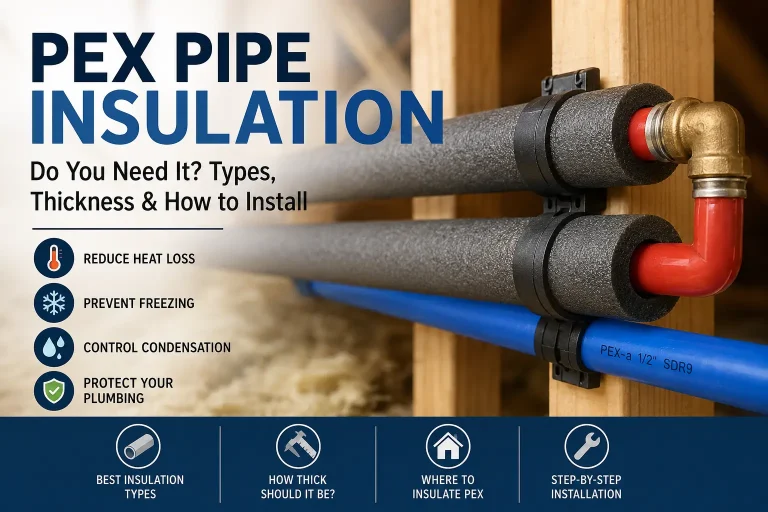
- Proper insulation
- Correct pipe placement
- Sealing drafts
- Protecting exposed plumbing
- Maintaining appropriate indoor temperatures
Which is better for freezing weather?
PEX generally has an advantage over copper in freeze-prone applications because of its flexibility, but proper freeze protection is still necessary.
7. Temperature Resistance
Copper has excellent temperature capability and has long been used in hot-water plumbing.
PEX can also be used for hot-water distribution when the tubing is properly rated for the application.
However, PEX has specific pressure-temperature limitations.
ASTM F876 covers PEX tubing with pressure ratings at multiple water temperatures, and those pressure ratings decrease as temperature increases.
This is why you should never assume that any plastic tubing can be used for any temperature or pressure condition.
Always check:
- Manufacturer specifications
- Tubing markings
- Fitting ratings
- Applicable plumbing code
Winner for high-temperature tolerance: Copper
8. UV Exposure
UV exposure is an important consideration with PEX.
PEX should not simply be installed in a location where it will receive prolonged sunlight unless the specific product and installation method are designed for that exposure.
ASTM requirements for PEX include UV-resistance testing, but this does not mean ordinary PEX can be left exposed to sunlight indefinitely. Product-specific requirements still apply.
Copper does not have the same UV degradation concern.
This makes copper useful in certain exposed installations where UV exposure is unavoidable.
Can PEX be installed outdoors?
It depends on the product, location, protection, and applicable requirements.
For long-term installations, follow the manufacturer’s exposure limitations and local plumbing code.
9. Water Quality
Both PEX and copper are used in potable-water plumbing systems.
The important point is to use products that are approved or certified for the intended potable-water application and installed according to applicable requirements.
PEX is not automatically unsafe simply because it is plastic.
Likewise, copper is not automatically better simply because it is metal.
Copper can interact with water chemistry and may experience corrosion under certain conditions.
New PEX installations can sometimes produce a temporary taste or odor that diminishes with use and flushing, depending on the product and installation.
If you’re concerned about drinking-water quality, focus on:
- Product certification
- Water chemistry
- Proper installation
- Pipe condition
- System age
- Local water quality
rather than assuming one material is universally safer.
10. Water Pressure and Flow
A common question is:
Does PEX reduce water pressure compared with copper?
The answer is more complicated than simply choosing one material.
Flow depends on factors such as:
- Pipe size
- Inside diameter
- Total pipe length
- Number of fittings
- Fitting geometry
- Water pressure
- Flow demand
- System design
PEX can be very effective in residential plumbing when properly sized.
However, different PEX connection systems can have different fitting geometries and internal restrictions.
This means a well-designed PEX system should be sized based on actual water demand rather than assuming that all PEX systems provide identical flow.
Copper also requires correct sizing.
The material alone does not determine your home’s water pressure.
11. PEX vs Copper: Noise and Water Hammer
PEX’s flexibility can help reduce the transmission of some plumbing noise and pressure fluctuations.
Copper is rigid and can transmit vibration through the plumbing system.
Water hammer occurs when moving water suddenly stops or changes direction, creating a pressure wave.
Noise can be influenced by:
- Water pressure
- Pipe size
- Pipe supports
- Valves
- Fittings
- Pipe movement
- Building framing
- Plumbing layout
PEX may have an advantage for some residential installations, but correct pipe support and system design are still important.
12. PEX vs Copper Repairs
PEX can be relatively straightforward to repair.
A damaged section can often be removed and replaced using an appropriate coupling and connection system.
Copper repairs can involve:
- Cutting out the damaged section
- Preparing the pipe
- Soldering
- Press connections
- Compression fittings
- Specialized repair methods
The exact method depends on the plumbing system and accessibility.
Which is easier to repair?
PEX is generally easier for many residential repairs, especially when access is limited.
However, a poorly installed PEX connection can still leak, so installation quality matters.
PEX vs Copper for a Whole-House Repipe
This is where the decision becomes much more practical.
If an older home has widespread copper leaks, you may be considering whether to install new copper or replace the old system with PEX.
PEX can be attractive for a whole-house repipe because it can:
- Reduce material cost
- Reduce installation time
- Route through difficult areas
- Require fewer connections in some layouts
- Simplify certain remodeling projects
Copper may still make sense when:
- Existing copper is in excellent condition
- You strongly prefer rigid metal piping
- UV exposure is unavoidable
- The project requires copper for a particular application
- Long-term material preference outweighs installation cost
Should you replace copper with PEX?
Not automatically.
If your existing copper is performing well and has no significant corrosion or leak problems, there may be no reason to replace it simply because PEX is newer.
If the copper has widespread pinhole leaks, severe corrosion, repeated failures, or a major repipe is already necessary, PEX becomes a much more attractive option.
The condition of the existing plumbing should be evaluated before deciding.
PEX vs Copper for New Construction
New construction gives you more freedom because you aren’t working around an existing plumbing system.
PEX can be especially attractive when:
- Installation speed matters
- Labor costs need to be controlled
- The plumbing layout has many turns
- A manifold system is desired
- The project requires long flexible runs
Copper can be attractive when:
- Rigid piping is preferred
- The project has exposed sections
- High temperature capability is important
- The builder or homeowner prefers copper
- Specific project requirements favor copper
The plumbing design should come before the material choice.
PEX vs Copper by Climate
Your climate can influence the best choice.
Cold Climate
PEX has an advantage because its flexibility can make it more tolerant of freezing than rigid copper.
However, both systems should be properly protected against freezing.
Hot Climate
Copper has excellent temperature performance, but PEX can also be used for hot-water systems when properly rated.
Attic installations require careful consideration of temperature and UV exposure.
Coastal Environment
Water chemistry and environmental conditions should be considered.
Copper can experience corrosion under certain water conditions, while PEX does not corrode in the same way.
Hard or Aggressive Water
If water chemistry is causing problems with existing copper, PEX may be worth considering.
A water-quality professional or plumber can help determine whether the water itself needs treatment.
PEX vs Copper for Different Projects
| Project | Material to Consider First | Why |
|---|---|---|
| Whole-house repipe | PEX | Flexible and often less expensive to install |
| New residential construction | PEX or copper | Depends on design and project requirements |
| Difficult remodeling project | PEX | Easier to route around obstacles |
| Freeze-prone area | PEX | More flexible during freeze events |
| Exposed sunlight location | Copper | Better UV resistance |
| High-temperature application | Copper | Strong temperature performance |
| Existing healthy copper | Keep existing copper | Replacement may not provide enough benefit |
| Corrosion-prone water | PEX | Does not corrode like copper |
| Budget-focused project | PEX | Usually lower installed cost |
| Rigid exposed piping | Copper | Provides a rigid installation |
This table should be treated as a starting point, not a substitute for local code and project-specific engineering.
Is PEX Better Than Copper?
For many residential plumbing projects, PEX is the better practical choice because it is flexible, easier to install, and generally less expensive.
But that does not make copper obsolete.
Copper can be the better choice when you need:
- High temperature performance
- Rigid piping
- UV resistance
- A highly durable exposed installation
- A material with excellent recyclability
- A specific application where copper is preferred or required
The best plumbing material is the one that matches the installation.
Final Verdict:
PEX usually wins on installation cost, flexibility, ease of routing, and practicality for many whole-house repiping projects. Copper wins on rigidity, UV resistance, high-temperature performance, and its long-established track record.