
PEX Pipe Insulation: Do You Need It? Types, Thickness & How to Install
Quick Answer: Does PEX Pipe Need Insulation?
Not always, but often it’s a good idea. PEX doesn’t need insulation everywhere it runs, but it should generally be insulated in unheated or semi-conditioned spaces — attics, crawl spaces, garages, and exterior walls — and on hot-water lines running through unconditioned areas where heat loss matters.
PEX transfers heat more slowly than copper, which helps it hold water temperature a bit better and gives it some natural resistance to bursting in cold weather. That’s not the same thing as insulation, and it’s not the same thing as freeze protection. A pipe with no insulation, sitting in a drafty crawl space through a hard freeze, can still freeze — PEX or not.
This guide walks through why you’d insulate, which type of insulation fits which situation, how thick it should be, and where insulation alone isn’t enough.
Why Insulate PEX Pipe?
Insulation on a water line is doing one of a few different jobs, and it helps to know which job you actually need done before buying anything.
Reduce Heat Loss From Hot Water
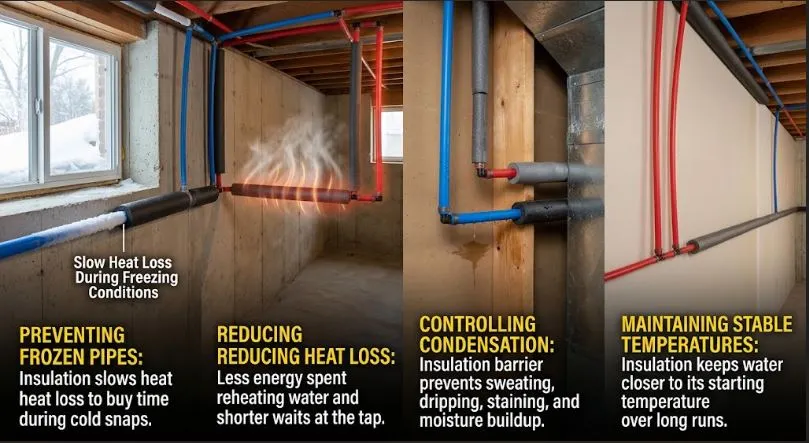
Hot water traveling through an uninsulated line loses heat to the surrounding air the entire way from the water heater to the fixture. In a conditioned space that heat isn’t really “lost” — it just ends up warming the house instead of your shower. But in an attic, garage, or crawl space, that heat is gone. Insulating hot-water PEX in those areas means less energy spent reheating water and less of a wait for hot water at the tap.
Help Control Condensation
Cold-water lines can sweat when warm, humid air contacts a cooler pipe surface — common in basements, humid climates, or near HVAC ductwork. Insulation acts as a barrier that keeps that warm air from touching the cold pipe directly, which reduces dripping, staining, and the moisture buildup that can eventually cause mold or rot nearby.
Slow Heat Loss During Freezing Conditions
In cold weather, insulation slows how fast the water inside a pipe loses heat to its surroundings. That can buy time during a cold snap, especially on lines that see some warm water flow periodically. It does not stop heat loss entirely, and it doesn’t add heat — it only slows the rate of loss.
Maintain More Stable Water Temperatures
For long runs — especially hot-water recirculation lines — insulation helps keep water closer to its starting temperature over distance, which matters for both comfort and energy use.
Should You Insulate Hot or Cold PEX?
Hot and cold PEX lines are insulated for different reasons, and the priority level often depends on where the pipe runs.
| Pipe Type | Main Reason to Insulate | Priority | Notes |
|---|---|---|---|
| Hot-water PEX | Reduce heat loss, save energy, faster hot water at the tap | High in unconditioned spaces; lower in conditioned interior walls | Recirculation lines benefit the most |
| Cold-water PEX | Condensation control, freeze protection in cold climates | Moderate to high depending on climate and location | Higher priority in basements and unheated areas |
In a heated, conditioned space, insulating either line is more about comfort and efficiency than necessity. In an attic, crawl space, or garage, both hot and cold lines benefit — hot water for heat retention, cold water for freeze risk and condensation.
Where Should PEX Pipe Be Insulated?
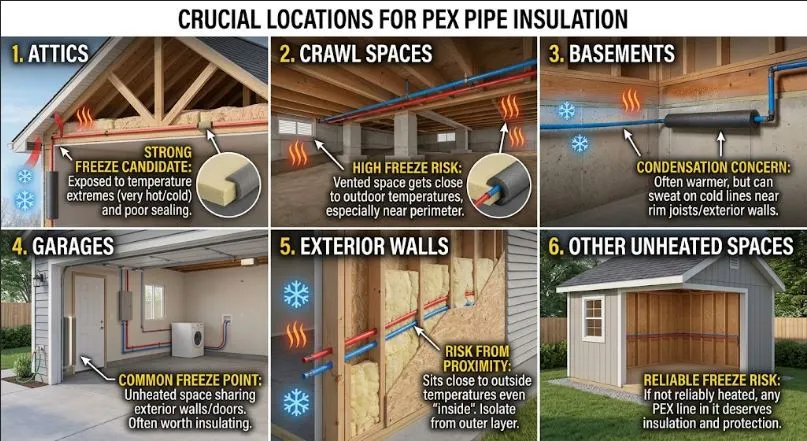
Learn the crucial areas to insulate PEX water lines to prevent freezing, control condensation, and maintain energy efficiency throughout your home’s unheated spaces.
Attics
Attics swing between extremes — very cold in winter, very hot in summer — and are often poorly sealed against outside air. Any PEX run through an attic, especially near soffit vents or exterior walls, is a strong candidate for insulation, and in cold climates it’s worth checking whether the run should be relocated to conditioned space entirely.
Crawl Spaces
Vented crawl spaces can get close to outdoor temperatures. Uninsulated PEX near the crawl space perimeter, foundation vents, or exterior walls is at meaningfully higher freeze risk than pipe run through the interior.
Basements
Basements are usually warmer than attics or crawl spaces but can still get cold near rim joists, exterior walls, or unheated sections. Condensation is often the bigger concern here on cold lines, especially in humid climates.
Garages
Garages are frequently unheated and share exterior walls or overhead doors with the outside. PEX in a garage — especially lines feeding an exterior hose bib or a laundry setup — is a common freeze point and generally worth insulating in any climate that sees hard freezes.
Exterior Walls
Pipe routed through an exterior wall, particularly on the side facing prevailing winter winds, sits close to outside temperatures even though it’s technically “inside” the house. This is a location worth avoiding when possible, and insulating when it can’t be avoided.
Other Unheated Spaces
Sheds, unconditioned additions, and mechanical rooms without heat all follow the same logic: if the space isn’t reliably kept above freezing, any PEX line in it deserves insulation and, in harsh climates, additional freeze protection.
What Type of Insulation Is Best for PEX?
There isn’t a single “best” insulation for every situation — the right choice depends on temperature range, moisture exposure, and how the pipe is accessed.
| Material | Best For | Advantages | Limitations |
|---|---|---|---|
| Polyethylene foam (pipe sleeves) | General residential hot and cold lines | Inexpensive, easy to slide on or slit and snap over pipe, widely available | Less effective at very low temperatures if seams aren’t sealed; can degrade with UV exposure outdoors |
| Elastomeric/rubber insulation | Areas with condensation risk or wider temperature swings | Good moisture resistance, flexible, handles a wider temperature range | Costs more than foam, needs proper sizing to fit snugly |
| Fiberglass pipe insulation | Larger mechanical runs or where higher R-value per inch is wanted | Higher insulating value for its thickness | Needs a vapor barrier/jacket in humid or condensation-prone spots, less common for typical residential branch lines |
For most residential PEX branch lines, foam sleeves sized to the pipe diameter cover the basic job. Elastomeric insulation earns its higher cost in basements, near HVAC equipment, or anywhere condensation is a recurring problem. Fiberglass shows up more often on larger supply or mechanical-room runs than on typical fixture branch lines.
Whatever material is chosen, check that it’s rated for the pipe’s actual temperature range — foam rated for cold-water use isn’t automatically suitable pressed against a hot-water line, and vice versa.
PEX Pipe Insulation by Location
| Location / Application | Insulate? | Main Reason | Important Consideration |
|---|---|---|---|
| Attic | Usually yes | Freeze risk, heat loss | Extreme temperature swings; check for drafts near vents |
| Crawl space | Usually yes, especially near perimeter | Freeze risk | Vented crawl spaces track close to outdoor temps |
| Basement (cold-water line) | Often yes | Condensation control | More relevant in humid climates |
| Basement (hot-water line, conditioned) | Optional | Minor heat-loss/comfort benefit | Lower priority than unconditioned spaces |
| Garage | Usually yes | Freeze risk | Frequently unheated; near exterior doors |
| Exterior wall | Yes when unavoidable | Freeze risk | Better to reroute through conditioned space if possible |
| Interior conditioned wall | Optional | Minor efficiency gain | Low freeze risk in most climates |
| Hot-water recirculation line | Usually yes | Heat loss, energy savings | Benefits scale with run length |
How Thick Should PEX Pipe Insulation Be?
Thickness isn’t determined by pipe diameter alone. A ½-inch PEX line in a mild climate, inside a conditioned wall, needs far less insulation than the same ½-inch line running through a vented attic in a cold climate.
A few things actually drive the thickness decision:
- Application — heat-loss reduction, condensation control, and freeze mitigation don’t always call for the same thickness.
- Climate — colder regions generally call for thicker insulation on exposed or unconditioned runs.
- R-value — this measures resistance to heat flow; higher R-value per inch means more insulating performance for the same thickness, but manufacturers rate this differently by material.
- Local plumbing and energy codes — some jurisdictions specify minimum insulation requirements for certain pipe types or locations, particularly for hot-water and recirculation lines. Check local code before finalizing a plan rather than assuming a blanket number applies everywhere.
- Manufacturer instructions — insulation products are rated and sized by the manufacturer for specific pipe diameters and temperature ranges; following that guidance keeps performance and any warranty coverage intact.
Because these numbers vary by product, climate zone, and jurisdiction, there’s no single universal thickness that’s correct everywhere. Treat manufacturer sizing charts and local code as the two references that actually matter, rather than a generic rule of thumb.
How to Insulate PEX Pipe
- Measure the pipe diameter and confirm it against the insulation’s sizing chart — a sleeve that’s too loose leaves gaps, and one that’s too tight can be difficult to install without damage.
- Clean and dry the pipe before installing, especially in areas prone to condensation.
- Slide or snap the insulation over the pipe, working from one end of the run to the other. Most residential foam and elastomeric sleeves have a pre-slit seam that snaps closed over the pipe.
- Seal the seams with the manufacturer-recommended tape or adhesive, particularly on cold-water lines where condensation or on any run exposed to outside air where freeze protection matters.
- Cover joints between insulation sections so there are no exposed gaps along the run — a small gap can undercut the insulation’s performance for the whole section.
- Address fittings and valves (see below) rather than stopping insulation right at each connection.
- Check for pinch points where insulation might compress against framing, hangers, or other pipes, since compressed insulation loses effectiveness.
For runs that are hard to access, oddly shaped, or involve tie-ins near a water heater or manifold, it’s reasonable to bring in a qualified plumber rather than working in a tight or hard-to-reach space.
Also read: a pex: what is it?
Should You Insulate PEX Fittings and Valves?
Yes, where practical. Elbows, tees, couplings, and valves are often the weakest point in an insulation job — it’s easy to insulate the straight runs and leave every fitting exposed, which creates a series of cold spots along an otherwise protected line.
Pre-formed fitting covers exist for common configurations, or insulation can be cut, wrapped, and taped around irregular shapes to maintain reasonable continuity. Manifolds deserve particular attention since they concentrate several connections — and often several pipe diameters — in one spot. Avoid covering valves in a way that blocks the handle or access needed for normal operation or maintenance, and don’t wrap insulation around anything it isn’t rated or intended for, including near equipment where it could create a moisture or fire hazard.
Does PEX Insulation Prevent Freezing?
No — insulation slows the rate of heat loss, which can delay freezing during a cold snap, but it does not prevent it during sustained hard freezes, especially with water sitting still in the pipe and no active heat source nearby.
This is a common point of confusion, partly because PEX itself has some flexibility that makes it more freeze-tolerant than rigid pipe — PEX can expand somewhat without splitting the way copper often does. That’s a separate property from insulation, and neither one is a guarantee against freezing. For a deeper look at how PEX behaves in freezing temperatures and what actually causes pipes to burst, see our guide on whether PEX pipes can freeze.
Is Insulation Enough in Very Cold Weather?
Often not on its own. A few factors determine whether insulation alone is sufficient or whether additional protection is warranted.
- Air sealing matters as much as insulation. A well-insulated pipe sitting in a strong cold draft — from a gap around a foundation vent, an unsealed rim joist, or a drafty attic hatch — can still lose heat quickly, because moving cold air strips heat away faster than still air. Insulation and air sealing solve different problems, and skipping one undermines the other.
- Maintaining some ambient heat in the surrounding space, even minimally, reduces freeze risk far more effectively than insulation alone.
- Heat cable or heat tracing provides active heat rather than just slowing heat loss, and is sometimes the right call for pipes that consistently freeze despite being insulated, such as exposed exterior runs or persistently cold crawl space sections. Any heat cable or heat tape used on PEX should be a product specifically approved for that pipe and application, installed and used according to the manufacturer’s instructions — not a generic product intended for a different use.
- Chronically vulnerable locations — an exterior wall with poor insulation, an exposed pipe in an unheated garage, a long crawl space run near vents — may need a combination of insulation, air sealing, and active heat rather than any single fix.
Common PEX Insulation Mistakes
- Assuming PEX can’t freeze. PEX resists bursting better than rigid pipe in some cases, but it isn’t immune to freezing.
- Assuming insulation makes a pipe freeze-proof. Insulation slows heat loss; it doesn’t add heat or guarantee protection.
- Choosing insulation thickness by pipe diameter alone, without accounting for climate, location, or application.
- Leaving gaps between insulation sections or at transitions, which undercuts the whole run’s performance.
- Skipping fittings and valves, leaving cold spots at exactly the points most prone to freezing or condensation.
- Ignoring drafts and air movement around insulated pipe, especially near vents and gaps in framing.
- Using insulation not rated for the application — a cold-water product pressed onto a hot line, or indoor-rated foam left exposed outdoors to UV and weather.
- Ignoring moisture and condensation risk, particularly in basements and humid climates, where the wrong material can trap moisture against the pipe.
- Ignoring local plumbing or energy code requirements for insulation thickness or coverage.
- Relying on insulation alone in locations that really need active freeze protection, such as chronically cold exterior runs.