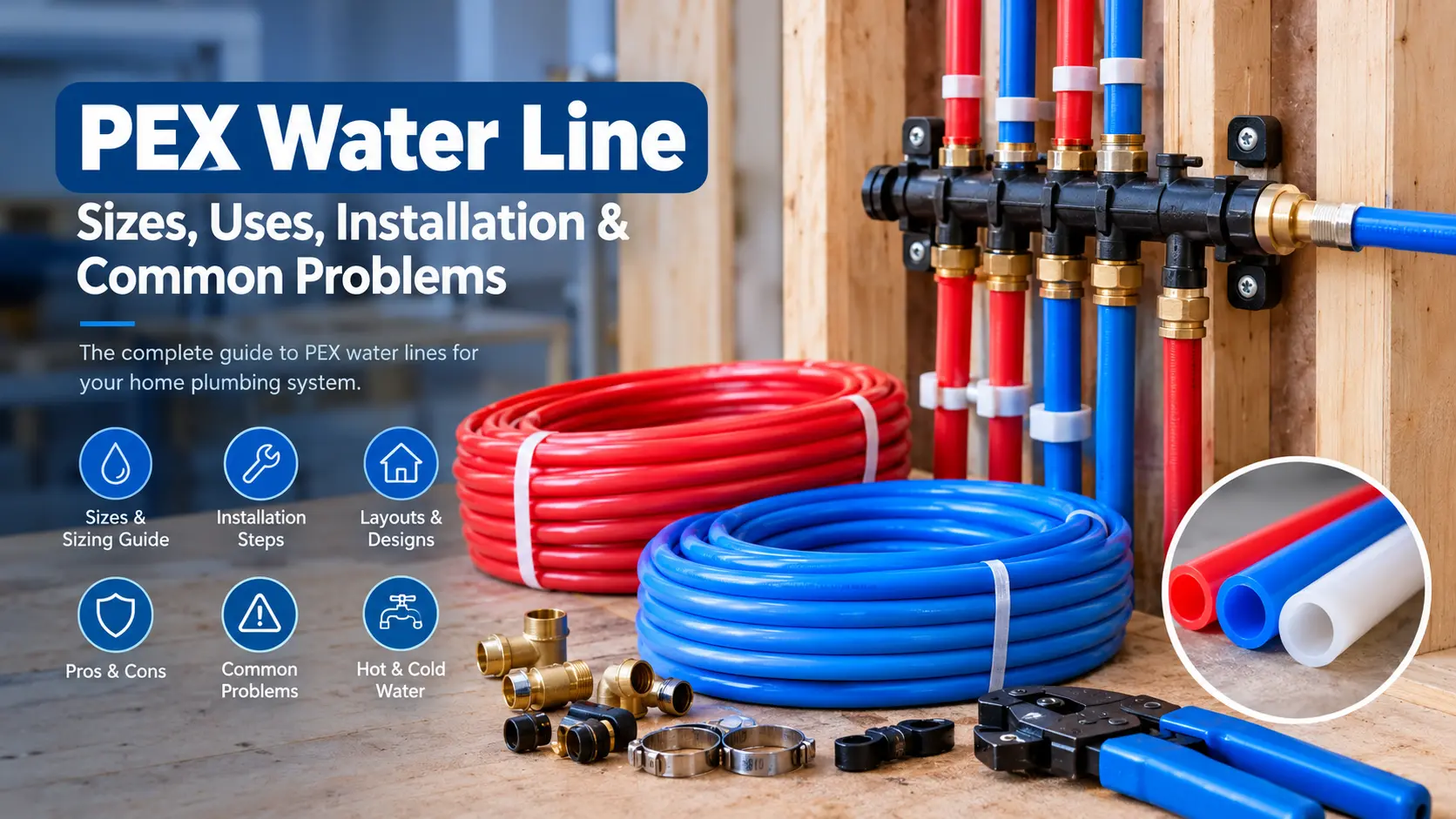
PEX Water Line: Sizes, Uses, Installation & Common Problems
PEX water line is flexible cross-linked polyethylene tubing used to carry hot and cold water through residential plumbing systems. It can serve fixture branches, whole-house distribution systems, and approved water-service applications.
For many homes, 1/2-inch PEX is common for individual fixture branches, while 3/4-inch or 1-inch PEX may be used for larger supply lines. The right size depends on water pressure, developed pipe length, fixture demand, and the plumbing layout—not simply the size of the fixture connection.
| PEX water line | Common use |
|---|---|
| 3/8 inch | Some individual fixture connections |
| 1/2 inch | Common fixture branches such as sinks, toilets, and showers |
| 3/4 inch | Larger branches and many residential supply lines |
| 1 inch+ | Larger homes, longer runs, or higher-demand systems |
These are common residential applications, not universal sizing rules. Proper sizing should account for the entire system and applicable plumbing code.
What Is a PEX Water Line?
A PEX water line is a run of PEX tubing that transports water from the supply source to a fixture or another part of the plumbing system.
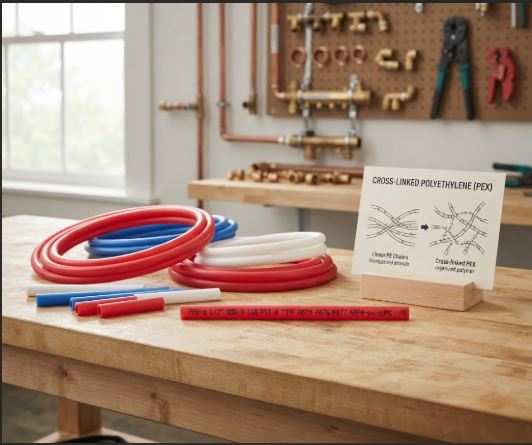
PEX stands for cross-linked polyethylene. Unlike rigid copper or CPVC pipe, PEX can bend around many obstacles and can often be installed in long continuous runs with fewer fittings.
PEX is commonly used for hot and cold potable-water distribution. PEX is also available for specific water-service applications, but the tubing must be approved for the intended use and installed according to the manufacturer’s instructions and local code. The Plastics Pipe Institute lists water-service lines and hot- and cold-water distribution among PEX applications.
If you want the broader explanation of the material and how PEX plumbing works, see our guide to what PEX plumbing is.
What Size PEX Water Line Do You Need?
The correct PEX water line size depends on more than the fixture. You need to consider the number of fixtures, water-supply pressure, developed length, elevation, and expected demand.
Most residential systems use a combination of 1/2-inch, 3/4-inch, and 1-inch tubing. Current residential sizing guidance also notes that PEX can have greater friction loss than an equivalent nominal size of copper or CPVC because of its internal diameter.
| Application | Common PEX size | Important note |
|---|---|---|
| Bathroom sink | 1/2 inch | Often supplied by a 1/2-inch branch |
| Toilet | 1/2 inch | Final connection may use a smaller stop/connector |
| Shower | 1/2 inch | Demand and pressure still matter |
| Kitchen sink | 1/2 inch | Usually a branch-line application |
| Branch supply | 1/2–3/4 inch | Depends on fixture demand and run length |
| Main residential supply | 3/4–1+ inch | Requires system-level sizing |
Is 1/2-Inch PEX Enough for a House?
Usually, you should not treat 1/2-inch PEX as the default size for an entire house. It is commonly used for individual branches, but a whole-house supply may need larger tubing to deliver adequate flow when multiple fixtures operate at the same time.
A long 1/2-inch run can also create more pressure loss than a shorter run. For larger homes or longer distances, moving to 3/4-inch or 1-inch tubing may be appropriate after proper sizing.
Is 3/4-Inch PEX Enough for a Main Water Line?
It can be, depending on the home’s demand, water pressure, and length of the run. A 3/4-inch line is common in residential plumbing, but it should not automatically be selected for every house.
For a more technical sizing approach, consider water supply fixture units (WSFUs), developed length, elevation, and available pressure. These factors are part of established residential water-supply sizing methods.
PEX-A vs. PEX-B vs. PEX-C for Water Lines
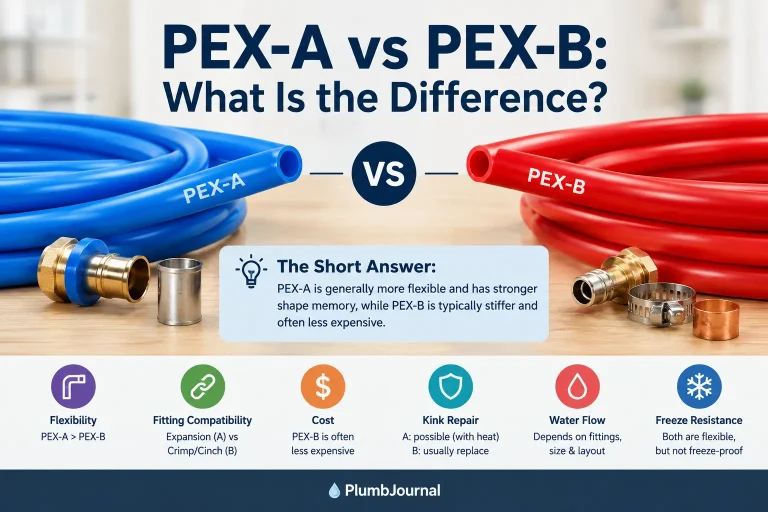
PEX-A, PEX-B, and PEX-C are different manufacturing classifications of PEX tubing. All can be used in appropriate water-distribution applications when the specific product is approved for that use.
| Type | General characteristic | Common connection options |
|---|---|---|
| PEX-A | Very flexible and has strong shape memory | Expansion, crimp, clamp and compatible systems |
| PEX-B | Generally stiffer and widely available | Crimp, clamp and compatible systems |
| PEX-C | Generally stiffer and less common in residential work | Connection method depends on the product |
The important point is that the fitting system must match the tubing and manufacturer’s requirements. For example, expansion systems are designed for compatible PEX tubing rather than being a universal connection method for every type.
See our detailed guide on PEX-A vs. PEX-B if you want to compare the two most common types in more detail.
Can PEX Be Used for Hot and Cold Water?
Yes. Approved PEX tubing can be used for both hot- and cold-water distribution when the product is rated for the application.
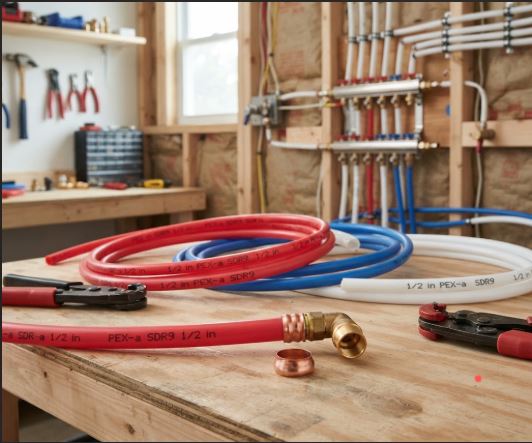
PEX is frequently color-coded to make installation easier. Red is commonly used to identify hot-water lines, while blue commonly identifies cold-water lines. White and other neutral colors may be used for either application depending on the product.
The color itself does not determine whether the tubing is suitable for hot or cold water. Always check the markings, temperature and pressure ratings, product documentation, and applicable code.
Is PEX Safe for Drinking Water?
Potable-water-rated PEX is commonly used for drinking-water plumbing. The important distinction is that not every piece of plastic tubing should automatically be assumed to be suitable for potable water.
Look for tubing specifically approved for potable-water use and follow the manufacturer’s installation requirements. Applicable standards and certifications can include ASTM requirements and NSF/ANSI standards, depending on the product and application.
Current PEX industry guidance specifically identifies potable-water safety and long-term reliability among PEX’s applications and characteristics.
PEX Water Line Layouts
How you arrange the water lines can be just as important as the tubing size.
Trunk-and-Branch System
A larger supply line acts as the trunk, with smaller branch lines feeding individual fixtures or groups of fixtures.
This layout can use less tubing, but it requires careful planning of branch sizes and fittings.
Manifold or Home-Run System
A manifold distributes water through separate lines running directly to individual fixtures. Each line can have its own shutoff at the manifold.
This approach can simplify maintenance and reduce the number of concealed branch connections. It can also require more tubing and sufficient space for the manifold.
PEX design guidance recognizes both manifold and conventional distribution approaches as part of residential PEX system design.
How to Install a PEX Water Line
Installing PEX is relatively straightforward, but a good installation starts with planning rather than cutting tubing.
- Plan the route. Identify the water source, fixtures, shutoffs, and hot- and cold-water paths.
- Choose the correct tubing size. Consider pressure, developed length, fixture demand, and the complete system.
- Select compatible fittings. Match the connection method to the PEX tubing and fittings.
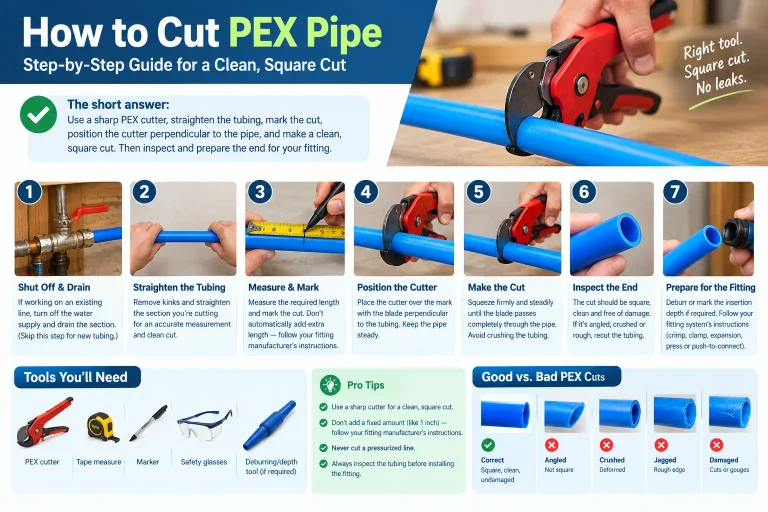
- Cut the tubing squarely. A clean, square cut helps the fitting make a proper connection.
- Make the connection. Use the manufacturer’s specified crimp, clamp, expansion, press, or push-fit method.
- Support and protect the tubing. Keep PEX away from damaging edges, excessive heat, and prolonged UV exposure.
- Pressure-test the system. Test the completed installation according to the applicable code and manufacturer’s instructions.
- Inspect for leaks. Check every connection before closing walls or inaccessible areas.
Our guide on how to crimp PEX covers the crimping process in greater detail, including proper connection checks.
Common PEX Water Line Connections
Several connection systems are used with PEX water lines, including:
- Crimp fittings: Use a copper or compatible crimp ring and a crimping tool.
- Cinch/clamp fittings: Use a stainless-steel clamp tightened with a compatible tool.
- Expansion fittings: Used with compatible PEX tubing and an expansion system.
- Push-to-connect fittings: Useful for certain repairs and transitions when approved for the application.
- Threaded adapters: Used when transitioning between PEX and threaded valves, fixtures, or other piping components.
Connection quality matters. A poor fitting connection can cause a leak even when the tubing itself is perfectly sound.
For a deeper explanation of fitting styles, see our guide to PEX pipe fittings.
Can PEX Water Lines Be Buried Underground?
Yes, PEX can be used for certain underground water-service applications when the specific tubing is approved for that use.
Do not assume that every PEX product is automatically suitable for burial. Water-service tubing may have different specifications and installation requirements from indoor distribution tubing.
For an underground installation, consider:
- the product’s water-service rating
- local plumbing requirements
- trench and bedding requirements
- protection from physical damage
- freezing conditions
- connection and transition requirements
- pressure testing before the line is concealed
Manufacturers such as Uponor publish separate guidance for PEX water-service systems, reinforcing the distinction between general indoor plumbing and dedicated water-service applications.
Can PEX Water Lines Freeze?
Yes. PEX water lines can freeze. PEX is flexible and can tolerate expansion better than some rigid piping materials, but that does not make it freeze-proof.
Freezing can still damage tubing, fittings, valves, or connected components. Install PEX in a way that protects it from prolonged freezing conditions, particularly in exterior walls, crawl spaces, garages, and other vulnerable areas.
If a PEX line freezes, never use an open flame to thaw it. After thawing, inspect the line and fittings for damage before assuming the system is safe.
Common PEX Water Line Problems
PEX itself is rarely the only thing to blame when a water system performs poorly. Common problems include:
- Leaking fittings: Often related to an incorrect or improperly made connection.
- Kinked tubing: A severe kink can restrict water flow.
- Low water pressure: May result from system pressure, pipe sizing, excessive length, restrictions, or another plumbing issue.
- UV exposure: PEX should not be left exposed to sunlight beyond the product’s permitted exposure period.
- Freezing: Can damage tubing and connections.
- Abrasion: Tubing passing through framing may need appropriate protection.
- Incorrect sizing: An undersized line can cause excessive pressure loss when several fixtures operate.
If you’re troubleshooting a PEX system, start by determining whether the problem affects one fixture or the entire house. That simple distinction can help narrow down whether you’re dealing with a fixture restriction, branch-line issue, or supply problem.
PEX Water Line vs. Copper vs. CPVC
| Factor | PEX | Copper | CPVC |
|---|---|---|---|
| Flexibility | High | Low | Low |
| Corrosion resistance | High | Depends on water and environment | High |
| Installation | Flexible and relatively fast | Requires more specialized joining methods | Solvent-welded joints |
| Hot water | Yes, when rated | Yes | Yes, when rated |
| Common connection methods | Crimp, clamp, expansion and others | Solder, press and others | Solvent cement |
Each material has applications where it makes sense. PEX’s main advantages are its flexibility, corrosion resistance and range of connection options. Copper remains widely used, while CPVC provides another plastic piping option.
For a deeper comparison, read our guides on PEX vs. copper and PEX vs. CPVC.
How Long Does a PEX Water Line Last?
PEX is designed as a long-term plumbing material, but its service life depends on the product, installation, temperature, pressure, UV exposure, water conditions, and connection quality.
Rather than relying on one universal lifespan number, inspect the system periodically for leaks, damaged tubing, deteriorated fittings, or other signs of trouble. Proper installation and using tubing within its rated conditions are important for long-term performance.
PEX Water Line FAQs
What is the best size PEX for a water line?
There is no single best size for every water line. 1/2-inch is common for fixture branches, while 3/4-inch and 1-inch tubing may be appropriate for larger supply lines. Proper sizing depends on pressure, length, fixture demand, and system layout.
Can you use PEX for the main water line?
Yes, PEX products are available for water-service applications. The tubing must be approved for that use and installed according to the applicable code and manufacturer’s requirements.
Can PEX be used for drinking water?
Yes. PEX manufactured and certified for potable-water applications is commonly used for residential drinking-water systems.
Does red PEX mean hot water?
Red PEX is commonly used to identify hot-water lines, but color is primarily a visual identification system. Always verify the tubing’s markings and application rating.
Does blue PEX mean cold water?
Blue PEX is commonly used to identify cold-water lines. The color does not by itself determine the tubing’s approved application.
Can PEX be used underground?
Yes, when the specific PEX product is approved for underground water-service use and installed according to the applicable requirements.
Is 3/4-inch PEX better than 1/2-inch PEX?
Not automatically. 3/4-inch PEX can provide greater flow capacity, but the appropriate size depends on the complete water-supply system. Using larger tubing simply because it is larger can also increase material and water volume.
What causes low water pressure in a PEX line?
Possible causes include low source pressure, undersized tubing, excessive run length, a kink, restricted fittings, a partially closed valve, or a problem at the fixture itself.