
How Long Does PEX Plumbing Last? Lifespan, Signs of Failure & More
How long does PEX plumbing last? In most homes, properly installed PEX plumbing can provide about 40 to 50 years or more of service under normal conditions. However, 50 years is not an expiration date. The actual life of PEX depends on heat, water pressure, sunlight, water chemistry, installation quality, fittings, and physical damage.
PEX has become a popular choice for residential water supply lines because it is flexible, corrosion-resistant, and easier to install than many rigid pipes. Industry standards also require potable-water PEX to meet a minimum extrapolated 50-year time-to-failure under specific hot chlorinated water testing conditions.
So, does that mean your PEX pipe will fail when it reaches 50 years?
No.
A well-protected PEX system may continue working beyond that point. On the other hand, a poorly installed or damaged system can develop problems much sooner.
Let’s look at what really determines how long PEX plumbing lasts.
How Long Does PEX Plumbing Last?
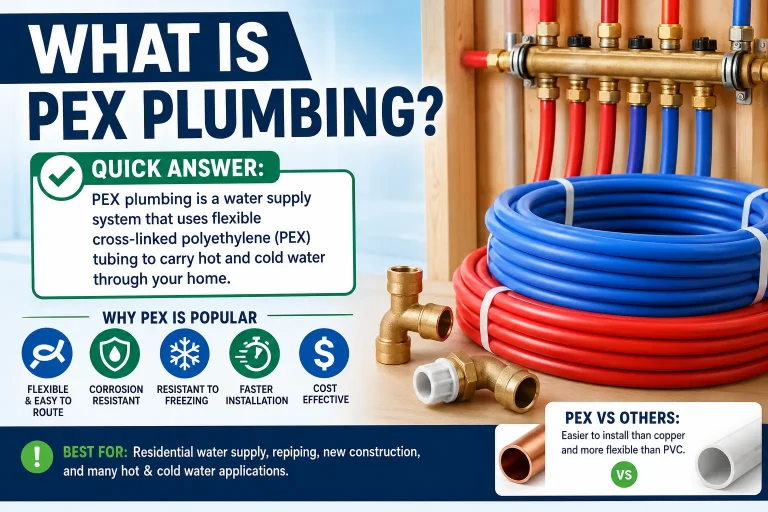
PEX plumbing commonly lasts 40 to 50 years or more when the tubing is properly rated, installed correctly, and kept within its operating limits.
The important part is the phrase “under normal conditions.”
For example, imagine two houses.
House A has PEX installed inside walls and floors. The tubing is protected from sunlight. The fittings are installed correctly, and the water temperature and pressure stay within the system’s limits.
House B has PEX running through a hot attic. Some tubing sits in direct sunlight. A few fittings were poorly installed, and sections of pipe rub against sharp framing.
Both houses may have PEX installed at the same time.
Their plumbing may not have the same service life.
That is why a single number cannot tell you exactly when PEX will fail.

PEX vs. Copper: Which Lasts Longer?
Both PEX and copper can provide long service when properly installed.
They simply have different strengths and failure risks.
| Factor | PEX | Copper |
|---|---|---|
| Typical PEX service benchmark | About 40–50+ years | Can provide several decades of service |
| Corrosion | Highly resistant to corrosion | Can corrode under some water conditions |
| Flexibility | Very flexible | Rigid |
| UV exposure | Must be protected | Less vulnerable to UV |
| Rodent damage | Can be chewed | Not affected in the same way |
| Freeze tolerance | More flexible during freezing | More likely to split when frozen |
| Installation | Generally easier | More labor-intensive |
| Fittings | Important part of system reliability | Connections also matter |
So which one lasts longer?
There is no single answer for every house.
Water chemistry, installation quality, temperature, pressure, exposure, and maintenance can matter more than the material name printed on the pipe.
How to Make PEX Plumbing Last Longer
You cannot make any plumbing system last forever.
But you can avoid many common problems.
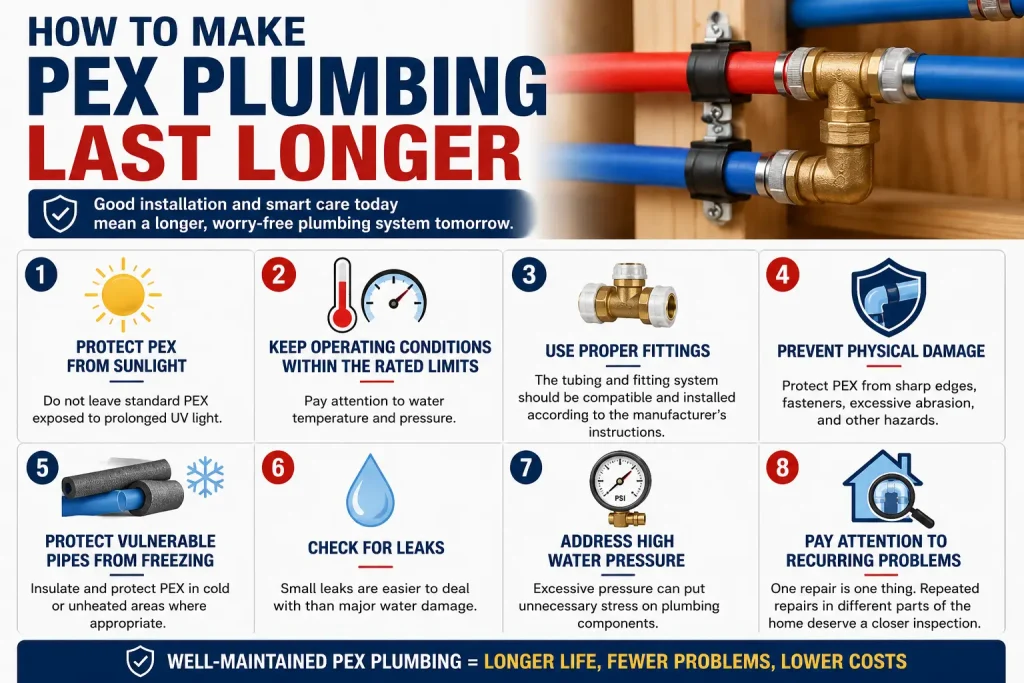
Protect PEX from sunlight
Do not leave standard PEX exposed to prolonged UV light.
Keep operating conditions within the rated limits
Pay attention to water temperature and pressure.
Use proper fittings
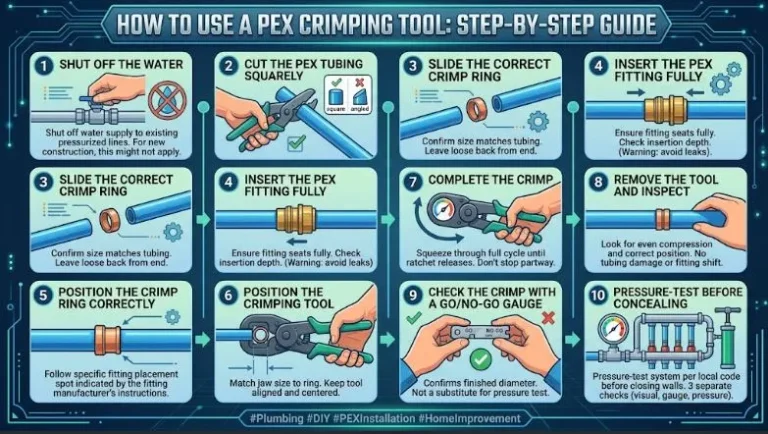
The tubing and fitting system should be compatible and installed according to the manufacturer’s instructions.
Prevent physical damage
Protect PEX from sharp edges, fasteners, excessive abrasion, and other hazards.
Protect vulnerable pipes from freezing
Insulate and protect PEX in cold or unheated areas where appropriate.
Check for leaks
Small leaks are easier to deal with than major water damage.
Address high water pressure
Excessive pressure can put unnecessary stress on plumbing components.
Pay attention to recurring problems
One repair is one thing.
Repeated repairs in different parts of the home deserve a closer inspection.
What Does a 50-Year PEX Lifespan Really Mean?
You may see websites say that PEX lasts 50 years. Others may give a shorter or longer number.
This can be confusing.
The 50-year figure is not a promise that every PEX pipe will fail after five decades. It is closely tied to industry testing and service-life evaluation.
For potable-water PEX, ASTM-related testing evaluates resistance to oxidative damage in hot chlorinated water. The Plastics Pipe Institute notes a minimum extrapolated time-to-failure of 50 years under specified test conditions.
That distinction matters.
Laboratory testing gives us a way to evaluate long-term performance. A real house has many other factors.
Your plumbing may experience:
- Different water temperatures
- Different water pressure
- UV exposure
- Freezing conditions
- Physical damage
- Poor installation
- Different water chemistry
- Fitting stress
So, think of 40 to 50 years as a reasonable service-life benchmark, not a countdown clock.
Can PEX Plumbing Last 50 Years or More?
Yes, it can.
PEX has been used in demanding plumbing and heating applications for decades. The Plastics Pipe Institute notes that cross-linked polyethylene technology has been used internationally since the late 1960s, with more than 50 years of use in different applications.
However, you should not assume that every PEX system will automatically reach 50 years.
The tubing needs the right conditions.
For example, PEX installed indoors and protected from sunlight has a much better chance of reaching its expected service life than tubing left exposed to strong UV light.
Installation also matters.
A good PEX system is not just good tubing. It is good tubing, compatible fittings, proper support, correct routing, and proper installation.
Why Do Some Sources Give Different PEX Lifespans?
You may find estimates such as:
- 25 to 40 years
- 40 to 50 years
- 50 years or more
Why are the numbers different?
Because service life and actual field life are not exactly the same thing.
A manufacturer or industry standard may use controlled testing to evaluate long-term performance. A homeowner may be asking how long an entire plumbing system will remain trouble-free.
Those are different questions.
Also, the tubing is only one part of a plumbing system.
A PEX installation may contain fittings, valves, manifolds, transition connections, and other components. Any one of those parts can develop a problem before the tubing itself.
So instead of asking only, “How old is my PEX?” ask:
“What condition is my entire PEX plumbing system in?”
That is a much better way to judge whether replacement is necessary.
What Shortens the Life of PEX Plumbing?
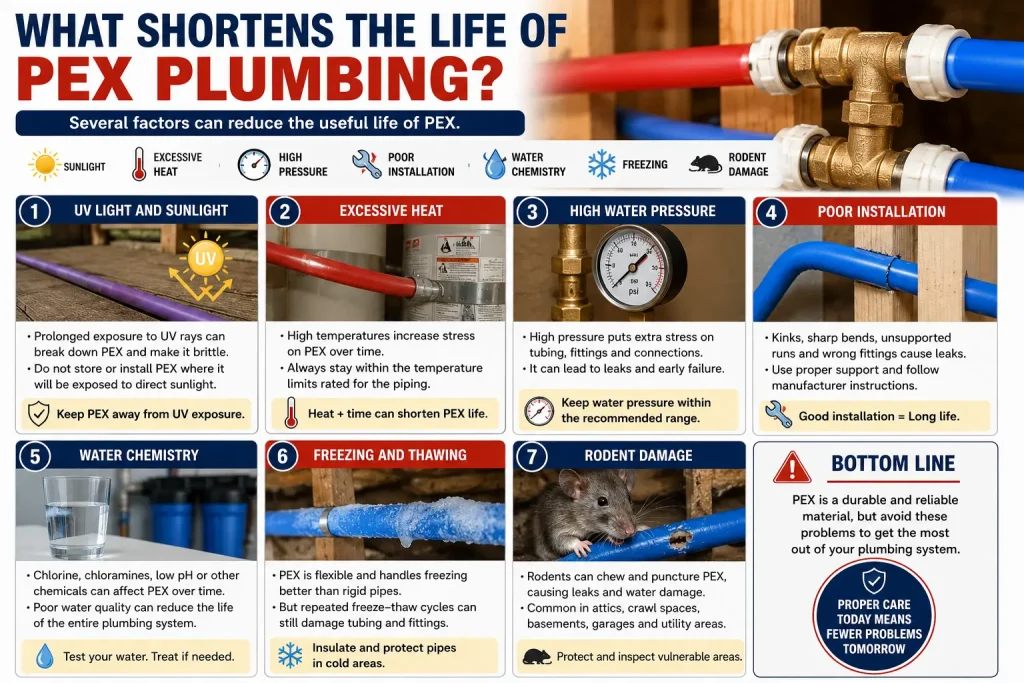
Several factors can reduce the useful life of PEX.
The most important ones are sunlight, excessive heat, physical damage, poor installation, water conditions, and problems with fittings.
1. UV Light and Sunlight
PEX does not like prolonged exposure to ultraviolet light.
This is one of the most important things to remember about PEX.
Standard PEX should not be left exposed to direct sunlight for long periods. UV exposure can damage the material over time. This applies not only after installation but also to how tubing is stored before installation.
For example, imagine PEX running across an uncovered section of a garage where sunlight reaches it every afternoon.
That is very different from PEX installed inside a protected wall.
Keep PEX away from prolonged UV exposure whenever the product and installation requirements call for it.
2. Excessive Heat
PEX is designed to handle both hot and cold water. But temperature still matters.
As operating temperature increases, the demands on the tubing also increase. Long-term exposure to high temperatures can affect material aging.
This is one reason plumbers pay attention to both temperature and pressure when designing a water system.
A pipe that operates within its intended limits is in a much better position than one that is constantly pushed beyond them.
3. High Water Pressure
Water pressure also affects plumbing components.
PEX is designed for pressure service, but the system still needs to operate within its rated limits.
High pressure can put extra stress on:
- Tubing
- Fittings
- Valves
- Connections
- Appliances
If your home has unusually high water pressure, fixing the pressure problem can protect the entire plumbing system.
4. Poor Installation
This is a big one.
Good PEX can still have problems when it is installed poorly.
Examples include:
- Excessive bending
- Sharp kinks
- Poorly supported tubing
- Incorrect fittings
- Damaged tubing
- Abrasion against framing
- Improper connections
- Unprotected penetrations
Think about a PEX line passing through a piece of framing.
If the tubing constantly rubs against a sharp edge, that area may eventually become a weak point.
The problem is not necessarily the PEX material.
The problem is the installation.
5. Water Chemistry
Water chemistry can affect plumbing materials over time.
PEX is resistant to corrosion because it is not a metal pipe. However, that does not mean water chemistry is irrelevant.
Disinfectants such as chlorine and chloramines are considered in the testing and standards used for potable-water PEX. The PEX industry uses specific testing to evaluate resistance to oxidative damage from hot chlorinated water.
This is another reason you should avoid making a blanket statement such as “PEX lasts forever because it does not rust.”
It does not rust like copper or galvanized steel.
But it can still age under certain conditions.
6. Freezing and Thawing
PEX has an advantage in cold weather because it is flexible.
When water freezes, PEX can expand more readily than rigid pipe materials. This may reduce the chance of a catastrophic burst in some situations.
But PEX is not freeze-proof.
A severe or repeated freeze can still damage tubing, fittings, and connections.
For example, a PEX line in an unheated crawl space may survive one cold event without leaking. Repeated freezing and thawing can create more stress over time.
Protect vulnerable plumbing from freezing whenever possible.
7. Rodent Damage
Rodents can chew PEX.
This is especially worth remembering in:
- Crawl spaces
- Attics
- Basements
- Garages
- Utility areas
If a mouse or rat damages a PEX line, the tubing can leak regardless of how long it was expected to last.
That is physical damage, not normal aging.
Do PEX Fittings Fail Before the Pipe?
They can, and this is an important point that homeowners often miss.
When people ask how long PEX plumbing lasts, they usually think about the tubing.
But a complete PEX system contains much more than tubing.
It can include:
- Crimp fittings
- Clamp fittings
- Expansion fittings
- Tees
- Elbows
- Manifolds
- Shutoff valves
- Transition fittings
- Connections to fixtures
The tubing may remain in good condition while a connection develops a leak.
For example, suppose you have a 25-year-old PEX system.
The tubing looks clean and flexible. But several fittings have started leaking over the last two years.
That does not automatically mean the PEX tubing has reached the end of its life.
It means you need to find out why the connections are failing.
Poor installation, incompatible components, movement, stress, or another system problem could be responsible.
This is why a plumber should evaluate the whole system instead of judging it by the age of the tubing alone.
Does 20-Year-Old PEX Need to Be Replaced?
Not necessarily.
Age alone is not a good reason to replace an otherwise healthy PEX system.
A 20-year-old system with no leaks, no visible damage, and properly installed connections may still be working well.
On the other hand, a newer system with repeated leaks deserves attention.
When evaluating older PEX, look at:
- The number of leaks
- Where the leaks occur
- The condition of fittings
- Visible UV damage
- Kinks or abrasion
- Water pressure
- Installation quality
- Previous repairs
- The overall condition of the system
Example
Imagine two 20-year-old homes.
Home A: One small leak occurred at a damaged section of tubing. The rest of the system looks good.
Home B: Six fittings have leaked in different parts of the house over the last two years.
These situations are not the same.
Home A may only need a targeted repair.
Home B may need a more detailed plumbing inspection to determine whether there is a larger system problem.
Signs Your PEX Plumbing May Be Failing
PEX does not always give you an obvious warning before a leak.
However, there are signs worth watching.
Look for:
- Repeated leaks
- Water stains
- Damp drywall
- Wet insulation
- Musty smells
- Leaking fittings
- Visible cracks or damage
- Severe kinks
- Abrasion
- Discoloration or deterioration
- Unexpected moisture
- Repeated repairs in different areas
A single leak does not automatically mean the entire plumbing system needs replacement.
The pattern matters.
One isolated problem may be easy to repair.
Repeated problems in several locations deserve a closer look.
Should You Repair or Replace PEX Plumbing?
The right choice depends on the cause and size of the problem.
Repair may make sense when:
- One section is damaged
- One fitting is leaking
- A nail or screw damaged a pipe
- A local freeze caused damage
- The rest of the system is in good condition
- The problem is easy to isolate
For example, if a contractor accidentally puts a fastener through one PEX line during a remodeling project, replacing that damaged section may be all you need.
There is no reason to replace every pipe in the house because of one accidental puncture.
Replacement may make sense when:
- Leaks are happening in several areas
- Many fittings are failing
- The same type of connection keeps leaking
- Tubing has widespread damage
- The installation has major problems
- Repairs are becoming frequent
- A plumber finds a larger system-wide issue
The goal is not to replace PEX simply because it is old.
The goal is to have a plumbing system that is safe, reliable, and suitable for the home.
Can PEX Plumbing Last 100 Years?
You may have heard claims that PEX can last 100 years.
Be careful with that statement.
Long-term service-life projections can extend beyond the commonly quoted 40-to-50-year residential benchmark. But a 100-year lifespan should not be treated as a guarantee for every PEX installation.
There is a big difference between a calculated or projected service life and a century of real-world experience in millions of homes.
PEX has a long history of use, but modern residential PEX has not been installed in U.S. homes for 100 years.
So the practical answer is:
PEX may have a very long potential service life under suitable conditions, but homeowners should use the manufacturer’s ratings, applicable standards, installation conditions, and the actual condition of the system when making decisions.
That is more useful than promising that every PEX system will last a century.
Does PEX-A Last Longer Than PEX-B?
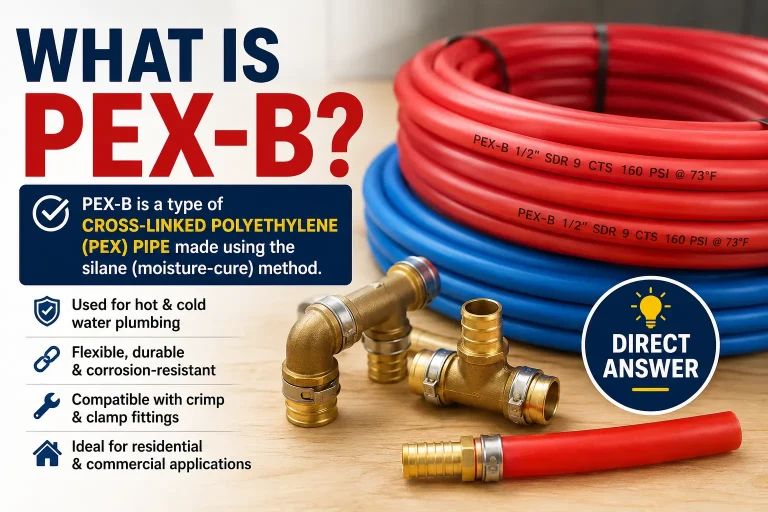
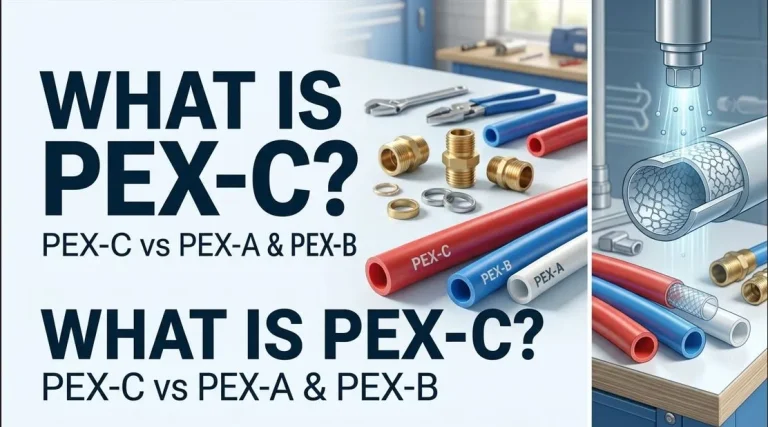
PEX-A and PEX-B are different manufacturing types of PEX.
They have different production methods and can differ in flexibility and connection methods.
However, it is too simple to say:
The quality of the product, correct rating, installation method, operating conditions, and overall system design all matter.
If you are choosing between PEX-A and PEX-B, look at the entire system instead of choosing a pipe only because of its letter designation.
Is PEX a Good Long-Term Plumbing Material?
For many homes, yes.
PEX has several qualities that make it useful for residential water supply plumbing. It is flexible, resistant to corrosion, and can be installed with fewer connections in some layouts.
Its flexibility can also help it tolerate movement and freezing conditions better than some rigid pipe materials.
But PEX is not indestructible.
It still needs proper installation and protection.
The best way to think about PEX is simple:
PEX can last for decades, but its service life depends on how the entire system is designed, installed, and treated.
Final Answer:
So, how long does PEX plumbing last?
A good practical answer is about 40 to 50 years or more under normal conditions.
But do not treat 50 years as a deadline.
A properly installed PEX system can continue performing well for decades. A poorly installed system can develop problems much sooner.
The biggest factors are UV exposure, heat, pressure, water chemistry, freezing, physical damage, fittings, and installation quality.
If you have older PEX, do not replace it simply because of its age. Look at the condition of the tubing and the entire plumbing system.
A 20-year-old PEX system with no major problems may be perfectly serviceable. A newer system with repeated leaks may need attention.
In plumbing, age is only one piece of the puzzle. The condition of the system tells you much more.