What Is PEX-B? A Complete Guide to Type B PEX Pipe
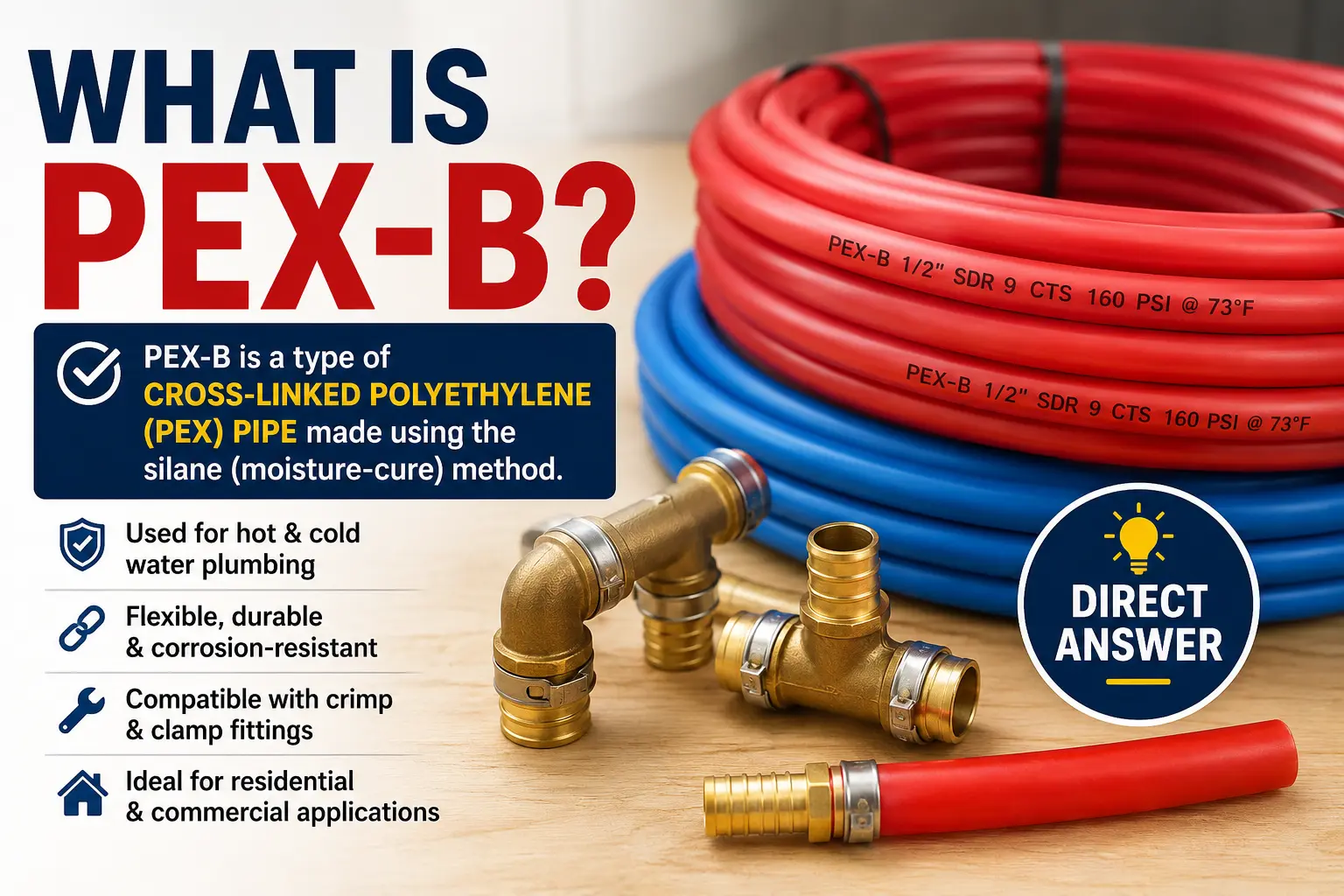
PEX-B is a type of cross-linked polyethylene (PEX) tubing made using the silane, or moisture-cure, manufacturing method. It is widely used for residential plumbing, including hot and cold water lines. The “B” in PEX-B does not mean a lower grade of pipe. It describes how the polyethylene is cross-linked during manufacturing.
Compared with PEX-A, PEX-B is generally a little stiffer and has more coil memory, but it is widely available, cost-effective, and works with common crimp and clamp connection systems. The right choice depends on the specific tubing, its ratings, the application, and the fitting system you plan to use.
What Is PEX-B?
PEX-B is cross-linked polyethylene tubing manufactured with the silane or moisture-cure method.
Like other types of PEX, it starts with polyethylene. During manufacturing, a silane compound is introduced into the material. After the tubing is extruded, moisture and heat activate the cross-linking process, joining the polymer chains together.
That cross-linked structure is what gives PEX its useful combination of flexibility, temperature resistance, pressure performance, and durability.
The important point is this:
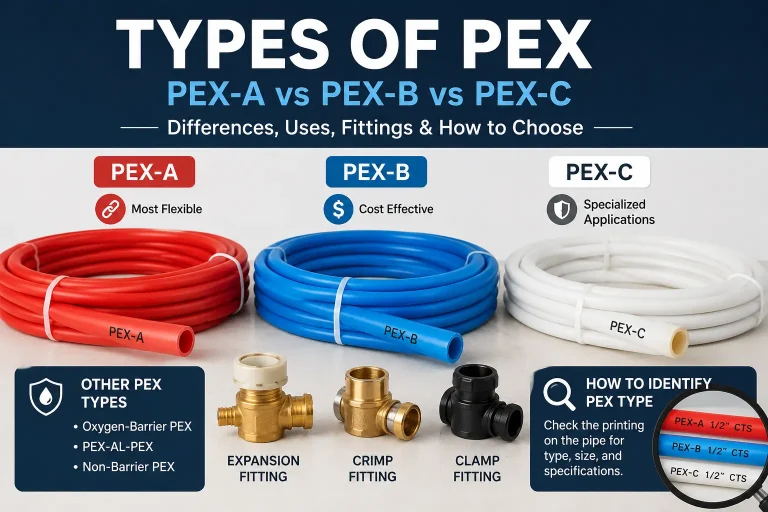
PEX-A, PEX-B, and PEX-C are manufacturing classifications, not quality grades.
So PEX-B isn’t automatically worse than PEX-A just because it has a “B” after the name. A better way to compare PEX products is to look at their actual ratings, certifications, intended application, bend radius, and compatible fittings.
What Does the “B” in PEX-B Mean?
The B refers to the manufacturing method used to cross-link the polyethylene.
PEX-B is commonly called:
- Silane PEX
- Moisture-cure PEX
- Type B PEX
- PEX-B pipe
- PEX-B tubing
The silane method is different from the peroxide method used for PEX-A and the electron-beam process used for PEX-C.
In practical terms, you don’t need to remember the chemistry to use PEX-B correctly. The important thing to remember is that the manufacturing process affects characteristics such as flexibility, bend radius, and which connection systems are suitable for the tubing.
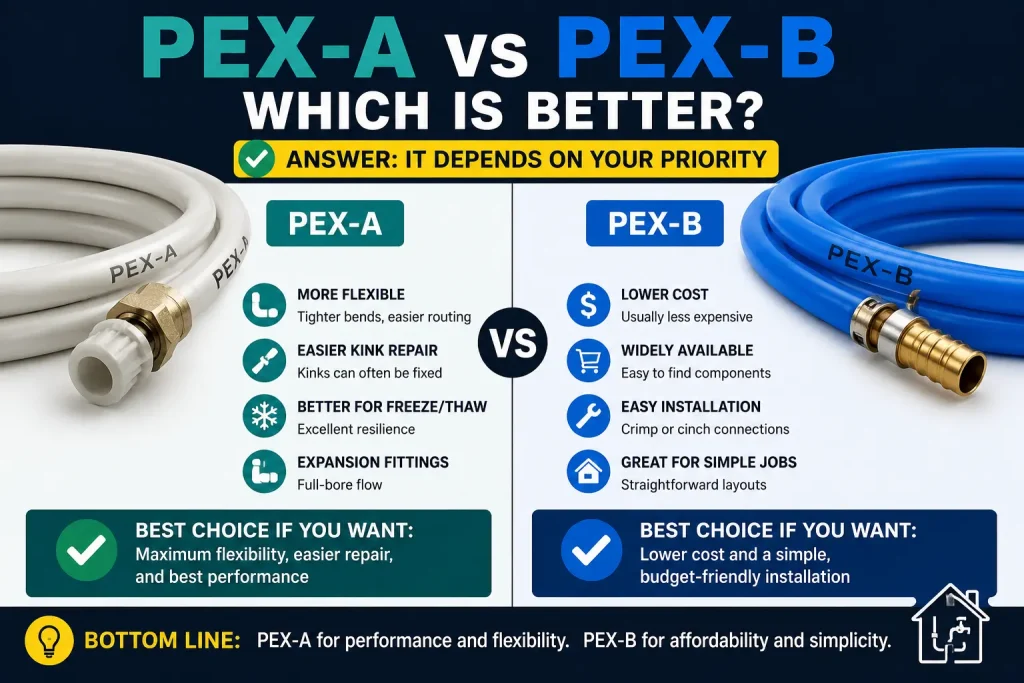
Read our guide on PEX-A vs PEX-B?
How Is PEX-B Made?
PEX-B is made using a silane moisture-cure process.
A simplified version looks like this:
Polyethylene resin → silane added → tubing extruded → moisture and heat → cross-linking → finished PEX-B tubing
The cross-linking doesn’t simply happen because the pipe comes out of the extrusion machine. The silane compounds need moisture to complete the process. This is why the method is also known as moisture cure.
Cross-linking changes the behavior of the polyethylene. Instead of acting like ordinary thermoplastic plastic, the finished material has a network of molecular bonds that improves its ability to handle the demands of plumbing service.
PEX-A cross-links during extrusion using the peroxide/Engel process, while PEX-B completes its cross-linking through the silane moisture-cure process.
What Is PEX-B Used For?
PEX-B is used in a wide range of plumbing applications.
Common uses include:
- Residential hot and cold water supply
- Potable water systems when the specific product is approved for that use
- Residential plumbing repairs
- New plumbing installations
- Manifold-based water distribution systems
- Some commercial plumbing applications
- Hydronic heating applications when the tubing is specifically designed and approved for them
There is one rule I would not ignore: don’t choose PEX solely because it says PEX-B.
Check the markings and manufacturer’s specifications to make sure the tubing is rated for the application. PEX products can have different pressure, temperature, chlorine-resistance, UV-resistance, and other performance ratings.
What Are the Advantages of PEX-B?
PEX-B has earned its place in plumbing for good reasons.
1. It is generally cost-effective
PEX-B is often an attractive option when keeping material and installation costs under control matters.
The silane manufacturing process is well established, and PEX-B is widely available in the plumbing market.
2. It is flexible compared with rigid pipe
PEX-B isn’t as flexible as PEX-A, but it is still much easier to route around many obstacles than rigid copper or other rigid piping materials.
You can run long sections of tubing with fewer fittings when the layout allows it.
3. It works with common connection systems
Traditional PEX-B installations commonly use insert-style fittings with crimp or clamp connections.
There are also other approved connection systems on the market. The key is to follow the manufacturer’s instructions and use tubing and fittings that are designed to work together.
4. It is widely available
If you need a replacement section of PEX-B, finding compatible tubing, fittings, and tools is generally straightforward.
That’s a practical advantage that doesn’t always get enough attention. A plumbing system is easier to repair when the parts are readily available.
5. It is available for different applications
PEX-B isn’t limited to one kind of plumbing job. Manufacturers produce different PEX-B products with different ratings and intended uses, including potable-water and hydronic applications.
Again, check the product markings rather than assuming every PEX-B tube is interchangeable.
What Are the Disadvantages of PEX-B?
PEX-B isn’t perfect.
Its biggest practical disadvantage compared with PEX-A is flexibility.
PEX-B is generally stiffer than PEX-A
If you’ve worked with both, you’ll notice the difference.
PEX-B tends to hold the shape of the coil it came in. This is often called coil memory. Straightening a long coil before installation can take some effort, especially in cold weather.
PEX-A is generally more flexible and handles tight routing more easily.
PEX-B generally needs a larger bend radius
Because PEX-B is stiffer, you can’t bend it as tightly as you can many PEX-A products.
The exact bend radius is manufacturer-specific, so don’t use one number as a universal rule for every PEX-B product. Check the printing on the tubing or the manufacturer’s installation instructions.
Kinks are a bigger problem
PEX-B doesn’t have the same shape-memory behavior associated with PEX-A.
If you put a serious kink in PEX-B, don’t assume a heat gun will restore it to service. In practice, a damaged section may need to be cut out and repaired with an approved coupling.
That’s different from compatible PEX-A products that can often recover from minor kinks with controlled heat.
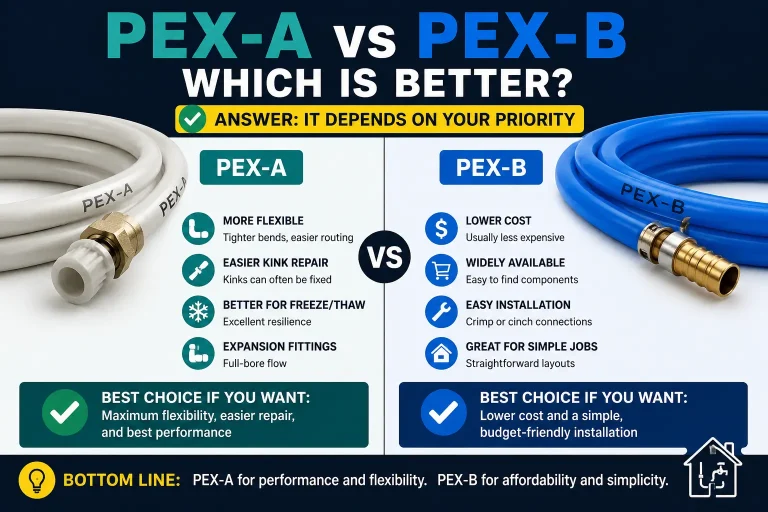
PEX-B vs PEX-A: What’s the Difference?
This is the comparison most homeowners eventually want to know.
| Feature | PEX-B | PEX-A |
|---|---|---|
| Manufacturing method | Silane / moisture cure | Peroxide / Engel |
| Flexibility | Generally moderate to high | Generally higher |
| Bend radius | Generally larger | Generally tighter |
| Coil memory | More noticeable | Less noticeable |
| Shape memory | Less pronounced | Stronger |
| Common connection methods | Crimp, clamp and other approved systems | Expansion and other approved systems |
| Typical advantage | Cost and availability | Flexibility and tight routing |
| Is either automatically better? | No | No |
The letter isn’t a quality ranking. The actual product’s tested performance and compatibility matter more than whether the tube is labeled A or B.
Which is better: PEX-A or PEX-B?
For a straightforward plumbing job, PEX-B can be an excellent choice.
If the installation involves lots of tight turns, difficult routing, or you specifically want to use an expansion fitting system designed for compatible PEX-A tubing, PEX-A may make more sense.
On the other hand, if you’re comfortable with crimp or clamp connections and want a widely available, cost-effective tubing option, PEX-B is worth considering.
There is no universal winner.
What Fittings Are Used With PEX-B?
Traditional PEX-B installations commonly use insert fittings secured with crimp rings or stainless-steel clamp/cinch rings.
The fitting goes inside the tubing, and the ring is compressed around the outside of the pipe to create the connection.
Common systems include:
- Copper crimp rings
- Stainless-steel clamp/cinch rings
- Compatible insert fittings
- Some approved press or push-to-connect systems
However, don’t mix components just because they physically fit.
The tubing, fitting, ring, and connection method need to be compatible according to the manufacturer’s instructions.
For example, PEX systems can use different fitting standards and connection methods, and manufacturers may approve specific combinations rather than every possible combination.
Can You Use Expansion Fittings With PEX-B?
This is one of those questions where a simple yes-or-no answer can get you into trouble.
Traditional cold-expansion systems are designed around tubing with the necessary elastic or shape-memory characteristics, most notably compatible PEX-A products.
Do not assume that a PEX-B tube can be used with an expansion fitting simply because the outside diameter looks the same.
Always check the tubing and fitting manufacturer’s compatibility requirements for the exact system.
For conventional PEX-B plumbing, crimp and clamp connections are common choices.
Is PEX-B Safe for Drinking Water?

Yes, PEX-B can be used for potable water when the specific product is approved and certified for that application.
But don’t treat the words “PEX-B” as the certification.
Different PEX products can have different approvals and ratings. When you’re working on a drinking-water system, look at the markings on the tubing and the manufacturer’s documentation for the applicable potable-water certifications and standards.
This is especially important when buying tubing for a new installation. A cheap roll of tubing isn’t a bargain if it isn’t approved for the job you’re doing.
For a deeper look at this topic, see our guide on Is PEX Safe for Drinking Water?.
Does PEX-B Reduce Water Pressure?
PEX-B itself doesn’t automatically mean you’ll have poor water pressure.
What people often call “low pressure” is actually a flow restriction problem.
Pipe size, inside diameter, total run length, fittings, valves, bends, fixture demand, and system pressure all affect how much water reaches a fixture.
This matters with PEX-B because common insert-style fittings put a fitting inside the tube. The fitting can reduce the effective flow passage at the connection.
That doesn’t mean PEX-B is unsuitable for plumbing. It simply means the system needs to be sized correctly.
If a large house is supplied with undersized tubing and a pile of restrictive fittings, changing the material from PEX-B to another type of pipe won’t magically fix the design.
How Do You Identify PEX-B Pipe?
The easiest place to start is the printing on the tubing.
Look along the side of the pipe for the manufacturer’s information, product designation, standards, pressure/temperature information, and other markings.
Don’t rely on pipe color.
Red, blue, white, and other colors are commonly used to distinguish hot and cold water or for product identification. Color alone does not tell you whether the tubing is PEX-A, PEX-B, or PEX-C.
If you’re trying to identify existing tubing, also look at the fittings and connection style. A crimp or clamp connection can provide a useful clue, but the pipe’s actual markings are a better starting point.
What should you look for on the pipe?
Depending on the product, the print line can include information about:
- Manufacturer
- PEX type
- Size
- Applicable standards
- Pressure rating
- Temperature rating
- Chlorine resistance
- UV resistance
- Certification information
The four-digit PEX designation code printed on tubing can also provide important information about tested performance.
Does PEX-B Freeze?
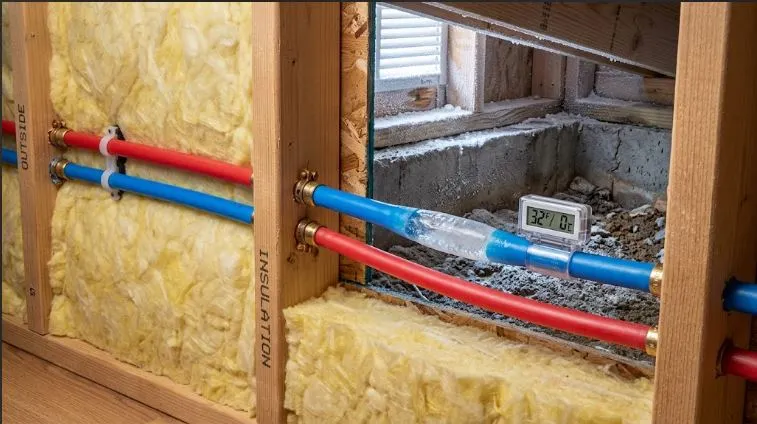
PEX-B is not freeze-proof.
Like other PEX tubing, it has some ability to expand when water freezes inside it, which can make it more tolerant of freezing conditions than some rigid piping materials.
But that does not mean you should intentionally let a PEX-B water line freeze.
A frozen plumbing system can still suffer damage, particularly at fittings and connections. Repeated freezing and thawing can also put unnecessary stress on the system.
If your plumbing is exposed to freezing temperatures, proper insulation and freeze protection are still important.
For more detail, see Does PEX Pipe Freeze?.
What Sizes Does PEX-B Come In?
PEX-B is available in a range of tubing sizes, with common residential sizes including:
- 3/8 inch
- 1/2 inch
- 3/4 inch
- 1 inch
- Larger sizes for specific applications
The exact sizes available depend on the manufacturer and product line.
For residential water distribution, 1/2-inch and 3/4-inch PEX are especially common, but you should size the pipe according to the actual water demand and plumbing layout rather than choosing a size simply because it is common.
What Standards Should PEX-B Meet?
When buying PEX-B for plumbing, don’t stop at the word “PEX-B.”
Look at the actual product markings and specifications.
PEX tubing is manufactured and tested against applicable standards, including ASTM F876 and ASTM F877 for PEX tubing used in plumbing applications. Other standards apply to particular fittings and connection systems.
You may also see certification information relating to potable-water use.
The important lesson is simple:
Choose the certified product for the application, not merely the PEX type.
The PEX-A/B/C designation tells you how the tubing was manufactured. The product markings and ratings tell you much more about how that particular tube is designed to perform.
PEX-B for Radiant and Hydronic Heating
PEX-B is also available for hydronic heating applications.
But standard potable-water PEX and tubing designed for closed-loop heating aren’t necessarily the same product.
For hydronic systems, you may encounter oxygen-barrier PEX. The oxygen barrier is designed to limit oxygen diffusion through the tubing, which can be important in closed-loop systems containing ferrous components.
If you’re installing radiant-floor heating or another hydronic system, use tubing specifically rated for that application and follow the system manufacturer’s requirements.
PEX-B vs PEX-A vs PEX-C
All three are cross-linked polyethylene, but the manufacturing methods are different.
| Type | Manufacturing method | General characteristic |
|---|---|---|
| PEX-A | Peroxide / Engel | Generally the most flexible |
| PEX-B | Silane / moisture cure | Generally stiffer and cost-effective |
| PEX-C | Electron-beam irradiation | Product characteristics vary |
These are broad comparisons, not guarantees for every product on the market. Manufacturer specifications should always take priority.
Is PEX-B Good for Plumbing?
Yes. PEX-B is a good plumbing material when you choose the right product and install it correctly.
It isn’t the “cheap version” of PEX-A, and you shouldn’t choose between the two based only on the letter.
PEX-B makes a lot of sense for straightforward plumbing layouts where its flexibility is sufficient and a crimp, clamp, or other approved connection system fits the project.
PEX-A may be the better fit when you need tighter bends, greater flexibility, or a specific expansion-based system.
For most homeowners, the better question isn’t:
“Is PEX-A or PEX-B better?”
It’s:
“Which approved PEX system fits this plumbing job?”
That’s the question that leads to a reliable installation.
Bottom Line
PEX-B is cross-linked polyethylene made with the silane or moisture-cure manufacturing process. The “B” describes how the tubing is manufactured; it does not mean the pipe is a lower-quality version of PEX-A.
Its main trade-off is straightforward: PEX-B is generally less flexible than PEX-A, but it is widely available, cost-effective, and well suited to many residential plumbing applications.