Types of PEX: PEX-A vs PEX-B vs PEX-C, Uses, Fittings & How to Choose
PEX is popular in residential plumbing because it is flexible, easy to install, and less prone to corrosion than some traditional piping materials. But once you start shopping for it, things get confusing fast: PEX-A, PEX-B, PEX-C, oxygen-barrier PEX, PEX-AL-PEX—what do all these names actually mean?
The good news is that choosing PEX doesn’t have to be complicated. This guide explains the main types of PEX, how they differ, which one is best for different jobs, what works with expansion fittings, and how to identify the PEX already installed in your home.
What Types of PEX Are Available?
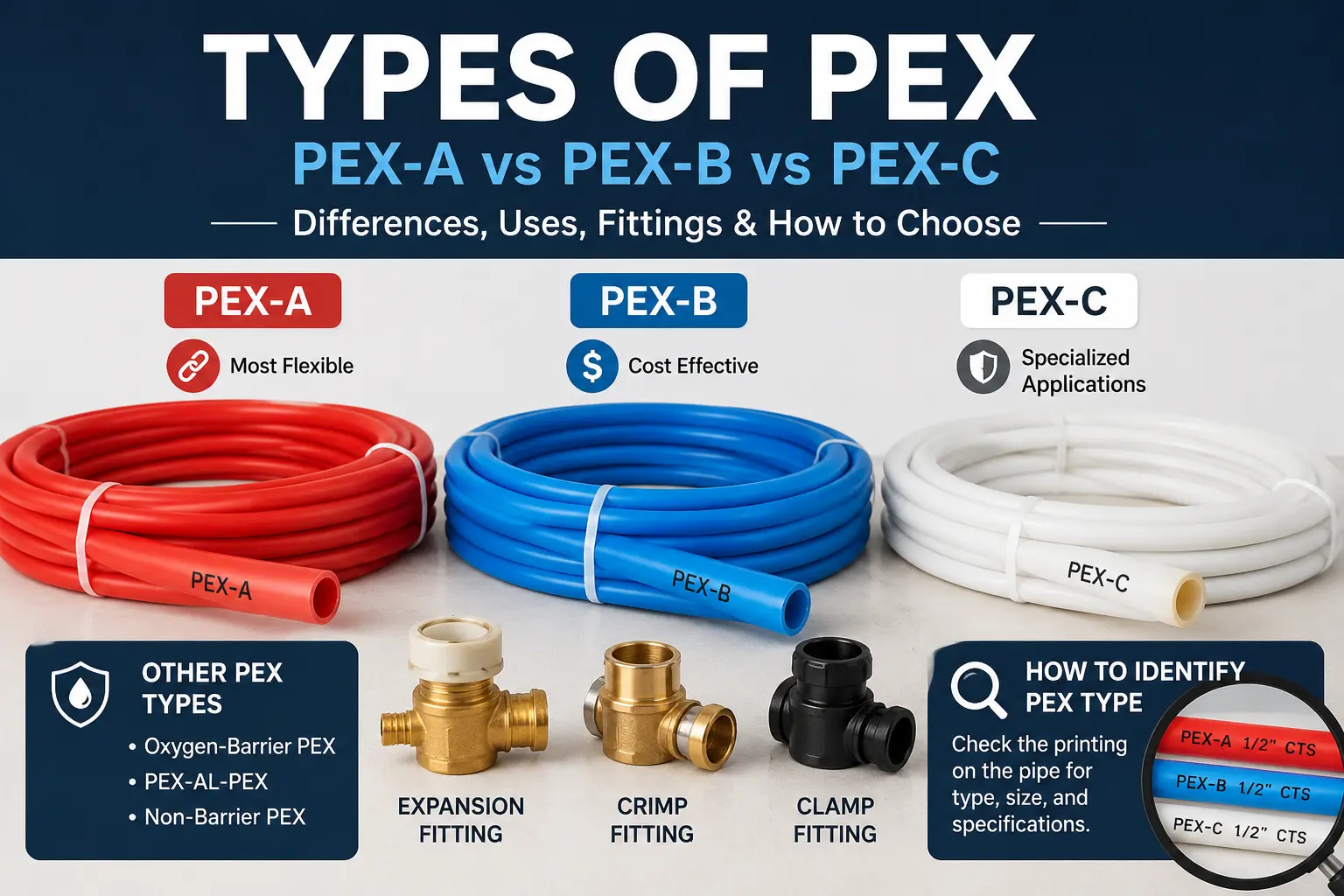
The three main types of PEX are:
- PEX-A — made using the peroxide/Engel method
- PEX-B — made using the silane/moisture-cure method
- PEX-C — made using electron-beam irradiation
These letters describe how the polyethylene is cross-linked, not whether one type is automatically better than another.
You can also find other PEX products based on their construction or intended use, including non-barrier PEX, oxygen-barrier PEX, and PEX-AL-PEX.
Which PEX Should You Choose?
| If you need… | Consider… |
|---|---|
| Maximum flexibility | PEX-A |
| Tight bends | PEX-A |
| Expansion fittings | Compatible PEX-A |
| Standard residential plumbing | PEX-A or PEX-B |
| Lower material cost | PEX-B often makes sense |
| Freeze-related flexibility | PEX-A |
| Radiant/hydronic heating | Properly rated oxygen-barrier PEX |
| Shape-retaining multilayer tubing | PEX-AL-PEX |
| To identify existing tubing | Check the printed markings |
These are general recommendations. The product’s installation instructions and local plumbing requirements should always take priority.
What Is PEX-A?
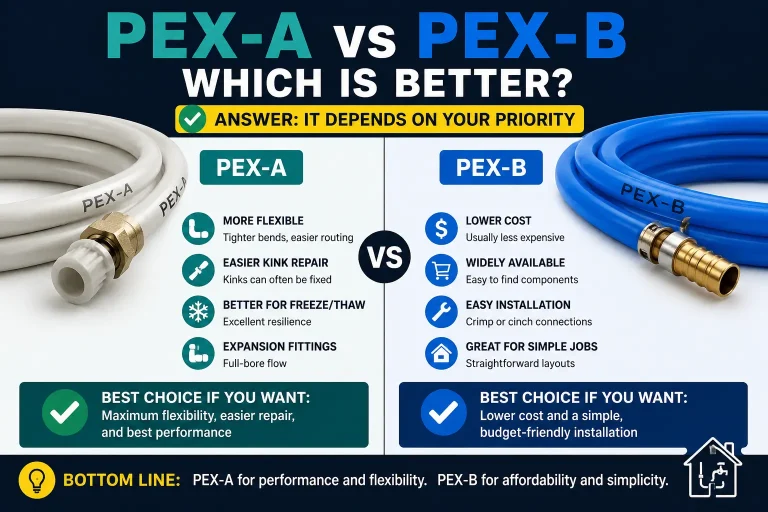
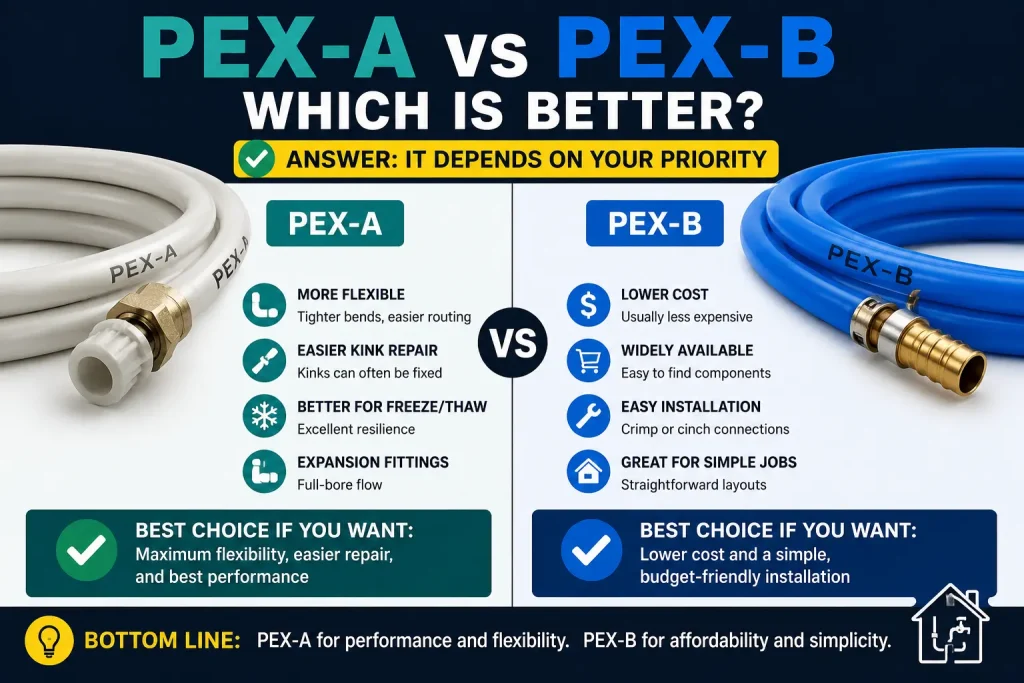
PEX-A is manufactured using the peroxide, or Engel, method. It is generally the most flexible of the three main PEX types, which makes it useful when tubing needs to make bends or pass through tight spaces.
One of its biggest advantages is its ability to handle expansion and contraction. PEX-A is also commonly used with expansion fitting systems, provided the specific tubing and fittings are approved for use together.
PEX-A advantages
- Very flexible
- Good for tight spaces and bends
- Commonly compatible with expansion fittings
- Good resistance to freeze-related expansion
- Kinks can often be repaired using an approved heat-repair method
PEX-A disadvantages
- Often costs more than PEX-B
- Its flexibility isn’t necessary for every plumbing job
Related: Plumbing Cost Estimator
What Is PEX-B?
PEX-B is manufactured using the silane or moisture-cure method. It is widely used in residential plumbing and is often less expensive than PEX-A.
PEX-B is generally more rigid than PEX-A and has more coil memory. That isn’t necessarily a problem. For straightforward plumbing runs, PEX-B can be a very practical option.
PEX-B advantages
- Usually more affordable
- Widely available
- Good for standard residential plumbing
- Commonly used with crimp and clamp connection systems
- Suitable for many hot- and cold-water applications
PEX-B disadvantages
- Less flexible than PEX-A
- More coil memory
- You should not assume it works with expansion fittings
Always check the manufacturer’s instructions before mixing tubing and fittings.
Related: What is better: PEX A or PEX B?
What Is PEX-C?
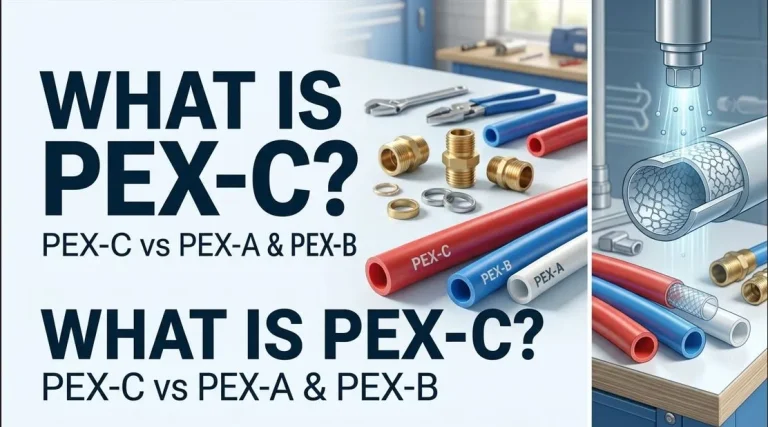
PEX-C is produced using electron-beam irradiation. It is less commonly discussed in residential plumbing than PEX-A and PEX-B.
PEX-C can still be suitable for plumbing and heating applications when the specific product meets the required standards and is approved for that use.
The main thing to remember is that PEX-C isn’t automatically “bad PEX.” The A, B and C labels aren’t quality rankings.
PEX-A vs PEX-B vs PEX-C: What’s the Difference?
The main difference is the manufacturing process, but that process affects how the tubing behaves.
| Feature | PEX-A | PEX-B | PEX-C |
|---|---|---|---|
| Manufacturing method | Peroxide/Engel | Silane/moisture cure | Electron beam |
| Flexibility | Highest | Moderate | Generally lower |
| Coil memory | Lower | Higher | Varies |
| Residential use | Common | Very common | Less common |
| Expansion fittings | Common with approved systems | Don’t assume compatibility | Don’t assume compatibility |
| Main advantage | Flexibility | Cost and availability | Specific product/application |
These are general differences. The actual performance of a PEX product also depends on its formulation, manufacturer, certification, and intended application.
Are PEX-A, PEX-B and PEX-C Different Quality Grades?
No.
This is one of the biggest misconceptions about PEX.
PEX-A isn’t simply “Grade A,” and PEX-C isn’t “Grade C.” The letters refer to the cross-linking method used during manufacturing.
A properly manufactured and certified PEX-B product can be an excellent choice for a plumbing installation. In some situations, it may make more sense than paying extra for PEX-A.
So don’t choose PEX just because the letter sounds better.
Is PEX-A Actually Better Than PEX-B?
Not in every situation.
PEX-A has a clear advantage when flexibility matters. It is easier to bend and is commonly used with expansion connection systems. That’s useful in tight spaces, remodeling projects, and complicated plumbing layouts.
PEX-B, on the other hand, can be a great choice when you’re looking for a more economical option for conventional plumbing.
A simple way to think about it is:
Choose PEX-A when flexibility and expansion connections are important. Choose PEX-B when you want a reliable, widely available option for standard plumbing and cost is a bigger consideration.
The best choice depends on the installation, not the alphabet.
Which PEX Is Best for Plumbing?
For normal residential hot- and cold-water plumbing, certified non-barrier PEX-A or PEX-B can both be good choices.
Before buying, check:
- Whether the tubing is approved for potable water
- The required pressure and temperature ratings
- Fitting compatibility
- Applicable plumbing codes
- Manufacturer installation instructions
- Required certifications
For a straightforward plumbing project, PEX-B may offer good value. For complicated layouts where flexibility matters, PEX-A may be worth the extra cost.
PEX-C can also be used when the particular product is approved for the application, although it’s less common.
What Type of PEX Works With Expansion Fittings?
PEX-A is the type most commonly associated with expansion fittings.
Its flexibility and ability to expand temporarily make it well suited to expansion connection systems such as ASTM F1960 systems.
However, don’t assume that every PEX-A tube works with every expansion fitting.
The tubing and fitting manufacturers must approve the combination. Always check the specific product instructions before installation.
For standard crimp or clamp systems, compatibility can be broader, but you still need to verify the manufacturer’s requirements.
If you’re comparing connection methods, our guide to PEX pipe fittings goes deeper into crimp, clamp, expansion, and other fitting options.
What Type of PEX Is Best for Freezing Temperatures?
PEX-A is often preferred when freeze-related expansion is a major concern.
Its flexibility allows it to expand more readily when water inside the tubing freezes.
But don’t take that to mean PEX is freeze-proof.
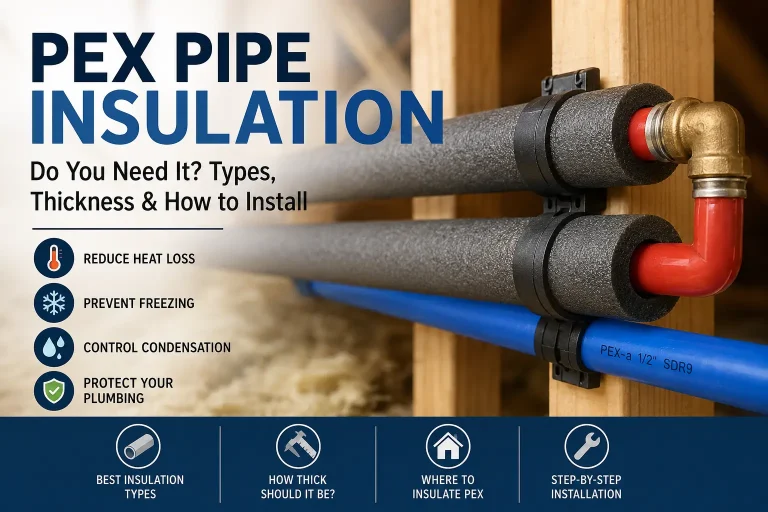
Frozen water can still damage fittings, valves, connections, and other parts of the plumbing system. Proper insulation and freeze protection are still important.
So if your question is simply, “Which PEX handles freezing conditions best?”, PEX-A generally has the advantage. But no PEX should be deliberately exposed to freezing conditions.
Are There Other Types of PEX?
Yes. This is where things get a little confusing.
PEX-A, PEX-B and PEX-C describe manufacturing methods. Other terms describe the tubing’s construction or application.
Non-Barrier PEX
This is the standard PEX commonly used for residential hot- and cold-water plumbing.
Oxygen-Barrier PEX
Oxygen-barrier PEX is designed to limit oxygen diffusion through the tubing. It is commonly used in closed-loop hydronic and radiant heating systems.
Don’t assume oxygen-barrier PEX is the right choice for ordinary drinking-water plumbing. Always check the product’s approved applications.
PEX-AL-PEX
PEX-AL-PEX is a multilayer tube made from:
PEX + aluminum + PEX
The aluminum layer gives the tubing different characteristics from ordinary PEX. It can hold its shape after bending and also provides an oxygen barrier.
So PEX-AL-PEX isn’t simply another “PEX type” alongside A, B and C. It is a different multilayer construction.
How Do I Identify the Type of PEX I Already Have?
Don’t try to identify PEX-A, PEX-B or PEX-C by its color.
Red PEX doesn’t automatically mean PEX-A, and blue PEX doesn’t automatically mean PEX-B.
Instead, look at the writing printed along the tubing. Depending on the product, it can include:
- Manufacturer name
- Product name
- PEX type
- Tubing size
- Standard designation
- Material designation
- Pressure and temperature information
- Certification markings
Look for markings that specifically identify PEX-A, PEX-B, or PEX-C.
If you can’t find the type, write down the manufacturer and product information printed on the tube and check the manufacturer’s technical documentation.
Does PEX Color Tell You Its Type?
No.
Color is generally used to make plumbing lines easier to identify. Red is commonly used for hot-water lines and blue for cold-water lines.
It doesn’t tell you whether the tubing is PEX-A, PEX-B or PEX-C.
So if you’re replacing a section of blue PEX, don’t buy PEX-B simply because the existing pipe is blue. Check the markings first.
PEX Types vs PEX Sizes
Don’t confuse PEX type with PEX size.
PEX-A, PEX-B and PEX-C describe the manufacturing method.
Sizes such as:
- 3/8 inch
- 1/2 inch
- 3/4 inch
- 1 inch
describe the tubing’s dimensions.
For example, 1/2-inch PEX-A means the tubing is 1/2 inch in size and is PEX-A.
You’ll need to know both the size and the fitting compatibility when replacing or extending an existing PEX line.
Which PEX Is Best for a House Repipe?
For a whole-house repipe, PEX-A and PEX-B are usually the two options worth comparing first.
PEX-A makes sense when you have lots of bends, tight spaces, or want to use an approved expansion fitting system.
PEX-B can be attractive when you’re looking for a more economical option and the installation works well with conventional crimp or clamp connections.
Also consider your local plumbing code, water conditions, product certifications, fitting availability, and the installer’s experience.
If you’re planning a repipe, you can also use our Repipe Cost Calculator to estimate the potential project cost before comparing materials.
Bottom Line
The three main PEX types are PEX-A, PEX-B and PEX-C, and the letters describe how the tubing is manufactured, not a simple quality ranking. PEX-A is generally the most flexible, PEX-B is widely used and often more economical, and PEX-C is less common.
For most homeowners, the real choice comes down to PEX-A vs PEX-B, the fitting system, the installation conditions, and the product’s certifications. And if you’re dealing with radiant heating or other specialized applications, oxygen-barrier PEX or PEX-AL-PEX may be more appropriate. When identifying existing PEX, ignore the color and check the markings printed on the tubing.