
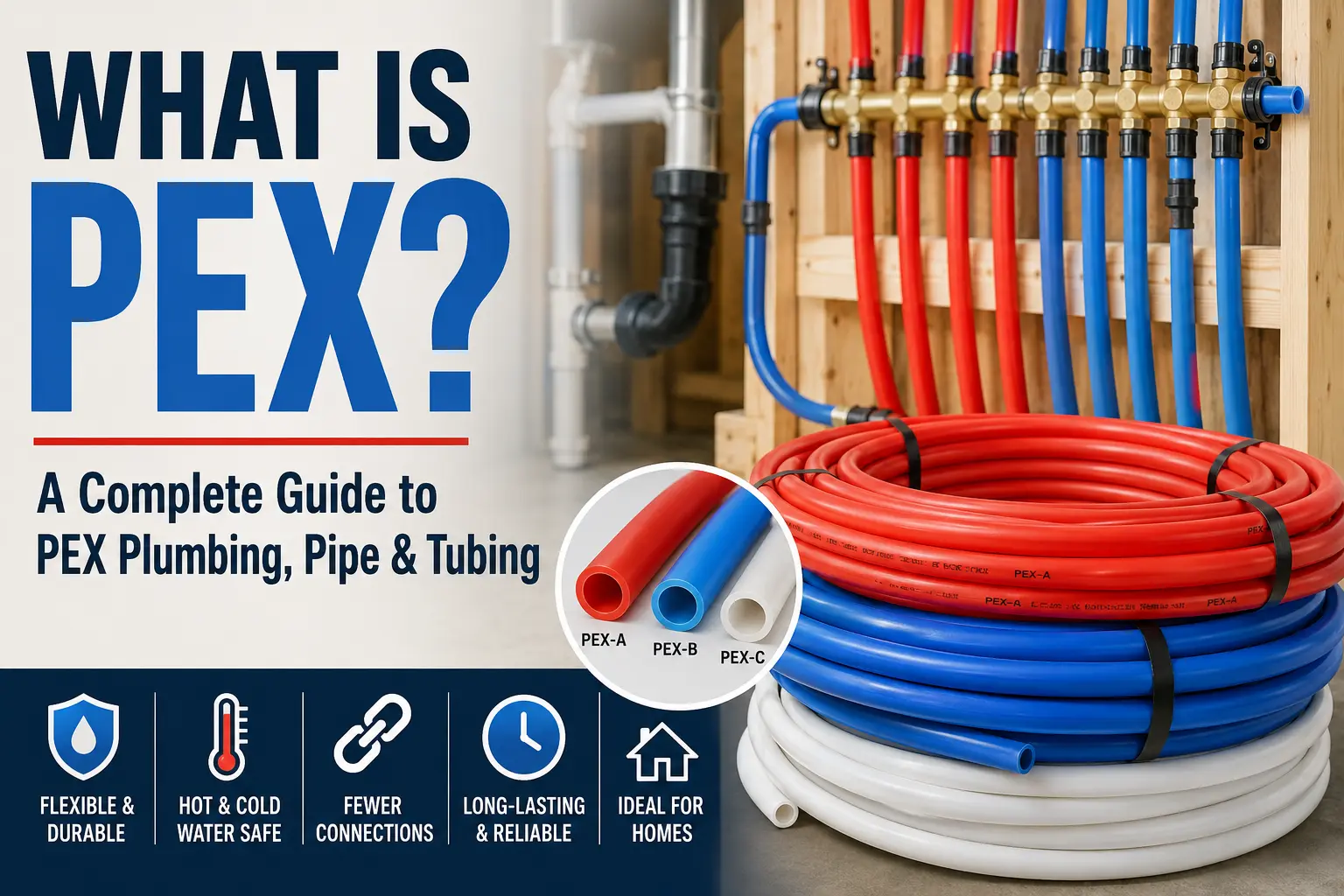
What Is PEX Plumbing? A Complete Beginner’s Guide
PEX stands for cross-linked polyethylene. It is a flexible plastic tubing material commonly used for hot- and cold-water supply lines and other approved plumbing and heating applications. PEX is made by chemically or physically bonding polyethylene molecules together, which gives the tubing added strength, flexibility, and resistance to temperature extremes compared with ordinary plastic pipe.
Because PEX bends easily, it can be routed through walls, floors, and tight spaces with fewer joints than rigid pipe. This has made it one of the most common materials for residential water-supply systems in the United States. The rest of this guide explains what PEX is made of, how it works, the different types available, and how it compares with copper, CPVC, and PVC.
What Is PEX?
PEX is cross-linked polyethylene tubing used for residential and commercial water distribution. It is flexible, resists corrosion, and is commonly approved for both hot- and cold-water supply lines when the specific product is rated for that use.
Unlike copper or PVC, PEX is not rigid. It comes in coils or straight lengths and can curve around corners and obstacles, which often reduces the number of fittings needed in a plumbing run. PEX is used for main water-supply lines, branch lines to individual fixtures, and in some radiant-heating systems, always subject to the manufacturer’s ratings and local plumbing code.
What Does PEX Stand For?
PEX stands for PolyEthylene, cross-linked, with the “X” representing cross-linking. Polyethylene is a common plastic; the cross-linking process is what turns ordinary polyethylene into a material suitable for pressurized water lines.
What Does “Cross-Linked” Mean?
Cross-linking is a process that creates bonds between individual polyethylene molecule chains, tying them together into a stronger, more stable network. Think of ordinary polyethylene as loose strands of rope lying next to each other, while cross-linked polyethylene is closer to those same strands woven and tied together.
This matters for plumbing because cross-linking improves:
- Flexibility – the tubing can bend without breaking down over time.
- Strength – the material better resists pressure and physical stress.
- Temperature resistance – cross-linked polyethylene holds up better under hot water than non-cross-linked plastic.
- Durability – the tubing resists cracking, scaling, and long-term degradation from water exposure.
What Is PEX Plumbing?
It helps to separate three related terms. PEX is the raw material (cross-linked polyethylene). PEX tubing or PEX pipe is the physical product manufactured from that material. PEX plumbing is the plumbing system built using PEX tubing, fittings, and related components to move water through a home.
In a PEX plumbing system, tubing carries water from the main supply line to a distribution point, then out to individual fixtures such as sinks, showers, and appliances. The system relies on fittings to join tubing sections, connect to other materials like copper or CPVC, and terminate at fixtures.
Where Is PEX Plumbing Used?
PEX plumbing is commonly used in:
- Bathrooms (sinks, tubs, showers, toilets)
- Kitchens (sinks, dishwashers, ice makers)
- Laundry rooms
- Water heater connections
- Whole-house water supply lines
- New home construction
- Remodeling projects
- Whole-house repiping
- Radiant floor heating and hydronic heating systems, where the specific product is rated and approved for that application
What Is PEX Pipe, PEX Tubing, and PEX Piping?
“PEX pipe,” “PEX tubing,” and “PEX piping” generally refer to the same physical product: flexible cross-linked polyethylene tubing used to carry water. Manufacturers and plumbers use these terms somewhat interchangeably, though “tubing” is technically more accurate for a flexible product, while “pipe” is often used out of habit from rigid-pipe terminology.
Is PEX Pipe the Same as PEX Tubing?
Yes. In everyday use, PEX pipe and PEX tubing describe the same flexible cross-linked polyethylene product. Any small distinctions in terminology come down to industry habit rather than a difference in the material itself.
What Is PEX Piping?
PEX piping refers to a plumbing system built from PEX tubing, along with its fittings, manifolds, and valves. It’s the broader system-level term, while “PEX pipe” or “PEX tubing” refers to the tubing itself.
What Are PEX Pipes Used For?
PEX pipes are mainly used to supply hot and cold water to fixtures and appliances throughout a home. Depending on the specific product’s ratings, PEX may also be used in radiant heating, snow-melt systems, and certain commercial water-distribution applications.
What Is PEX Made Of?
PEX is made from polyethylene, a common thermoplastic, that has been cross-linked using one of several manufacturing methods. Cross-linking is what differentiates PEX from ordinary polyethylene pipe and gives it the properties needed for pressurized water lines.
What Is PEX Pipe Made Of?
PEX pipe is made of cross-linked polyethylene resin, extruded into tubing form. The exact resin formulation and any additives can vary by manufacturer and product line.
What Is PEX Tubing Made Of?
PEX tubing is made from the same cross-linked polyethylene base material as PEX pipe. Formulations may differ slightly between manufacturers, particularly for products designed for radiant heating, which often include an oxygen-barrier layer to reduce corrosion in metal system components.
Is PEX Plastic?
Yes, PEX is a plastic. Specifically, it is a cross-linked form of polyethylene, which is chemically modified to perform better under pressure, heat, and long-term water exposure than standard, non-cross-linked polyethylene.
Why Is Cross-Linking Important?
Ordinary polyethylene softens more readily under heat and can be more prone to long-term stress cracking under pressure. Cross-linking bonds the polymer chains together, which improves heat tolerance, pressure resistance, and long-term durability. This is what makes cross-linked polyethylene suitable for hot- and cold-water plumbing, while ordinary polyethylene generally is not used in the same way. Exact formulations and additives can vary by manufacturer and product.
How Is PEX Pipe Made?
At a high level, PEX manufacturing generally follows this sequence:
- Polyethylene base material – Manufacturers start with a polyethylene resin as the base plastic.
- Cross-linking – The resin is cross-linked using one of three main industry methods (covered below as PEX-A, PEX-B, and PEX-C), which differ in when and how the cross-linking bonds form.
- Tubing formation/extrusion – The material is extruded into continuous tubing at a controlled diameter and wall thickness.
- Testing – Finished tubing is tested for dimensional accuracy, pressure rating, and compliance with applicable standards.
- Product markings – Approved tubing is printed with information such as size, standard, certification, and pressure/temperature ratings.
This is a simplified overview, not a full industrial process guide. Exact procedures vary by manufacturer.
What Does PEX Pipe Look Like?
PEX pipe looks like a smooth, flexible plastic tube, typically sold in long coils or in shorter straight lengths. It has a consistent round cross-section, a printed label running along its length, and comes in various diameters depending on the application.
Common characteristics include:
- A flexible, slightly glossy surface
- Coiled rolls (common for smaller diameters) or straight sticks (common for larger diameters)
- Solid colors such as red, blue, white, or gray
- A printed line of text along the tubing showing size, standard, and certification information
- Diameters commonly ranging from about 3/8 inch to 1 inch or larger for residential use
What Do the Colors of PEX Pipe Mean?
PEX tubing commonly comes in red, blue, white, or other colors. Red and blue are often used as a visual identification convention, with red frequently associated with hot-water lines and blue with cold-water lines on job sites. However, color alone does not determine what a specific tubing product is approved for. The tubing’s actual rated application depends on its product markings, pressure and temperature ratings, manufacturer instructions, and applicable local plumbing code, not simply its color.
What Are the Different Types of PEX?
There are three main types of PEX: PEX-A, PEX-B, and PEX-C. The letters refer primarily to the manufacturing method used to cross-link the polyethylene, not a simple best-to-worst quality ranking. Each type has different handling characteristics, and each is compatible with a somewhat different set of fitting systems.
PEX-A
PEX-A is produced using the Engel, or peroxide, method, in which cross-linking occurs while the polyethylene is still in a melted state during extrusion. This tends to produce highly flexible tubing with strong “memory,” meaning it can be expanded and will shrink back to its original shape, which is the basis for expansion-style fittings. PEX-A is also generally noted for its ability to have minor kinks worked out with a heat gun.
PEX-B
PEX-B is produced using the silane, or moisture-cure, method, where cross-linking occurs after extrusion through exposure to moisture and a catalyst. PEX-B is widely used in residential plumbing, is generally somewhat stiffer than PEX-A, and is compatible with several common fitting systems, including crimp and clamp connections.
PEX-C
PEX-C is produced using an electron-beam (irradiation) method, where the finished tubing is exposed to an electron beam after extrusion to complete cross-linking. PEX-C is often used for supply lines from a stub-out to a fixture and can also be used in certain closed-loop heating applications, depending on the specific product’s rating.
PEX-A vs PEX-B vs PEX-C
| Feature | PEX-A | PEX-B | PEX-C |
|---|---|---|---|
| Manufacturing method | Peroxide (Engel) method, cross-linked during extrusion | Silane (moisture-cure) method, cross-linked after extrusion | Electron-beam (irradiation) method, cross-linked after extrusion |
| Flexibility | Generally the most flexible | Moderately flexible | Similar flexibility to PEX-B, varies by product |
| Kink behavior | Kinks can often be worked out with a heat gun | Kinks generally require cutting out the damaged section | Kinks generally require cutting out the damaged section |
| Common connection systems | Expansion fittings; also compatible with some crimp, clamp, and push-to-connect systems | Crimp, clamp/cinch, and push-to-connect systems | Crimp, clamp/cinch, and push-to-connect systems |
| Typical applications | Whole-home repiping, radiant heating, tight-bend installations | General residential and commercial supply lines | Fixture supply lines, some closed-loop heating systems |
| Relative cost positioning | Often positioned at a higher price point | Often the most widely available and cost-competitive | Positioning varies by manufacturer and region |
Suitability depends on the specific project, the fitting system chosen, the product’s own specifications, installer preference, and applicable local code — not simply the letter grade.
How Does PEX Plumbing Work?
In a typical home, water enters through a main supply line, then is distributed through the house using PEX tubing to individual hot- and cold-water lines. Along the way, fittings join tubing sections, valves allow shutoff at specific points, and the tubing ultimately connects to fixtures such as faucets, showers, and appliances.
Many PEX systems use a central manifold, a fixture with multiple valved outlets, to distribute individual “home-run” lines to each fixture. Other systems use a trunk-and-branch approach, similar to traditional rigid-pipe layouts, where a main trunk line feeds smaller branch lines to groups of fixtures. Either way, the basic function is the same: PEX tubing acts as the pathway that carries pressurized water from the supply source to where it’s used.
How Is PEX Plumbing Connected?
PEX tubing is joined to fittings, valves, and other pipe materials using several established connection methods. The right method depends on the type of PEX, the fitting system chosen, and the manufacturer’s instructions.
Crimp Connections
A crimp connection uses a copper or stainless-steel ring placed over the tubing and fitting, then compressed with a crimping tool to form a secure joint.
Clamp/Cinch Connections
A clamp, or cinch, connection uses a stainless-steel clamp ring tightened around the tubing and fitting with a cinch tool, creating a mechanical seal.
Expansion Connections
An expansion connection temporarily stretches the tubing and a fitting sleeve using an expansion tool, then relies on the tubing’s memory to shrink back around the fitting as it cools.
Press Connections
A press connection uses a specialized press tool to compress a fitting collar onto the tubing, commonly used with certain metal or hybrid fitting systems.
Push-to-Connect Connections
A push-to-connect fitting allows tubing to be inserted directly into the fitting body, where internal components grip and seal the connection without additional tools.
Fittings and connection methods are not universally interchangeable. Compatibility depends on the specific tubing type, the fitting system, manufacturer instructions, and applicable code requirements. This overview is for general education; it is not a step-by-step installation guide, and inexperienced individuals should not attempt plumbing connections without proper training or professional guidance.
What Are the Main PEX Plumbing Layouts?
Trunk-and-Branch
A trunk-and-branch layout uses a larger main line (the trunk) that branches into smaller lines feeding groups of fixtures, similar in concept to traditional copper or CPVC systems. It can use fewer total fittings for certain layouts but may involve more fittings at branch points compared with a manifold system.
Home-Run/Manifold
A home-run, or manifold, layout runs an individual PEX line from a central manifold directly to each fixture. This design allows each fixture to be shut off independently at the manifold and can simplify troubleshooting, though it uses more total tubing.
Hybrid
A hybrid layout combines elements of both approaches, such as using a manifold for some fixtures and trunk-and-branch for others, depending on the home’s layout and the installer’s design choices.
Where Is PEX Plumbing Used?
PEX plumbing is commonly used for residential water supply in new construction, remodeling, and whole-house repiping projects. It is used for both hot- and cold-water distribution, and, depending on the specific product and its approval, in radiant floor heating and hydronic heating applications. Some applications, such as heating systems or outdoor use, require a specific product rating and installer awareness of local code requirements; not every PEX product is designed or approved for every use.
What Are the Advantages of PEX?
- Flexibility – PEX bends around obstacles, often reducing the number of fittings needed compared with rigid pipe.
- Lightweight construction – PEX is lighter than copper, which can simplify handling and transport.
- Easier routing – Flexibility allows installers to route tubing through framing with fewer cuts and joints.
- Fewer fittings in some layouts – Home-run and hybrid layouts can reduce the number of fittings compared with certain rigid-pipe designs.
- Corrosion resistance – As a plastic material, PEX does not corrode the way metal pipe can.
- Resistance to scale buildup – PEX is often less prone to mineral scale buildup than some metal pipe.
- Installation efficiency – Flexibility and lighter weight can often speed up installation time.
- Quieter operation in some systems – PEX can reduce water-hammer noise in certain installations.
- Freeze tolerance compared with some rigid piping – PEX can expand somewhat under freezing conditions, which may reduce burst risk compared with some rigid materials, though it is not freeze-proof.
- Potential installation-cost advantages – In many installations, PEX can offer cost or labor advantages, though this depends heavily on the specific project, region, and material pricing at the time.
What Are the Disadvantages of PEX?
- UV sensitivity – Most PEX products are not designed for prolonged sunlight exposure.
- Potential rodent damage – PEX tubing can be vulnerable to gnawing by rodents in some settings.
- Temperature limitations – Every PEX product has a rated maximum temperature and pressure combination that must not be exceeded.
- Chemical compatibility – PEX is not compatible with every chemical or solvent, and manufacturer guidance should be followed.
- Fitting compatibility – Not all fittings work with all PEX types, which can create confusion during installation or repair.
- Risk from incorrect installation – Like any plumbing material, improper installation can lead to leaks or premature failure.
- Product-specific limitations – Ratings and approvals vary by manufacturer and product line.
- Local code restrictions – Some jurisdictions restrict or place conditions on certain PEX applications.
- Not suitable for every plumbing application – Some uses, such as fuel-gas lines, are outside the scope of standard water-supply PEX products.
Can PEX Be Used Outdoors?
Most standard PEX tubing is not designed for long-term outdoor or direct-sunlight exposure. Some manufacturers offer UV-resistant formulations or recommend protective sleeving or burial for outdoor runs, but this depends entirely on the specific product and manufacturer instructions.
Does Sunlight Damage PEX?
Yes, prolonged ultraviolet (UV) exposure can degrade standard PEX tubing over time, potentially weakening the material. This is why PEX is typically installed indoors, within walls, or below grade, unless a specific UV-resistant product is used and approved for exposed applications.
Is PEX Safe for Drinking Water?
PEX tubing that is specifically rated and certified for potable water use is considered safe for drinking-water applications. This depends on the individual product carrying appropriate certifications, such as testing to NSF/ANSI/CAN 61, and following the manufacturer’s instructions and local plumbing code. Not every PEX product on the market is automatically approved for every potable-water application; installers and homeowners should check the product’s printed markings and documentation before use.
Is PEX Safe for Hot Water?
PEX is widely used for hot-water supply lines in residential plumbing. That said, temperature and pressure ratings matter: the exact product installed must be rated for the hot-water conditions it will face, and manufacturer instructions and local code requirements must be followed to ensure a safe, long-lasting installation.
Can PEX Freeze?
Yes. PEX can freeze. It is not freeze-proof.
Water inside PEX tubing can freeze just like water in any other pipe material. Because PEX has some flexibility, it may expand somewhat under freezing conditions, which in some cases can reduce the risk of the tubing itself bursting compared with certain rigid pipe materials. However, this does not mean PEX is immune to freeze damage. Fittings, valves, and connected fixtures can still be damaged by freezing, and standard freeze-protection practices, such as insulation and maintaining heat in vulnerable areas, remain important regardless of pipe material.
How Long Does PEX Last?
PEX manufacturers commonly design and warranty their products for decades of service, though no single lifespan figure applies universally to every product or installation. Actual service life depends on several factors:
- Temperature – Consistently high operating temperatures can shorten service life.
- Pressure – Operating within rated pressure limits supports longevity.
- UV exposure – Unprotected sunlight exposure can degrade tubing over time.
- Water chemistry – Chlorine levels and water chemistry can affect long-term durability, which is part of why chlorine-resistance testing exists for PEX products.
- Installation quality – Proper support, connections, and routing all affect how long a system performs well.
- Tubing and fitting quality – Product quality varies by manufacturer.
- Environmental conditions – Factors like temperature swings and ground conditions (for buried lines) can play a role.
Because of these variables, homeowners should refer to the specific manufacturer’s warranty and documentation rather than relying on a single generic lifespan number.
How Can You Identify PEX Pipe in Your Home?
Homeowners can typically identify PEX tubing by a combination of characteristics:
- Flexibility – PEX bends by hand, unlike rigid copper or PVC.
- Appearance – A smooth, slightly glossy plastic surface.
- Color – Commonly red, blue, white, or gray, though color alone isn’t a reliable identifier of application.
- Printed markings – A line of text printed along the tubing’s length.
- Fittings – Crimp rings, clamp rings, or push-to-connect fittings are common with PEX.
- Location – Often found running from a manifold or trunk line to fixtures, water heaters, and appliances.
- Diameter – Residential PEX commonly ranges from about 3/8 inch to 1 inch.
How to Read PEX Pipe Markings
PEX tubing is typically printed with information that can include:
- The manufacturer’s name or brand
- Nominal tubing size
- The governing standard (commonly ASTM F876 and/or F877)
- Certification marks, which may include NSF-related listings for potable water
- Pressure and temperature rating information
- A product or type designation
Exact marking formats vary by manufacturer, and homeowners should not assume the meaning of a specific marking without verifying it against that manufacturer’s documentation.
PEX vs Copper vs CPVC vs PVC
| Feature | PEX | Copper | CPVC | PVC |
|---|---|---|---|---|
| Flexibility | Flexible, bends around obstacles | Rigid; requires fittings for direction changes | Rigid; requires fittings for direction changes | Rigid; requires fittings for direction changes |
| Corrosion resistance | Not subject to metal corrosion | Can corrode or pit over time in some water conditions | Not subject to metal corrosion | Not subject to metal corrosion |
| Installation characteristics | Often faster installation due to flexibility and fewer fittings | Requires soldering or specialized joining methods | Requires solvent welding or approved fittings | Requires solvent welding or approved fittings |
| Hot-water suitability | Suitable when the specific product is rated for hot water | Long history of hot- and cold-water use | Commonly rated for hot-water use | Commonly limited to cold-water and drain/waste/vent use, not typical hot-water supply |
| Typical applications | Residential hot/cold supply, some heating systems | Residential and commercial supply, historically very common | Hot- and cold-water supply, especially in some regions/codes | Cold-water supply, irrigation, and drain/waste/vent piping |
| Freeze behavior | Some flexibility may reduce (not eliminate) burst risk | Rigid; can be prone to bursting when frozen | Rigid; can be prone to cracking when frozen | Rigid; can be prone to cracking when frozen |
| Major advantages | Flexible, lightweight, corrosion-resistant | Long track record, heat tolerant, recyclable | Rigid stability, often lower material cost than copper | Low cost, widely used for non-potable and drain applications |
| Major limitations | UV sensitivity, fitting-compatibility considerations | Higher material cost, potential for corrosion, requires skilled soldering | Can become brittle with age or certain chemical exposure | Generally not approved for hot potable-water supply |
Not every material is interchangeable for every application, and the correct choice depends on project requirements, water conditions, and local plumbing code.
Common PEX Plumbing Problems
Kinked PEX
A sharp bend beyond the tubing’s rated bend radius can kink the material, restricting water flow or weakening the tubing at that point.
Leaking PEX Fittings
Leaks at fittings are often related to improper crimping, clamping, or connection technique rather than a failure of the tubing itself.
UV Damage
Extended, unprotected sunlight exposure can degrade standard PEX tubing over time.
Rodent Damage
In some settings, rodents can chew through exposed PEX tubing, leading to leaks.
Incorrect Connections
Mixing incompatible fitting systems or tubing types can lead to unreliable or leaking joints.
Poor Support or Installation
Inadequate support, incorrect spacing, or poor routing can stress tubing and connections over time.
PlumbJournal covers troubleshooting for these issues in more detail in our dedicated guides on PEX leaks and PEX pipe repair.
Common PEX Plumbing Myths
Myth 1: PEX Never Freezes Reality: PEX can freeze. Its flexibility may reduce certain burst risks compared with some rigid pipe, but it is not freeze-proof, and fittings can still be damaged.
Myth 2: Red PEX Is Always for Hot Water Reality: Color is a common visual convention, not a guarantee. The tubing’s actual approved application depends on its printed markings, ratings, and manufacturer instructions.
Myth 3: PEX-A Is Always Better Than PEX-B Reality: PEX-A, PEX-B, and PEX-C differ mainly in manufacturing method and handling characteristics. The right choice depends on the project, fitting system, and installer preference, not a simple quality ranking.
Myth 4: All PEX Fittings Are Interchangeable Reality: Fitting systems are not universally compatible across all PEX types and brands. Compatibility must be verified against manufacturer instructions.
Myth 5: PEX Can Be Left in Direct Sunlight Reality: Standard PEX is generally not designed for prolonged UV exposure and can degrade if left unprotected outdoors long-term.
Myth 6: PEX Is Just Ordinary Plastic Reality: PEX is cross-linked polyethylene, a plastic that has been chemically or physically modified to withstand pressure and temperature conditions that ordinary, non-cross-linked polyethylene is not designed for.
PEX Plumbing Pros and Cons at a Glance
| Pros | Cons |
|---|---|
| Flexible and easy to route | Not rated for prolonged UV/sunlight exposure |
| Lightweight and often faster to install | Vulnerable to rodent damage in some settings |
| Resists corrosion and mineral scale | Fitting systems vary by type and brand |
| Often fewer fittings in home-run layouts | Requires product-specific ratings for hot water and heating use |
| Some freeze-expansion tolerance | Not freeze-proof; fittings can still be damaged |
| Widely available and well-established in code | Subject to local code restrictions in some applications |
Final Verdict:
PEX can be an excellent option for many residential water-supply applications. Its flexibility, corrosion resistance, and installation efficiency have made it one of the most widely used plumbing materials in U.S. homes today. That said, PEX is not automatically the right choice for every situation. The right product and installation system depend on the specific application, temperature and pressure requirements, product rating, fitting compatibility, local plumbing code, and manufacturer instructions.
For homeowners considering a repiping project, remodel, or new build, understanding these basics is a strong starting point before comparing specific PEX products, fitting systems, or contractor recommendations. Explore PlumbJournal’s related guides on PEX-A vs PEX-B, PEX fitting types, and PEX plumbing costs for a deeper look at planning a PEX project.
Frequently Asked Questions
1. What does PEX stand for? PEX stands for cross-linked polyethylene, a flexible plastic tubing material used in plumbing.
2. What is PEX plumbing? PEX plumbing is a water-distribution system built using PEX tubing, fittings, and related components to carry hot and cold water through a building.
3. What is PEX pipe made of? PEX pipe is made of polyethylene that has been cross-linked using a peroxide, silane, or electron-beam method, depending on the type.
4. What is PEX tubing? PEX tubing is the flexible cross-linked polyethylene product used to carry water in a PEX plumbing system; the terms “PEX tubing” and “PEX pipe” are generally used interchangeably.
5. What does PEX pipe look like? PEX pipe looks like smooth, flexible plastic tubing, usually sold in coils or straight lengths, with printed markings along its surface and a solid color such as red, blue, or white.
6. Is PEX plastic? Yes, PEX is a plastic — specifically, cross-linked polyethylene.
7. Is PEX safe for drinking water? PEX products that are specifically certified for potable water use, following applicable standards and local code, are considered safe for drinking-water applications.
8. Is PEX safe for hot water? Yes, when the specific product is rated for hot-water use and installed according to manufacturer instructions and local code.
9. Can PEX freeze? Yes. PEX can freeze and is not freeze-proof, though its flexibility may reduce certain burst risks compared with some rigid pipe.
10. How long does PEX last? PEX is commonly designed and warrantied for decades of service, though actual lifespan depends on installation quality, water conditions, temperature, and product quality.
11. Is PEX better than copper? Neither material is universally “better.” PEX offers flexibility, corrosion resistance, and often faster installation, while copper has a long track record and different heat-handling characteristics. The right choice depends on the project and local code.
12. What is the difference between PEX-A, PEX-B, and PEX-C? The letters refer to the manufacturing method used to cross-link the polyethylene, which affects flexibility, kink behavior, and compatible fitting systems.
13. Can PEX be used outdoors? Standard PEX is generally not designed for long-term outdoor or UV exposure unless a specific UV-resistant product is used and properly rated for that application.
14. What is the difference between PEX pipe and PEX tubing? There is generally no meaningful difference; both terms refer to the same flexible cross-linked polyethylene product.