Repipe Cost Calculator
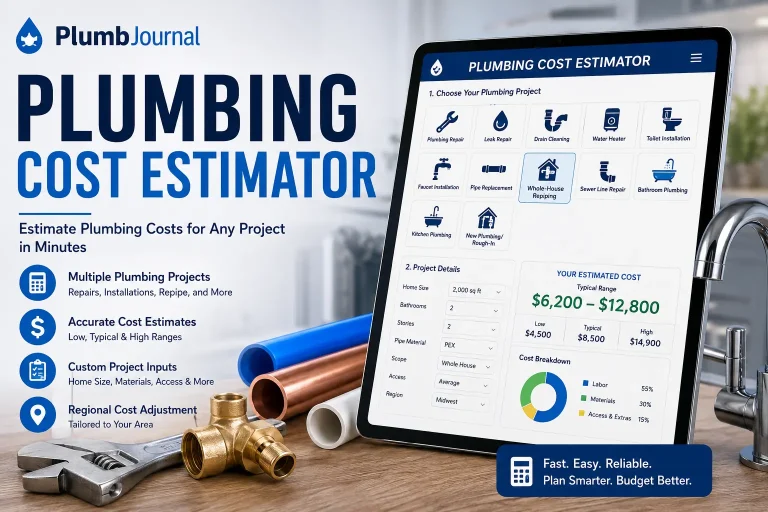
House repiping costs vary based on home size, pipe material, labor rates, accessibility, and location. Use the repipe cost calculator above to estimate a realistic planning range for your project — whether you’re pricing a whole-house repipe or a smaller partial repipe. This house repiping cost calculator uses the same transparent methodology described below, so the numbers you see match the article.
PlumbJournal Tools
Repipe Cost Calculator
Estimate your house repiping cost in about a minute. No email or sign-up required.
Fill in the details on the left, then select Calculate My Repipe Cost to see your estimated range.
Estimated Repipe Cost
$0 – $0
Estimated cost breakdown
How we estimate your repiping cost
This estimate is calculated from several factors you selected: home size, number of bathrooms, number of stories, repipe scope, pipe material, pipe accessibility, and a regional labor-cost adjustment. Each factor shifts the estimate up or down based on typical project patterns.
Real contractor quotes can differ substantially based on the condition of your existing plumbing, permit requirements, the specific layout of your home, wall/ceiling/floor restoration needs, and local market pricing at the time of your project.
Calculator estimates are for planning purposes only. Actual repiping costs vary by location, labor rates, home layout, accessibility, permits, materials, and contractor pricing. A licensed plumbing professional should provide the final project estimate.
Quick Cost Examples
These examples use the calculator's own methodology — a whole-house PEX repipe, average accessibility, and a representative regional adjustment — so the numbers stay consistent with what you'll see if you enter the same details above. Your own bathroom count, stories, material, access, and region will shift your specific range.
| Home Size | Bathrooms | Material | Estimated Range |
|---|---|---|---|
| 1,000 sq ft | 1–2 | PEX | $6,370 – $8,170 |
| 1,500 sq ft | 2 | PEX | $7,830 – $10,530 |
| 2,000 sq ft | 2–3 | PEX | $11,280 – $15,380 |
| 2,500 sq ft | 3 | PEX | $12,950 – $18,080 |
| 3,000 sq ft | 3–4 | PEX | $15,300 – $21,450 |
These are whole-house, average-access, PEX examples only — a copper repipe, difficult access, or a higher-cost region will push a given home's range higher, while easy access or a partial repipe will generally bring it down. Use the calculator above for a range built around your exact home.
How the Calculator Works
The calculator adds together a base project cost, a material cost based on your home's square footage, and a per-bathroom fixture cost — then adjusts that subtotal up or down based on your number of stories, pipe accessibility, and region, and finally scales the whole result down for a partial repipe if that's what you selected. Every factor is visible in the "How we estimate your repiping cost" section inside the calculator, so you can see exactly what's driving your number.
How Much Does It Cost to Repipe a House?
Most whole-house repiping projects fall somewhere between roughly $4,000 and $18,000+, depending heavily on home size, pipe material, and access difficulty. Small, easy-access homes with PEX piping tend to land near the lower end. Larger, multi-story homes with copper piping and difficult access — finished walls, tile, or concrete — tend to land toward the higher end or beyond it.
There is no single nationwide price for repiping a house, because the total cost is really the sum of several separate cost drivers:
- Labor: usually the largest share of the project, driven by local rates and job complexity.
- Materials: pipe, fittings, valves, and manifolds — cost varies by material choice.
- Home size: more square footage generally means more linear feet of pipe to run.
- Number of fixtures: each bathroom, kitchen, and laundry connection adds valves and labor time.
- Accessibility: open basements and crawlspaces are faster to work in than finished walls or slab foundations.
- Location: labor costs and permit requirements differ significantly by region and city.
- Permits: most jurisdictions require a permit and inspection for whole-house repiping.
- Wall and ceiling restoration: patching drywall, tile, or flooring is often billed separately from the plumbing work itself.
Because so many variables affect the final number, the most useful way to budget is to estimate a range — which is exactly what the calculator above is built to do — and then confirm the specifics with a licensed plumber who can see your actual plumbing system.
What Affects House Repiping Cost?
Home Size
Larger homes typically require more linear feet of pipe, more fittings, and more labor hours to complete a repipe. A 1,000 sq ft home and a 3,000 sq ft home aren't just different in price because of materials — the larger home usually also means longer runs between fixtures and more time spent routing pipe through walls, floors, and ceilings.
Number of Bathrooms
Each bathroom adds fixtures — sinks, tubs, showers, and toilets — that each need a supply line and shutoff valve. More bathrooms generally means more branch lines, more connections, and more labor time, even if the overall square footage doesn't change much.
Number of Stories
Multi-story homes require vertical pipe runs between floors, which can mean more cutting and patching of walls and ceilings, plus more time spent accessing tight spaces like wall cavities and soffits. A two- or three-story home often costs more to repipe than a single-story home of the same square footage.
Pipe Material
PEX, copper, and CPVC each have different material costs and installation labor requirements. PEX is flexible and can often be run faster than rigid pipe, which can reduce labor time. Copper generally costs more in both materials and labor. CPVC sits between the two in many markets, though pricing varies locally.
Accessibility
Pipes that are easy to reach — through an open basement, unfinished crawlspace, or exposed attic — are generally faster and less expensive to replace. Pipes hidden behind finished walls, ceilings, tile, or poured concrete slabs typically require cutting, patching, and sometimes specialty tools, which adds both time and cost.
Local Labor Costs
Plumbing labor rates vary significantly by metro area and region. A project that costs one amount in a lower-cost region can cost meaningfully more in a high-cost metro area, even with identical scope and materials.
Permits and Inspections
Most local building departments require a permit for whole-house repiping, and many require a follow-up inspection. Permit fees and requirements vary by city and county, so it's worth asking your contractor whether permit costs are included in their quote.
Wall and Ceiling Repairs
Plumbing contractors typically price the plumbing work itself — running new pipe, connecting fixtures, pressure testing — separately from drywall, tile, cabinetry, or paint repairs. Always confirm whether a quote includes restoration work or whether that's a separate line item or separate contractor.
Repiping Cost by Pipe Material
| Material | Relative Cost | Advantages | Considerations |
|---|---|---|---|
| PEX | Lower / Moderate | Flexible, fast installation, fewer fittings in many layouts | Needs UV protection if exposed; installation quality matters |
| Copper | Higher | Durable, long-established material | Higher material and labor cost; price can track copper markets |
| CPVC | Lower / Moderate | Familiar to many installers, often affordable | Material limitations and local code considerations vary |
No single material is universally "best." The right choice depends on your budget, local plumbing codes, water conditions, and what your plumber recommends for your specific home.
PEX vs. Copper Repiping Cost
PEX often costs less to install than copper for two main reasons: the material itself is generally less expensive, and its flexibility can reduce the number of fittings and the amount of time needed to route pipe through walls and framing. Copper, by contrast, is rigid and typically requires more joints, more precise measuring, and more labor time — which adds to the total project cost.
Accessibility affects this comparison too. In homes with difficult access, the labor-time savings from PEX's flexibility can become even more noticeable. Long-term considerations matter as well: some homeowners weigh copper's track record against PEX's faster, often lower-cost installation. Local plumbing codes, water chemistry, and installer expertise and preference should also factor into the decision — a conversation worth having directly with a licensed plumber.
For a deeper comparison of performance, longevity, and cost, see PlumbJournal's guide: PEX vs Copper.
Repiping Cost by House Size
Square footage is one input into your estimate — not the only one. Two homes of the same size can have very different repiping costs depending on the number of bathrooms, stories, accessibility, and material chosen. The ranges below reflect typical whole-house PEX repipes and are meant as a starting reference; use the calculator above for a range tailored to your specific home.
1,000 sq ft
Smaller homes generally have shorter pipe runs and fewer fixtures, which tends to keep whole-house repiping costs toward the lower end of typical ranges — though bathroom count and access still matter.
1,500 sq ft
A common single-family home size. Costs here depend heavily on bathroom count and whether the home is one or two stories.
2,000 sq ft
At this size, homes often have 2–3 bathrooms and may span two stories, both of which push the estimate upward compared to a similarly sized single-story home.
2,500 sq ft
Larger homes in this range often include more bathrooms and longer pipe runs, and multi-story layouts become more common.
3,000 sq ft
Larger homes typically see higher totals due to increased pipe length, fixture count, and often more complex access — though the per-square-foot rate doesn't necessarily increase.
Partial vs. Whole-House Repiping
Partial Repiping
Partial repiping replaces only specific sections or branches of the plumbing system — for example, pipes serving one bathroom, one problem area, or a known section of failing pipe. It's typically less expensive than a whole-house repipe and can make sense when problems are isolated to a specific part of the home.
Whole-House Repiping
Whole-house repiping replaces most or all of the domestic water supply piping throughout the home. It's often considered when a home has widespread corrosion, recurring leaks in multiple locations, aging pipe materials known for failure, or when a homeowner wants to address the entire system at once rather than repeatedly repairing individual sections.
Homeowners sometimes start with a partial repipe to address an urgent issue, then plan a whole-house repipe later. Others choose to repipe the whole house at once to avoid repeated disruption. Either approach can be reasonable depending on the condition of your plumbing and your budget — a licensed plumber can help you weigh the tradeoffs for your specific situation.
When Should You Repipe a House?
Consider having your plumbing evaluated by a professional if you notice:
- Repeated leaks, especially in different locations over time
- Visibly corroded, pitted, or deteriorating pipes
- Persistent low water pressure that isn't explained by a simple fixture issue
- Discolored water associated with pipe corrosion
- Frequent plumbing repairs that keep recurring
- An aging plumbing system nearing or beyond its typical service life
- Multiple pipe problems happening around the same time
These signs don't automatically mean your home needs a full repipe — but they're worth having a licensed plumber inspect in person. A remote diagnosis isn't reliable; an on-site evaluation is the only way to know what's actually happening inside your walls and under your slab.
How to Reduce Repiping Costs
- Get multiple estimates from licensed plumbing contractors before deciding.
- Ask exactly what's included — materials, labor, permits, testing, and cleanup.
- Confirm whether permits are included in the quoted price or billed separately.
- Ask whether drywall, tile, or flooring restoration is included, or whether you'll need a separate contractor.
- Compare material options and ask your plumber to explain the tradeoffs for your home.
- Ask about warranties on both materials and labor.
- Plan access in advance — clearing space around walls, closets, or crawlspace entry points can reduce labor time.
- Avoid choosing a contractor solely on the lowest bid — compare scope, materials, and reputation together.
When to Hire a Professional Plumber
Whole-house repiping is a significant plumbing project that affects your home's entire water supply system. It's worth getting a professional, on-site evaluation when:
- You've had multiple leaks in different areas of the home
- Pipes are visibly corroded or deteriorating
- Your plumbing system is old and nearing the end of its typical service life
- You're experiencing ongoing water pressure problems
- You're planning a major renovation that will expose plumbing anyway
- A large portion of your plumbing system needs replacement rather than a single repair
A licensed plumber can inspect your specific system, explain your options, and provide a detailed quote based on the actual condition and layout of your home.
Frequently Asked Questions
How much does it cost to repipe a house?
Most whole-house repiping projects cost roughly $4,000 to $18,000 or more, depending on home size, pipe material, number of bathrooms, accessibility, and local labor rates. Use the calculator above for an estimate based on your home's specifics.
How much does it cost to repipe a 2,000 sq ft house?
A 2,000 sq ft home's repipe cost depends on bathroom count, number of stories, material choice, and access difficulty. Enter 2,000 sq ft into the calculator above along with your other details for a tailored estimate.
Is PEX cheaper than copper for repiping?
PEX is often less expensive to install than copper, due to lower material cost and typically faster installation. However, exact pricing depends on your local market, home layout, and installer.
How long does it take to repipe a house?
Timelines vary based on home size, accessibility, and scope, but many whole-house repiping projects take several days to about a week or more, plus any additional time for wall or ceiling restoration.
Is it cheaper to repipe or repair?
A single, isolated repair is usually cheaper upfront than a full repipe. However, if a home has recurring leaks or widespread pipe deterioration, repeated repairs can add up over time, which is why some homeowners choose a full or partial repipe instead. A licensed plumber can help you compare the two paths for your situation.
Does homeowners insurance cover repiping?
It depends on your specific policy, the cause of the damage, and any applicable exclusions. Some policies may cover sudden, accidental damage but exclude gradual wear, corrosion, or lack of maintenance. Check with your insurance provider to understand what your policy covers before assuming repiping costs will be reimbursed.
Does repiping include drywall repair?
Not always. Many plumbing contractors price the plumbing work separately from drywall, tile, or flooring restoration. Always ask your contractor whether restoration work is included in your quote or billed separately.
How long does house repiping last?
Lifespan varies by material, water conditions, and installation quality. Properly installed modern piping materials are generally designed for decades of service, but no material is guaranteed to last a specific number of years in every situation. Ask your plumber about manufacturer and installer warranties.
Related PlumbJournal Resources
About This Calculator
This repipe cost calculator is designed to help homeowners understand the factors that influence house repiping costs and get a realistic planning range before contacting a contractor. It's intended for budgeting and research — not as a substitute for an on-site plumbing estimate.
Editorial team: PlumbJournal Editorial Staff
Last updated: [17 August 2026]
Methodology: See "How we estimate your repiping cost" inside the calculator above.
Calculator estimates are for planning purposes only. Actual repiping costs vary by location, labor rates, home layout, accessibility, permits, materials, and contractor pricing. A licensed plumbing professional should provide the final project estimate.