What Is PEX Plumbing? A Guide to PEX Pipe, Types, Uses & Pros and Cons
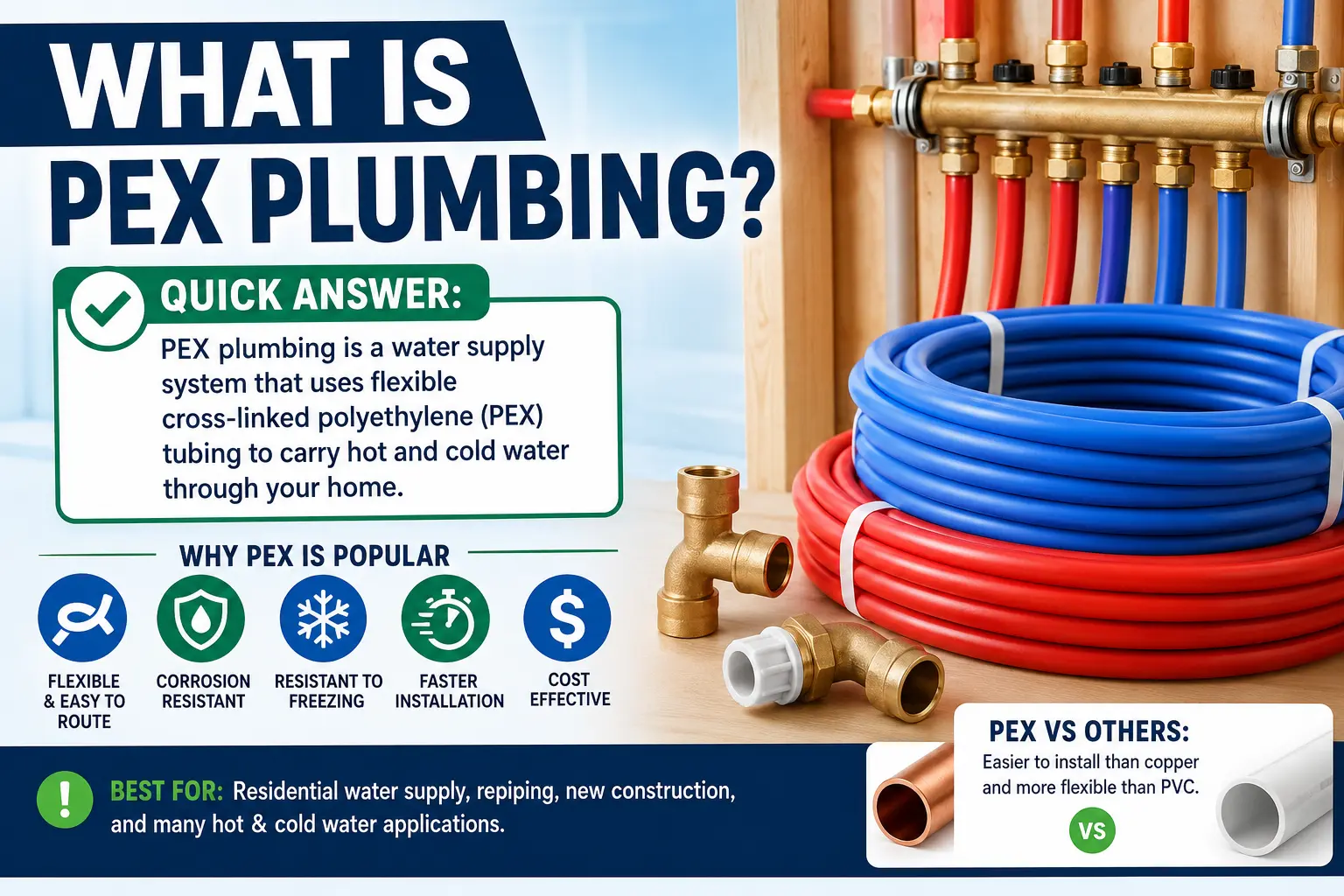
PEX plumbing is a water-supply system that uses flexible cross-linked polyethylene (PEX) tubing to carry hot and cold water around a home or building. PEX is popular because it is flexible, lightweight, corrosion-resistant, and easier to route than rigid pipe. Approved PEX tubing can be used for potable water when it meets the required standards and is installed correctly.
If you have seen red, blue, or white flexible tubing under a sink, behind a wall, or in a basement, you may already have PEX plumbing.
But what exactly is PEX? How does it work? Is it better than copper? What do PEX-A, PEX-B, and PEX-C mean? And is PEX safe for drinking water?
This guide explains PEX plumbing in simple terms so you can decide whether it is right for your home.
PEX Plumbing at a Glance
Here is a quick overview of what PEX plumbing is, where it is used, and how it compares with other common plumbing materials.
| Feature | PEX Plumbing |
|---|---|
| Full name | Cross-linked polyethylene |
| Material | Flexible plastic polymer |
| Main use | Hot and cold water distribution |
| Flexibility | High |
| Corrosion resistance | Excellent |
| Common colors | Red, blue, and white |
| Common sizes | 3/8", 1/2", 3/4", 1" and others |
| Hot-water use | Yes, when properly rated |
| Cold-water use | Yes |
| Drinking-water use | Yes, when the product is approved or certified for potable-water use |
| Main types | PEX-A, PEX-B, and PEX-C |
| Common connections | Crimp, cinch/clamp, expansion, and other approved systems |
| Main advantage | Flexible and easy to route |
| Main limitation | UV exposure and application-specific installation requirements |
| Compared with copper | Usually easier to route and install |
| Compared with PVC | More flexible and commonly used for water distribution |
| Best for | Residential water supply, repiping, new construction, and many hot- and cold-water applications |
What Is PEX Plumbing?
PEX plumbing is a plumbing system that uses cross-linked polyethylene tubing to distribute water.
Unlike rigid copper or plastic pipes, PEX tubing can bend around many obstacles. It can also be installed in long runs with fewer directional fittings in some layouts.
PEX is primarily used for water supply and distribution, including hot and cold water lines.
A typical PEX plumbing system may contain:
- PEX tubing
- Fittings
- Valves
- Manifolds
- Crimp rings or clamps
- Expansion rings
- Adapters
- Shutoff valves
- Connections to fixtures and appliances
So, PEX pipe is the tubing itself, while PEX plumbing refers to the larger water distribution system that uses that tubing.
The 2024 International Plumbing Code recognizes PEX tubing for water distribution when it meets the applicable standards, including ASTM F876 and CSA B137.5. It also requires compatible fittings and manufacturer-directed installation.
What Does PEX Stand For?
PEX stands for cross-linked polyethylene.
Polyethylene is a type of plastic. During manufacturing, the polymer chains are cross-linked to create tubing with properties that make it suitable for plumbing applications.
This gives PEX a useful combination of:
- Flexibility
- Strength
- Temperature resistance
- Pressure resistance
- Chemical resistance
- Freeze/thaw resilience
The exact properties vary between PEX products and manufacturing methods, so the tubing’s markings and manufacturer’s specifications still matter.
What Is PEX Pipe Made Of?
PEX pipe is made from cross-linked polyethylene plastic.
It is not the same thing as ordinary polyethylene pipe.
The cross-linking process changes the structure of the polyethylene and gives PEX its combination of flexibility and durability.
Different manufacturing methods produce different PEX classifications, which is why you will see names such as:
- PEX-A
- PEX-B
- PEX-C
These letters refer primarily to the manufacturing method, not a simple quality ranking.
That is important.
PEX-A is not automatically “better” than PEX-B for every plumbing project.
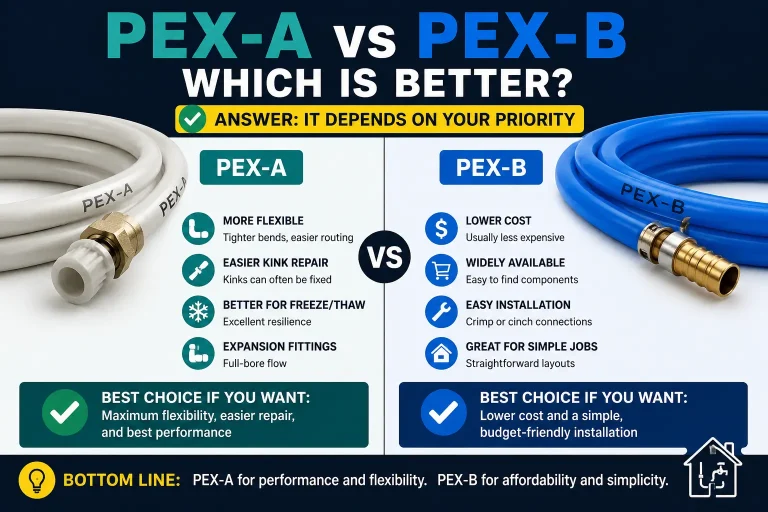
Related Post: PEX-A vs PEX-B?
The right choice depends on the application, fitting system, installation method, cost, and product specifications.
How Does PEX Plumbing Work?
PEX plumbing works in much the same basic way as other water-supply systems: pressurized water travels through tubing from the water source to individual fixtures.
A simplified system looks like this:
Main water supply → shutoff valve → manifold or branch system → PEX tubing → fixture
The fixture could be:
- Kitchen faucet
- Bathroom faucet
- Shower
- Toilet
- Washing machine
- Water heater
- Dishwasher
- Other approved water-using equipment
The flexibility of PEX allows the tubing to be routed through walls, floors, ceilings, and framing spaces.
Modern PEX design guidance covers several system layouts, including manifold-based and other distribution arrangements.
What Is a PEX Manifold?
A PEX manifold is a central distribution point that sends water to different fixtures or areas of a building.
Think of it like an electrical breaker panel.
Instead of one large line branching repeatedly throughout the house, a manifold can provide separate PEX runs to individual fixtures or groups of fixtures.
For example:
Main supply
↓
PEX manifold
↙ ↓ ↓ ↘
Kitchen | Bathroom | Laundry | Water heater
One benefit of this approach is that individual lines can often be shut off without shutting down the entire home’s water supply.
However, the best layout depends on the home’s design, water demand, pipe sizing, and applicable code.

PEX Plumbing vs PEX Pipe: What’s the Difference?
These terms are closely related but are not exactly the same.
| Term | Meaning |
|---|---|
| PEX | The cross-linked polyethylene material |
| PEX tubing/pipe | The physical tubing made from PEX |
| PEX plumbing | The complete water distribution system using PEX |
| PEX fitting | A component used to connect PEX tubing |
| PEX manifold | A distribution device that sends water to different lines |
So when someone says:
“This house has PEX plumbing.”
They usually mean the home’s water distribution system uses PEX tubing and compatible components.
What Is PEX Used For?
PEX is primarily used for water supply and distribution.
Common applications include:
| Application | PEX Use |
|---|---|
| Cold-water supply | Yes |
| Hot-water supply | Yes, with properly rated tubing |
| Bathroom supply lines | Yes |
| Kitchen plumbing | Yes |
| Laundry plumbing | Yes |
| Whole-house repiping | Yes |
| New residential construction | Yes |
| Building water distribution | Yes |
| Water service | Some approved products/applications |
| Radiant heating | Specialized PEX products |
| Outdoor exposed piping | Generally unsuitable for standard PEX |
| Drain/waste piping | No; use appropriate DWV materials |
The 2026 PEX design guide specifically covers hot- and cold-water distribution systems and also includes a chapter on PEX water service and building supply lines.
Types of PEX Pipe: PEX-A vs PEX-B vs PEX-C
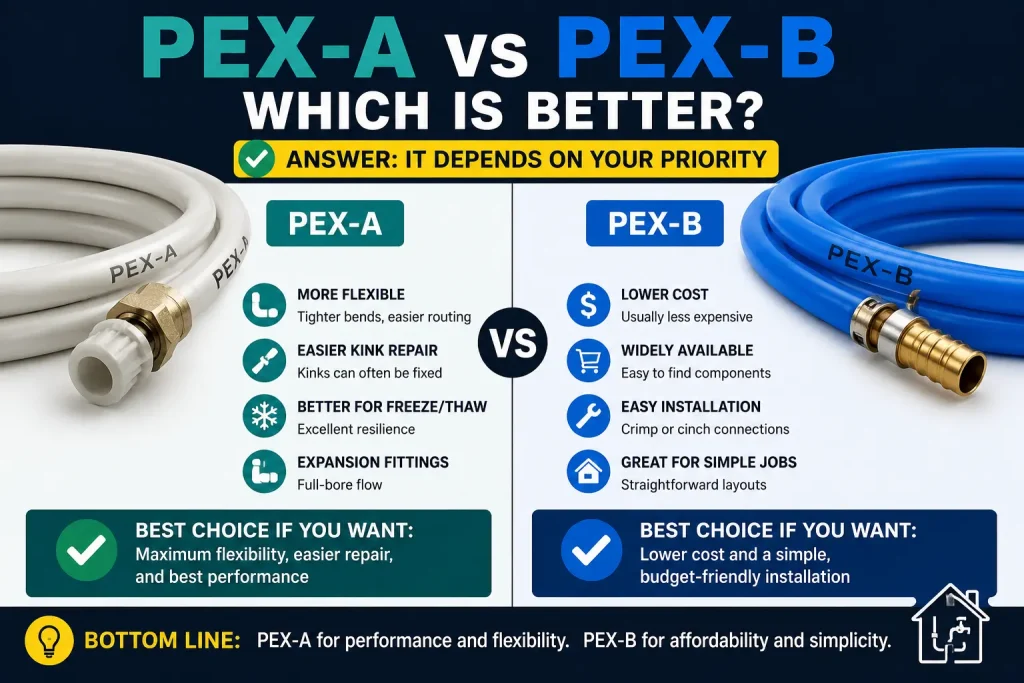
There are three main classifications of PEX tubing:
- PEX-A
- PEX-B
- PEX-C
The letters identify different manufacturing processes.
They do not mean that PEX-A is always the best, PEX-B is always second-best, and PEX-C is always the worst.
PEX-A
PEX-A is manufactured using the Engel or peroxide method.
It is generally the most flexible of the three common PEX types.
Common characteristics:
- Very flexible
- Tight bend radius
- Strong elastic memory
- Often compatible with expansion fitting systems
- Kinks may be repairable with controlled heat when permitted by the manufacturer
- Usually costs more
PEX-B
PEX-B is commonly manufactured using a silane/moisture-cure process.
It is generally stiffer than PEX-A.
Common characteristics:
- Less flexible than PEX-A
- Usually less expensive
- Widely available
- Commonly used with crimp or cinch systems
- Good choice for straightforward plumbing layouts
PEX-C
PEX-C is manufactured using an irradiation process.
It can be used in plumbing applications where the specific product is approved for the intended use.
PEX-C is generally less common in consumer discussions than PEX-A and PEX-B.
PEX-A vs PEX-B vs PEX-C
| Feature | PEX-A | PEX-B | PEX-C |
|---|---|---|---|
| Manufacturing method | Engel/peroxide | Silane/moisture cure | Irradiation |
| Flexibility | Highest, generally | Good | Generally lower than PEX-A |
| Bend radius | Tight | Larger | Larger |
| Common connection systems | Expansion and others | Crimp/cinch and others | Product/system dependent |
| Kink repair | Often possible with compatible products | Usually cut and repair | Product-dependent |
| Typical cost | Higher | Lower | Varies |
| Availability | Good | Very good | More limited in many markets |
| Best-known advantage | Flexibility | Value and availability | Alternative manufacturing option |
How Is PEX Plumbing Connected?
PEX does not use one universal connection method.
Common systems include:
Crimp connections
A metal crimp ring is compressed around the PEX tubing and fitting.
Cinch or clamp connections
A clamp is tightened around the tubing and fitting using a cinch tool.
Expansion connections
The end of compatible PEX tubing is expanded so an expansion fitting can be inserted. The tubing then contracts around the fitting.
Push-to-connect fittings
Some approved push-fit fittings can be used with PEX.
Important: Do not assume that every fitting works with every PEX product. The 2024 IPC requires PEX fittings to comply with applicable standards and states that they should be installed according to the manufacturer’s instructions.
What Sizes Does PEX Come In?
PEX tubing is available in different nominal sizes.
Common residential sizes include:
- 3/8 inch
- 1/2 inch
- 3/4 inch
- 1 inch
Larger sizes are also available.
Does Bigger PEX Always Mean Better Water Flow?
No.
Pipe sizing depends on factors such as:
- Water pressure
- Fixture demand
- Number of fixtures
- Pipe length
- Fittings
- System design
- Local plumbing code
So you should not simply replace 1/2-inch tubing with 1-inch tubing and assume the system will automatically perform better.
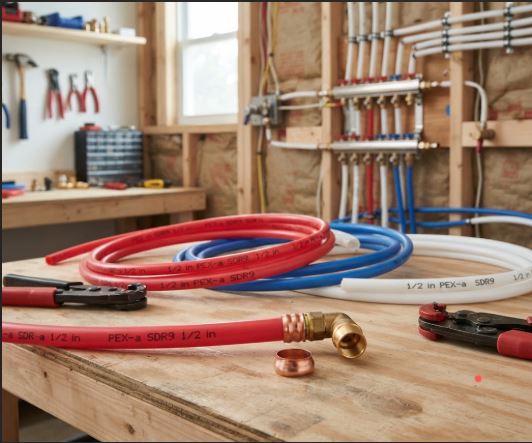
What Do Red and Blue PEX Pipes Mean?
You will commonly see:
- Red PEX for hot water
- Blue PEX for cold water
- White PEX for either hot or cold water
But the color is mainly a visual identification aid.
The color itself does not determine whether the tubing can handle hot water.
Always check the tubing’s markings and ratings.
For example, a red tube is not automatically suitable for every hot-water application just because it is red.
Is PEX Safe for Drinking Water?
Yes, PEX can be used for drinking-water systems when the specific product is approved or certified for potable-water use and installed according to applicable requirements.
This distinction is important.
Don’t assume that every plastic tube labeled “PEX” is automatically approved for every application.
The 2024 International Plumbing Code states that water distribution pipe and tubing must conform to NSF 61 and applicable material standards. It specifically lists PEX tubing under ASTM F876 and CSA B137.5.
The International Residential Code similarly requires water distribution piping in dwelling units to conform to NSF 61 and applicable standards.
What should you check?
Before using PEX for drinking water, check:
- Product certification
- Tubing markings
- Temperature and pressure ratings
- Fitting compatibility
- Manufacturer instructions
- Local plumbing requirements
The important point: “PEX is safe” is too broad. The correct statement is that properly approved PEX products can be used for potable-water applications.
Can PEX Be Used for Hot Water?
Yes. Properly rated PEX tubing can be used for hot-water distribution.
PEX is commonly used for both:
- Hot-water lines
- Cold-water lines
However, the tubing must have the appropriate temperature and pressure rating for the application.
The 2024 IPC specifies that hot-water distribution pipe and tubing must have a pressure rating of at least 100 psi at 180°F (82°C) under the code’s requirements.
That does not mean every PEX product should automatically be exposed to those conditions. Always follow the rating printed on the product and the manufacturer’s instructions.
Does PEX Freeze or Burst?
PEX has better freeze/thaw resilience than many rigid pipes, but that does not mean it is freeze-proof.
When water freezes, it expands.
PEX can tolerate some of that expansion because the tubing is flexible. Rigid materials have less ability to accommodate that movement.
But a frozen PEX plumbing system can still experience damage.
Fittings and connections can be particularly important because the entire system does not expand in exactly the same way.
Simple rule:
PEX is more freeze-resistant, not freeze-proof.
If your home is exposed to freezing temperatures, proper insulation and freeze protection are still important.
Can PEX Be Used Outdoors?
Standard PEX should not be treated as an exposed outdoor pipe.
The main concern is prolonged exposure to ultraviolet light from the sun.
UV exposure can degrade PEX over time.
If PEX is being used in an area where sunlight could reach it, check the specific product’s UV exposure limitations and installation instructions.
For outdoor or underground applications, use a product specifically approved for that application rather than assuming ordinary indoor PEX is suitable.
Advantages of PEX Plumbing
PEX became popular for several practical reasons.
1. PEX Is Flexible
You can bend PEX around many obstacles instead of installing a fitting at every change of direction.
That can make installation easier in walls, ceilings, floors, and tight spaces.
2. It Is Lightweight
PEX is much easier to carry and handle than many rigid pipe materials.
3. It Resists Corrosion
PEX does not rust like metal pipe.
That makes it useful in environments where corrosion can be a concern.
4. It Can Be Installed in Long Runs
Depending on the design, long continuous runs can reduce the number of fittings needed.
Fewer connections can also mean fewer potential connection points for leaks.
5. It Works for Hot and Cold Water
Properly rated PEX can be used in hot- and cold-water distribution systems. The current PEX industry guide specifically covers both applications.
6. It Handles Freezing Better Than Many Rigid Pipes
Its flexibility gives PEX greater freeze/thaw resilience than many rigid materials.
7. It Is Easy to Route
This is one of its biggest advantages during remodeling.
Instead of cutting and joining rigid pipe at every turn, an installer can often route flexible PEX through available spaces.
Disadvantages of PEX Plumbing
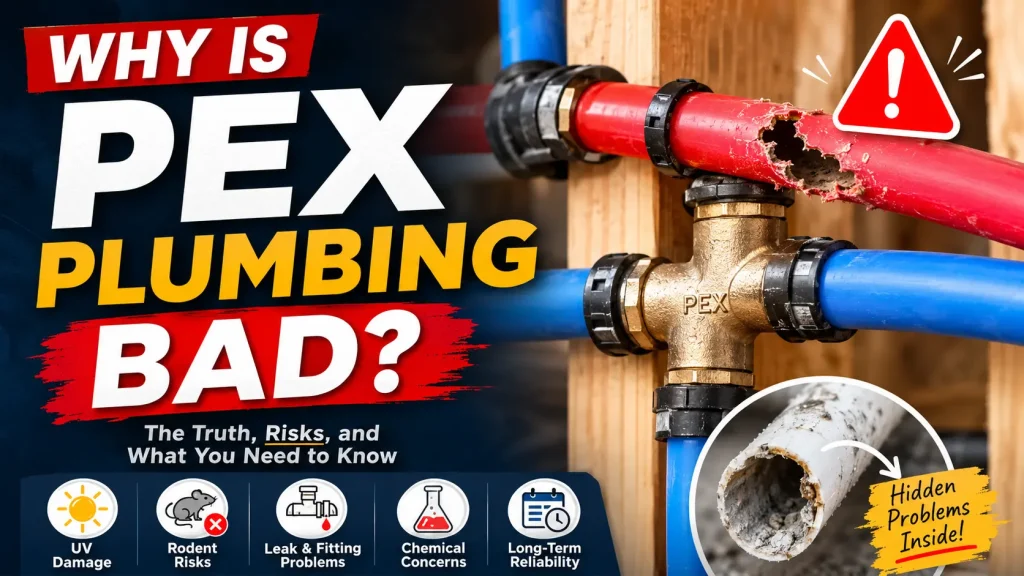
PEX is useful, but it is not perfect. Because;
1. UV Exposure Is a Concern
Standard PEX should not be left exposed to sunlight beyond the product’s permitted exposure limits.
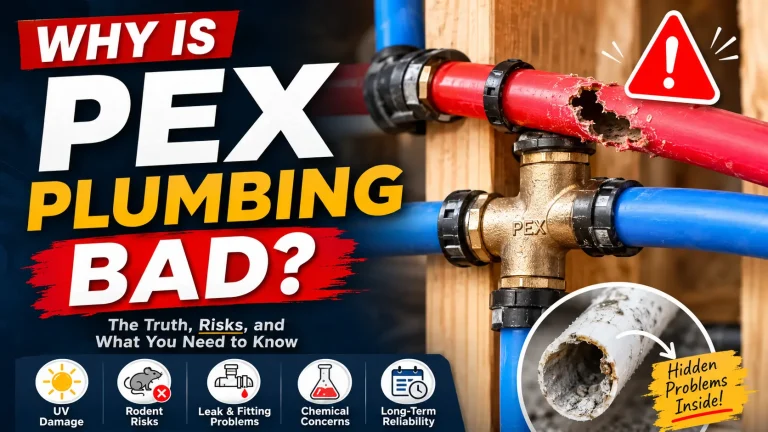
2. Rodent Damage Can Be a Concern
Like other plastic tubing, PEX can be damaged by rodents in certain environments.
Also read: why is pex plumbing bad
3. Fittings Still Matter
A high-quality tube does not make an incompatible or poorly installed fitting safe.
4. Installation Must Be Correct
Incorrect bends, supports, connections, or tubing selection can create problems.
5. Different PEX Systems Are Not Automatically Interchangeable
Don’t assume a fitting or connection tool works with every PEX tube.
6. PEX Is Not Suitable for Every Plumbing Application
PEX is primarily used for water distribution. It should not simply be substituted for drainage, vent, or other piping without checking the application’s requirements.
PEX vs Copper vs PVC vs CPVC
This is one of the most important comparisons for a homeowner.
| Feature | PEX | Copper | PVC | CPVC |
|---|---|---|---|---|
| Material | Cross-linked polyethylene | Metal | PVC plastic | Chlorinated PVC |
| Flexibility | High | Low | Low | Low |
| Corrosion resistance | Excellent | Can corrode | Excellent | Excellent |
| Typical water-supply use | Yes | Yes | Application/code dependent | Yes |
| Hot-water use | Yes, when rated | Yes | Application dependent | Yes |
| Easy to route around obstacles | Excellent | Difficult | Difficult | Difficult |
| Long continuous runs | Excellent | Limited by installation | Limited | Limited |
| Common connection methods | Crimp, cinch, expansion, etc. | Solder, press, compression, etc. | Solvent cement and other approved methods | Solvent cement and other approved methods |
| Weight | Light | Heavy | Light | Light |
| Freeze/thaw resilience | Good | Lower | Lower | Lower |
| Common advantage | Flexibility | Durability and long history | Rigid plastic piping | Hot-water capability |
| Main limitation | UV/application limitations | Cost and installation labor | Rigid | Rigid and temperature/application limits |
Which is better?
There is no universal winner.
Choose PEX when flexibility, easier routing, and efficient installation are important.
Choose copper when the application, design, preference, or local requirements favor copper.
PVC and CPVC have their own applications and requirements.
The 2024 IPC recognizes multiple materials for water distribution, including PEX, copper, CPVC, PVC, and others, subject to their applicable standards and requirements.
PEX Plumbing Tools: What Do You Need?
Your tools depend on the connection system.
| Tool | PEX-A Expansion | PEX-B Crimp/Cinch |
|---|---|---|
| Tubing cutter | Yes | Yes |
| Expansion tool | Yes for expansion systems | No |
| Expansion rings | Yes for expansion systems | No |
| Crimp tool | System-dependent | Common |
| Crimp rings | System-dependent | Common |
| Cinch tool | System-dependent | Common |
| Cinch clamps | System-dependent | Common |
| Deburring/calibration tools | Product/system-dependent | Product/system-dependent |
Buying tools for one project?
Don’t compare only the price of the tubing.
Compare the complete system:
Tubing + fittings + rings/clamps + tools + adapters
A cheaper roll of PEX can become the more expensive choice if the connection system requires tools or fittings you do not already own.
How Is PEX Plumbing Installed?
A basic PEX installation generally follows this sequence:
1. Plan the system
Determine where the water lines will run and which fixtures they will serve.
2. Choose the correct tubing
Select the appropriate size, rating, and approved application.
3. Cut the tubing
Make a clean, square cut using the correct tubing cutter.
4. Route the tubing
Run the PEX through the planned path while respecting bend and support requirements.
5. Connect the fittings
Use the connection system approved for the tubing and fitting combination.
6. Secure the tubing
Support the tubing as required by the installation instructions and applicable code.
7. Pressure-test the system
Test the completed system according to the applicable requirements.
8. Inspect everything
Check connections, supports, routing, and exposed sections before closing walls or ceilings.
The 2026 PEX Design and Installation Guide has dedicated sections covering joining systems, layouts and design, optimization, performance, installation, and water service.
Common PEX Plumbing Mistakes
If you are installing or inspecting PEX, watch for these mistakes.
1. Using the wrong fitting
PEX fittings need to be approved for the tubing and application.
2. Assuming every PEX system works together
Connection systems have specific requirements.
3. Leaving standard PEX in prolonged sunlight
UV exposure can damage the tubing.
4. Making bends that are too tight
Follow the tubing manufacturer’s minimum bend radius.
5. Using damaged tubing
Do not install tubing with serious cuts, abrasions, or other damage.
6. Ignoring tubing markings
The markings provide important information about the product, standards, ratings, and intended use.
7. Choosing pipe size by guesswork
Water demand and system design determine appropriate sizing.
8. Assuming red means “hot-water rated”
Color is mainly used for identification. Always check the actual product rating.
9. Assuming PEX is freeze-proof
It is more freeze-resistant than many rigid pipes, but freezing can still cause damage.
10. Ignoring local plumbing code
Plumbing requirements can vary by jurisdiction.
How Long Does PEX Plumbing Last?
PEX does not have one universal lifespan that applies to every installation.
Service life depends on factors such as:
- Temperature
- Pressure
- Water chemistry
- UV exposure
- Installation quality
- Product quality
- Fittings
- Operating conditions
The PEX industry has decades of North American plumbing experience, and the 2026 PEX guide reflects updated information about materials, fittings, design, installation, and code acceptance.
So rather than promising an exact number of years for every PEX system, it is better to say:
Properly selected and installed PEX can provide long-term service, but its actual service life depends on the product and operating conditions.
Can PEX Connect to Copper?
Yes. PEX can be connected to copper using an appropriate transition fitting.
For example, a plumbing system can contain both copper and PEX.
The connection must use a fitting approved for the materials being joined and must be installed according to the manufacturer’s instructions and applicable code.
This is useful during remodeling because you do not always need to replace every section of an existing copper system just because you are adding PEX.
Can PEX Connect to PVC?
PEX and PVC can also be connected as part of a plumbing system, but they are not normally joined directly to each other like two pieces of the same pipe.
A compatible transition fitting is typically used.
The exact connection depends on the system and application.
Remember:
PEX and PVC are different piping materials with different connection methods and applications.
Is PEX Good for a Whole-House Repiping?
PEX can be an excellent option for whole-house water-supply repiping when the product and installation meet the project’s requirements.
It can be especially useful when:
- Existing pipes are difficult to access
- Walls contain many obstacles
- Long flexible runs are helpful
- You want to reduce rigid-pipe connections
- A manifold system makes sense
- The local code permits the selected PEX system
But whole-house repiping should be designed around:
- Water pressure
- Fixture demand
- Pipe sizing
- Layout
- Fittings
- Temperature
- Existing plumbing
- Local code
The PEX industry guide specifically addresses residential plumbing design, layouts, installation, and water service.
PEX Plumbing: Pros and Cons at a Glance
PEX plumbing offers several advantages, especially flexibility and easy installation, but it also has limitations. Here’s a quick comparison of the main pros and cons.
| Pros | Cons |
|---|---|
| Very flexible | Sensitive to UV exposure |
| Lightweight | Can be damaged by rodents |
| Easy to route | Installation quality matters |
| Corrosion-resistant | Fittings must be compatible |
| Good freeze/thaw resilience | Not suitable for every application |
| Works for hot and cold water when properly rated | Different connection systems have different requirements |
| Can use long continuous runs | Product ratings must be checked |
| Often faster to install | Local plumbing code still applies |
| Suitable for many repiping projects | Not a universal replacement for every pipe |
Is PEX Plumbing Right for Your Home?
Use this quick guide.
| If your priority is… | PEX may be a good choice |
|---|---|
| Flexible pipe | Yes |
| Easy routing through walls | Yes |
| Residential repiping | Often |
| Hot and cold water | Yes, when properly rated |
| Corrosion resistance | Yes |
| Lightweight installation | Yes |
| Tight remodeling spaces | Often |
| Long continuous runs | Often |
| Traditional exposed metal piping | Copper may be preferable |
| Drainage and sewer piping | No |
| Prolonged outdoor UV exposure | No for standard PEX |
The simple decision
Choose PEX when you want a flexible, lightweight water-supply material that is easy to route through a building.
Consider other materials when the application, exposure, design, local code, or project requirements make another material more appropriate.
Final Verdict:
PEX plumbing is a water distribution system that uses flexible cross-linked polyethylene tubing to carry hot and cold water throughout a building.
Its biggest advantages are flexibility, corrosion resistance, lightweight handling, and easy routing. PEX can be used for many residential water-supply applications, including new construction and repiping, when the tubing and fittings are approved for the application.