
How to Tell PEX-A From PEX-B: 5 Easy Ways to Identify It
If you need to know whether your plumbing uses PEX-A or PEX-B, start by looking at the printing on the tubing. The manufacturer, product name, PEX designation, standards, and other information printed along the pipe are usually more reliable than color, flexibility, or the type of fitting you see.
If the printing is difficult to read, you can use the existing fitting and the physical characteristics of the tubing as additional clues.
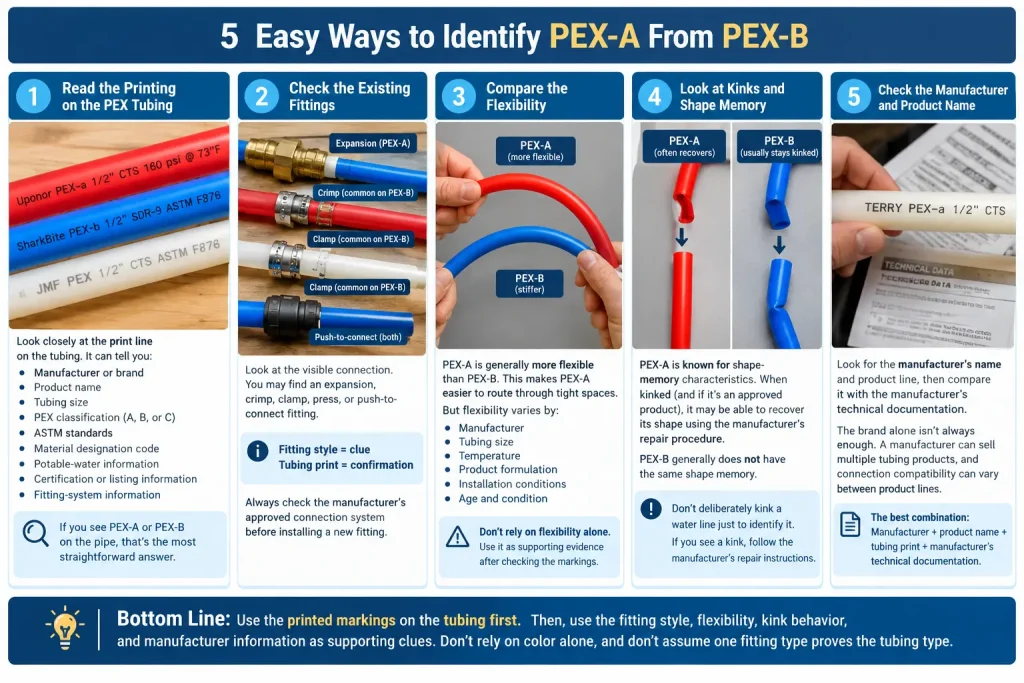
Here are the five practical ways to identify PEX-A or PEX-B:
- Read the markings on the pipe.
- Check the existing fitting system.
- Compare the tubing’s flexibility.
- Look at how it behaves around kinks.
- Use the manufacturer and product information to confirm it.
Quick Answer
The most reliable way to identify PEX-A or PEX-B is to read the printed markings on the tubing. Look for the manufacturer, product name, PEX designation, standards, and other identification information printed along the pipe.
If the markings are unavailable, use the existing fitting, flexibility, kink behavior, and manufacturer information as supporting clues.
| Identification clue | What you may notice | Reliability |
|---|---|---|
| Tubing markings | Manufacturer, product name, PEX designation and other printed information | Best |
| Manufacturer information | Product documentation can confirm the tubing type and approved fittings | Very high |
| Existing fitting | Expansion, crimp, clamp or another connection system | Useful clue |
| Flexibility | PEX-A is generally more flexible; PEX-B is generally stiffer | Supporting clue |
| Kink behavior | PEX-A commonly has stronger shape-memory characteristics | Supporting clue |
| Pipe color | Red, blue and white can all be used for different PEX products | Not reliable |
The important point is that PEX-A and PEX-B are manufacturing classifications, not quality grades. The letters describe how the polyethylene was cross-linked during manufacturing. They do not automatically tell you which tubing is better.
5 Easy Ways to Identify It
1. Read the Printing on the PEX Tubing
The first thing to do is look closely at the outside of the pipe.
PEX tubing normally has a continuous print line running along its length. Depending on the manufacturer and product, that print can contain information such as:
- Manufacturer or brand
- Product name
- Tubing size
- PEX classification
- ASTM standards
- Material designation code
- Potable-water information
- Certification or listing information
- Fitting-system information
If you can see the actual PEX-A or PEX-B designation, that is the most straightforward answer.
For example, manufacturer documentation may identify a particular product as PEX-a and list the standards and connection systems for which it is approved.
Uponor’s explanation of its PEX-a print string shows how much useful information can be contained in the tubing print line.
What if I see ASTM F876?
Don’t assume that ASTM F876 means PEX-A.
ASTM F876 is a specification for PEX tubing. It does not simply mean “this is PEX-A.” PEX-A, PEX-B, and PEX-C products can meet the applicable PEX standards.
The same applies to the four-digit material designation printed on PEX tubing.
2. Check the Existing Fittings
If the pipe markings are hidden or difficult to read, look at a visible connection.
You may find an:
- Expansion fitting
- Crimp fitting
- Stainless-steel clamp or cinch fitting
- Press connection
- Push-to-connect fitting
An expansion-style connection is a strong clue that you’re dealing with a PEX system designed for expansion connections. PEX-A is commonly used with expansion systems because of its elastic memory.
A crimp or clamp connection is commonly found on PEX-B installations. However, don’t treat the fitting as absolute proof of the tubing type.
That’s because connection compatibility is product- and system-specific. Some PEX-A products can be used with crimp or clamp connections, and the fact that a crimp fitting is installed does not automatically prove the pipe is PEX-B.
The safer approach is:
Fitting = clue → tubing print = confirmation
If you’re replacing a fitting, always check the tubing manufacturer’s approved connection system rather than choosing a fitting based only on whether the pipe looks like PEX-A or PEX-B.
For more background, see our guide to what PEX plumbing is and our detailed guide to PEX pipe fittings.
3. Compare the Flexibility
PEX-A is generally more flexible than PEX-B.
That’s one of the noticeable differences you may find when handling the two types of tubing. PEX-A’s manufacturing process gives it strong elastic memory, which is useful when routing tubing through tight spaces.
PEX-B is generally somewhat stiffer.
But here’s the important part:
Don’t use flexibility as your only identification test.
The feel of PEX can vary with:
- Manufacturer
- Tubing size
- Temperature
- Product formulation
- Installation conditions
- Age and condition of the tubing
A very flexible piece of PEX is not automatically PEX-A, and a relatively stiff piece is not automatically PEX-B.
Use flexibility as supporting evidence after checking the printed markings.
4. Look at Kinks and Shape Memory
Kink behavior can provide another clue.
PEX-A is known for its shape-memory characteristics. When an approved PEX-A product is kinked, the tubing may be capable of recovering its shape using the manufacturer’s specified repair procedure.
PEX-B generally does not have the same shape-memory behavior.
This is one reason PEX-A is popular for installations where the tubing needs to make tighter bends.
However, don’t deliberately kink an installed water line just to identify it.
If you’re looking at an existing kink, treat its behavior as supporting evidence rather than a definitive identification method.
And if you need to repair a kinked PEX line, follow the tubing manufacturer’s repair instructions rather than assuming that every PEX product can be repaired in the same way.
5. Check the Manufacturer and Product Name
Sometimes the easiest answer is the brand printed on the pipe.
Look for the manufacturer’s name and product line, then compare that information with the manufacturer’s technical documentation.
For example, Uponor publishes detailed information about the print string used on its PEX-a products. Other manufacturers offer their own PEX-A and PEX-B product lines, so the brand alone isn’t always enough.
This matters because you shouldn’t assume:
“Brand X always makes PEX-A.”
A manufacturer can sell multiple tubing products, and connection compatibility can vary between product lines.
The best combination is:
Manufacturer + product name + tubing print + manufacturer’s technical documentation
Can You Tell PEX-A From PEX-B by Color?
No. Color is not a reliable way to identify PEX-A or PEX-B.
Red and blue PEX are commonly used to distinguish hot and cold water lines, while white PEX may be used in either application depending on the product.
But the color doesn’t establish the cross-linking method.
So:
Red ≠ automatically PEX-A
Blue ≠ automatically PEX-B
White ≠ automatically PEX-A or PEX-B
If the only information you have is the color, keep looking for the print line.
What Does the Four-Digit PEX Code Mean?
You may notice a code such as PEX 1106 or another four-digit designation printed on the tubing.
This code is important, but it isn’t simply an A-or-B identifier.
The four-digit material designation communicates specific performance characteristics, including:
- Chlorine resistance
- UV resistance
- Hydrostatic design stress
Viega’s technical explanation of PEX designation codes notes that these performance classifications are printed on PEX tubing and should not be confused with the A/B/C manufacturing classifications.
In other words:
PEX-A/B/C tells you about the manufacturing process.
The four-digit designation tells you about specified material performance characteristics.
That distinction is easy to miss but important when reading PEX pipe markings.
What If the PEX Markings Are Missing or Unreadable?
This is common with older plumbing, tubing hidden behind insulation, or installations where only a short section of pipe is accessible.
Can’t Read the PEX Markings? Follow These Steps
Check around the water heater, manifold, basement, crawl space, or accessible cabinets.
Even partial printing may reveal the brand or product line.
Look for an expansion, crimp, clamp, press, or other connection system.
Use the product name and manufacturer information to verify the tubing and approved connection methods.
If you’re still unsure, verify compatibility before installing a replacement fitting.
If you’re comparing the two types for a new installation, our PEX-A vs. PEX-B guide covers the broader differences.
Key Takeaway
To tell PEX-A from PEX-B, check the printed identification on the tubing first. The fitting style, flexibility, kink behavior, and manufacturer information can help when the markings aren’t available.
Don’t rely on pipe color alone, and don’t assume that one fitting type automatically proves the tubing classification. When making a repair, identify the specific tubing product and use its approved connection system.
Frequently Asked Questions
How can I tell if my PEX is PEX-A or PEX-B?
Start by reading the print line on the tubing. Look for the manufacturer, product name, PEX classification, standards, and other product information. Use the existing fitting and tubing flexibility only as supporting clues.
Does red or blue PEX tell you whether it is PEX-A or PEX-B?
No. Red and blue generally identify hot and cold-water applications, not the PEX manufacturing method.
Is PEX-A more flexible than PEX-B?
Generally, yes. PEX-A commonly has greater flexibility and stronger elastic memory, while PEX-B is generally stiffer. However, flexibility varies by product, so it should not be your only identification method.
Can PEX-A use crimp fittings?
Some PEX-A products are approved for crimp or clamp connection systems. Always check the specific tubing manufacturer’s installation instructions rather than assuming compatibility from the PEX classification alone.
Can I identify PEX-B by its fittings?
A crimp or clamp connection is a useful clue because these systems are commonly used with PEX-B. But the fitting alone does not prove the tubing is PEX-B.
Does ASTM F876 mean the pipe is PEX-A?
No. ASTM F876 is a PEX tubing specification. It should not be treated as a simple PEX-A identifier.
What should I do if the PEX markings are completely gone?
Look for another exposed section of tubing, identify the manufacturer or product, inspect the existing connection system, and check the manufacturer’s technical documentation. If you’re replacing a fitting and compatibility is uncertain, verify the system before proceeding.