When Was PEX Invented? A History of PEX Plumbing
PEX has been around for more than 50 years, but there is not just one date that explains when it was “invented.”
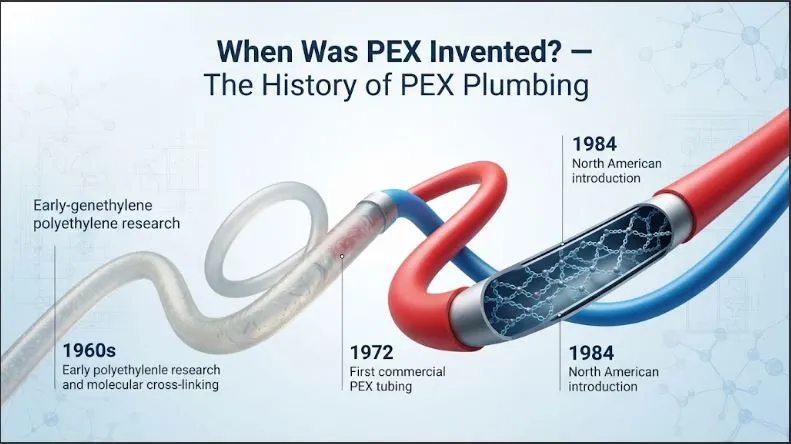
PEX (cross-linked polyethylene) was developed during the 1960s, with German inventor Dr. Thomas Engel playing a central role. Early work dates back to 1965, while 1967–1968 marks important development milestones. Commercial PEX tubing appeared in 1972, and PEX was introduced to North America in 1984, initially for radiant heating.
The key point: There is no single date that explains the entire history of PEX. The invention, commercial production, North American introduction, and plumbing-code adoption happened at different times.
That timeline matters because PEX was not originally developed as the residential plumbing material many homeowners know today. Its early commercial applications were closely connected to radiant and hydronic heating before its use expanded into hot- and cold-water plumbing.
Key Takeaways
- PEX was developed during the 1960s, with Dr. Thomas Engel playing a central role in developing polyethylene cross-linking technology.
- 1965 documents important early work, while 1967–1968 represents major development and production milestones.
- 1972 was an important commercial milestone for PEX tubing and radiant-heating applications in Europe.
- 1984 marked the introduction of PEX to North America, initially for radiant heating.
- PEX was not originally developed specifically for residential plumbing. Its early commercial history was closely connected to radiant and hydronic heating.
- PEX later expanded into hot- and cold-water plumbing as standards, manufacturing technology, and plumbing-code acceptance developed.
When Was PEX Invented?
PEX was developed in the 1960s, commercial PEX tubing appeared in 1972, and PEX was introduced to North America in 1984.
PEX originated from efforts to cross-link polyethylene and improve its performance as a piping material.
The Plastics Pipe Institute’s historical review explains that cross-linking technology for polyethylene was developed in Europe in the late 1960s, while the first PEX radiant heating systems were installed in Europe in 1972.
However, the story goes back further than 1968.
In an account of his work, Thomas Engel described discussing the cross-linking of polyethylene with scientists at Phillips Petroleum in Bartlesville, Oklahoma, in 1965. He then experimented with ways to produce a practical cross-linked material suitable for thicker sections.
This is why you may see different dates when researching the invention of PEX:
- 1965: Engel described early work and discussions concerning polyethylene cross-linking.
- 1967: REHAU says it began producing PEX-a after founder Helmut Wagner licensed Engel’s cross-linking technology.
- 1968: Uponor identifies this as the year Engel developed the method for chemically cross-linking polyethylene.
- 1972: Commercial PEX tubing and early radiant-heating applications became established in Europe.
- 1984: PEX was introduced to North America, with ASTM F876 also first published that year.
Why Do Sources Say 1965, 1967, or 1968?
The different dates do not necessarily represent a disagreement about who developed PEX.
They describe different stages of the technology’s development.
An invention can involve early laboratory work, development of a workable manufacturing process, patenting or licensing, commercial production, and eventual market adoption. Those events do not have to happen in the same year.
For PEX, the safest way to describe the history is to say that its development began in the 1960s, with Thomas Engel’s work being central to the technology, followed by commercial production in the early 1970s.
Who Invented PEX?
Dr. Thomas Engel, a German inventor and engineer, is widely credited with developing the technology used to create PEX by chemically cross-linking polyethylene.
Engel’s work focused on changing the molecular structure of polyethylene so that the resulting material could handle higher temperatures and demanding piping conditions better than conventional polyethylene.
The basic idea was important because ordinary polyethylene has useful flexibility and chemical resistance, but cross-linking creates a network between polymer chains. That changes the material’s performance and makes it suitable for applications involving pressure and elevated temperatures.
Uponor identifies Engel as the inventor of the chemical cross-linking method, while REHAU documents its production of PEX-a beginning in 1967 after its founder licensed Engel’s technology.
This distinction is worth remembering:
Engel developed the key cross-linking technology, while manufacturers helped turn that technology into practical commercial PEX tubing.
Why Was PEX Invented?
PEX was developed to make cross-linked polyethylene suitable for more demanding piping applications.
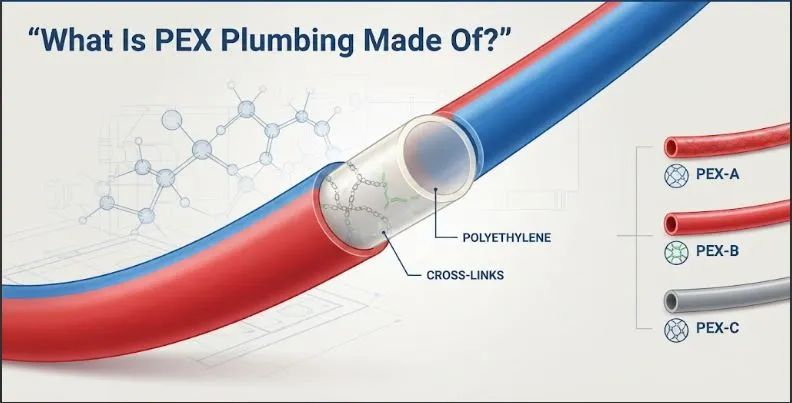
Cross-linking connects polymer chains into a three-dimensional molecular network. Compared with conventional polyethylene, PEX has improved performance at elevated temperatures along with useful resistance to several forms of chemical and mechanical degradation.
That combination created a material with an unusual balance of properties:
- Flexible compared with rigid piping materials
- Suitable for pressurized water applications
- Better high-temperature performance than standard polyethylene
- Resistant to many forms of corrosion
- Suitable for hydronic heating
- Capable of being manufactured as flexible tubing
If you want to understand the material itself, see our guide to what PEX plumbing is made of.
How Was PEX Invented?
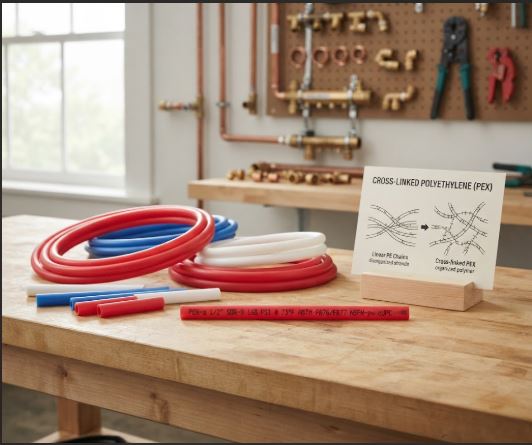
The basic concept behind PEX is easier to understand if you start with polyethylene.
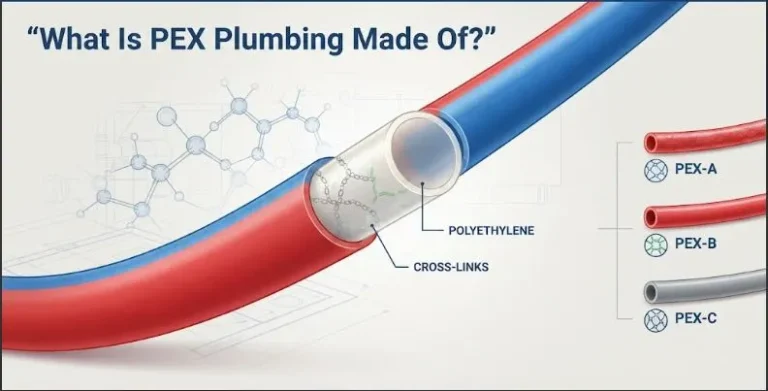
Polyethylene is a polymer made from long molecular chains. Cross-linking creates chemical connections between those chains.
Think of ordinary polyethylene as a collection of long strands. Cross-linking creates additional connections between the strands, producing a more interconnected molecular structure.
That molecular change is what gives PEX its combination of flexibility, strength, and temperature performance.
Engel’s historical account describes experimenting with different approaches to cross-link polyethylene. Earlier radiation-based methods had limitations, particularly for thicker materials. His later work focused on using heat, pressure, and a catalyst to achieve cross-linking in a more practical way.
The result was the foundation for modern PEX tubing.
For the plumbing side of the technology, you can also read our complete guide to what PEX plumbing is.
PEX History Timeline
PEX developed over several decades. These milestones show how the technology moved from polymer research to commercial tubing and eventually into North American plumbing.
Why Are There Different Dates for the Invention of PEX?
Different dates refer to different stages in the development of PEX. Here is how the major dates fit together.
| Date | What Happened | Why It Matters |
|---|---|---|
| 1965 | Early documented work on cross-linking polyethylene | Shows that the development began before the commonly cited 1968 date. |
| 1967 | PEX-a production milestone | Shows the technology was moving from development toward practical manufacturing. |
| 1968 | Engel’s chemical cross-linking method | This is the date commonly cited for the development of the chemical method behind PEX. |
| 1972 | Commercial PEX tubing milestone | Marks the transition from development to commercial PEX tubing applications. |
| 1984 | PEX introduced to North America | Marks an important beginning for the North American PEX market. |
| 1993 | PEX adopted into the BOCA National Plumbing Code | Represents an important milestone in North American plumbing-code acceptance. |
Bottom line: If someone asks when PEX was invented, “the 1960s” is the broad historical answer. If they ask when commercial PEX tubing appeared, 1972 is the key milestone. If they ask when PEX reached North America, the answer is 1984.
What Was PEX Originally Used For?
PEX was not originally developed specifically for household plumbing.
One of its earliest important commercial applications was radiant and hydronic heating.
The first PEX radiant heating systems were installed in Europe in 1972. PEX worked particularly well for these applications because the tubing could be flexible while still handling the temperatures and pressures required by the system.
PEX also became associated with applications such as:
- Radiant floor heating
- Hydronic heating
- Snow and ice melting
- Hot-water plumbing
- Cold-water plumbing
- Other pressure-piping applications
Historical industry sources note that the initial North American applications included hydronic radiant floor heating and snow- and ice-melting systems.
Was PEX Invented for Plumbing?
No—not originally.
The technology was developed around improving polyethylene for demanding piping applications. Its early commercial use was strongly associated with radiant and hydronic heating.
PEX later expanded into potable hot- and cold-water distribution as standards, codes, manufacturing, and installation systems developed.
When Did PEX Come to the United States?
PEX came to North America in 1984, initially for radiant floor heating.
Uponor’s historical account states that PEX-a was brought to North America in 1984, first for radiant floor heating and later for plumbing systems.
The North American market was therefore not the birthplace of PEX. The technology had already been commercially used in Europe for more than a decade.
The arrival of PEX in North America also coincided with an important standards milestone.
In 1984, ASTM F876, Standard Specification for Crosslinked Polyethylene (PEX) Tubing, was first published. The standard established requirements for PEX tubing, including dimensions, pressure-related performance, cross-linking, and other material requirements.
That helped create a more standardized framework for using PEX tubing in North American applications.
When Did PEX Become Common in Residential Plumbing?
There is no single year when PEX suddenly became common in every U.S. home.
Its adoption developed over time as manufacturers, standards organizations, plumbing codes, contractors, and builders gained experience with the material.
A major milestone came in 1993, when PEX was first adopted into the BOCA National Plumbing Code. PPI notes that this was followed by adoption into other model plumbing codes across the United States and Canada.
PPI’s historical review also notes that by 1997, ASTM F876 and F877 had been adopted into several plumbing codes, and PEX began being used for hot- and cold-water plumbing systems.
So a more accurate history is:
European development → radiant heating → North American introduction → standards and code development → broader residential plumbing adoption.
This gradual progression is more useful than assigning PEX a single “became popular” year.
When Did Plumbers Start Using PEX?
In North America, PEX was initially used heavily in radiant and hydronic heating after its introduction in the 1980s.
Its use for hot- and cold-water plumbing expanded as standards and plumbing-code acceptance developed during the 1990s.
The exact adoption date varied by location, code jurisdiction, manufacturer, and application.
When Was the First PEX Standard Published?
The first edition of ASTM F876 was published in 1984.
ASTM F876 is the standard specification for crosslinked polyethylene tubing. The original 1984 edition established requirements for PEX tubing, including material, dimensions, pressure performance, degree of cross-linking, and markings.
It is important not to confuse this with the invention of PEX.
PEX existed before ASTM F876.
The standard helped establish consistent technical requirements for PEX tubing as the material entered the North American market.
A related standard, ASTM F877, addressed PEX hot- and cold-water distribution systems and helped support the development of standardized PEX plumbing systems.
How Did PEX-A, PEX-B, and PEX-C Develop?
Modern PEX comes in several manufacturing types.
The three commonly discussed types are:
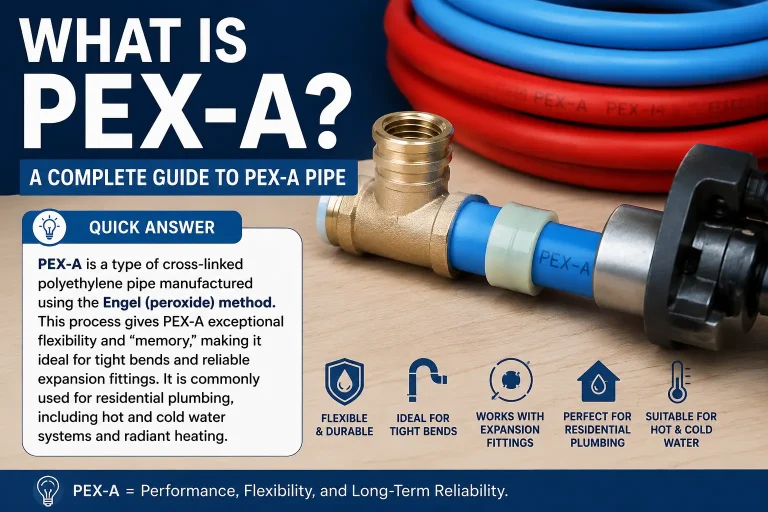
- PEX-A: Made using the peroxide or Engel method
- PEX-B: Made using the silane method
- PEX-C: Made using irradiation
These letters do not mean that PEX-A was invented first, PEX-B was second, and PEX-C was third in a simple chronological sequence.
They identify different manufacturing or cross-linking methods.
PEX-A is directly associated with the Engel process that played a major role in the early development of PEX. REHAU, for example, says it began producing PEX-a in 1967 after licensing Engel’s cross-linking technology.
For a detailed comparison of the two types most commonly discussed by homeowners and plumbers, see our guide to PEX-A and PEX-B.
How Has PEX Changed Since It Was Invented?
PEX has evolved considerably since its development in the 1960s.
The basic concept remains cross-linked polyethylene, but the surrounding plumbing technology has become much more sophisticated.
Modern PEX systems can include:
- PEX tubing in multiple sizes
- Expansion fittings
- Crimp and clamp fittings
- Press-style connection systems
- Manifold-based plumbing layouts
- Oxygen-barrier PEX for appropriate hydronic applications
- Tubing designed for potable-water distribution
- Specialized PEX products for different applications
The technology has also been supported by decades of testing, standards development, code changes, and field experience.
Today, PEX is used for hot- and cold-water distribution, hydronic heating and cooling, water service, fire protection, and other applications.
If you are moving from PEX history into installation, our guide explains how PEX connections are crimped, while our guide to PEX pipe fittings covers the connection side.
How Old Is PEX Plumbing?
The answer depends on what you mean by “PEX.”
If you mean the underlying cross-linking technology, its development dates to the 1960s.
If you mean commercial PEX tubing, an important milestone is 1972, when PEX radiant heating systems were installed in Europe.
If you mean PEX in North America, the important date is 1984.
If you mean PEX in North American plumbing codes, 1993 is another significant milestone, followed by broader code adoption during the 1990s.
That is why saying simply “PEX was invented in 1968” does not tell the whole story.
The history of PEX is therefore best understood as a multi-stage development, not a single invention date. Its journey from cross-linked polyethylene research in the 1960s to modern plumbing systems took several decades of engineering, manufacturing, standards development, and code adoption.