What Is PEX Plumbing Made Of?
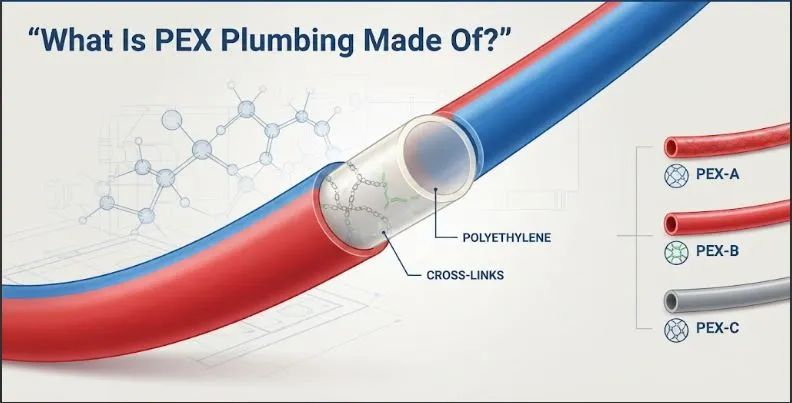
PEX plumbing is made primarily from cross-linked polyethylene, a type of plastic that has been chemically or physically modified to create stronger bonds between its polymer chains. This cross-linking gives PEX the flexibility, strength, heat resistance, and pressure performance needed for plumbing applications.
In simple terms, manufacturers start with a polyethylene-based compound, form it into tubing, and then cross-link the polymer. The exact cross-linking process depends on whether the tubing is classified as PEX-A, PEX-B, or PEX-C. ASTM F876 covers PEX tubing and recognizes several cross-linking methods, including peroxide, silane, and electron-beam processes.
But there is more to PEX than just “plastic pipe.” The material can also contain stabilizing components, and some products have additional polymer layers for specific applications.
Quick Answer
PEX plumbing is made primarily from cross-linked polyethylene, a plastic polymer that has been modified by creating bonds between its polymer chains.
The cross-linking process gives PEX the flexibility, strength, heat resistance, and pressure performance needed for many plumbing applications. PEX-A, PEX-B, and PEX-C use different cross-linking methods, while some products may also include stabilizing components or additional polymer layers.
What Is PEX Plumbing Made Of?
PEX plumbing is made from a polyethylene compound that has been cross-linked.
How Polyethylene Becomes PEX
The exact manufacturing and cross-linking process varies by PEX type and product.
The basic material chain looks like this:
Polyethylene → cross-linking → cross-linked polyethylene (PEX) → finished PEX tubing
Polyethylene is a polymer made from repeating molecular units. During PEX production, manufacturers create additional links between the polymer chains. These links form a network that changes how the material behaves.
This is what makes PEX different from ordinary polyethylene pipe.
ASTM F876 describes PEX tubing as cross-linked polyethylene tubing made from polyethylene compounds that are cross-linked through specified processes and tested for properties such as pressure performance, degree of cross-linking, stabilizer functionality, and oxidative stability.
What Material Is PEX Made From?
PEX starts with a polyethylene-based material.
You may also see PEX described as being made from high-density polyethylene, or HDPE, in plumbing resources. The important point is that the finished product is not simply ordinary HDPE pipe. The polyethylene is processed and cross-linked to produce the properties required for PEX tubing.
That cross-linking step is what gives PEX its name:
PEX = cross-linked polyethylene.
Different manufacturers can use different formulations and manufacturing processes. Therefore, it is better to describe PEX broadly as cross-linked polyethylene rather than assume that every PEX product has the exact same resin formulation.
What Does “Cross-Linked” Mean?
The word cross-linked describes what happens to the polymer chains inside the material.
Think of polyethylene as many long molecular chains.
Without cross-linking, those chains have more freedom to move independently. During PEX production, manufacturers create bonds between the chains.
A simple way to visualize it is:
Ordinary polyethylene
Long chain → Long chain → Long chain
Cross-linked polyethylene
Long chain ─┬─ Long chain
├─ Long chain
└─ Long chain
The result is a connected molecular network.
This change affects the tubing’s mechanical and thermal behavior. It helps PEX handle the temperatures and pressures associated with its intended plumbing applications.
ASTM F876 specifically includes requirements for the degree of cross-linking, along with pressure, dimensional, oxidative stability, and other performance tests.
What Is Added to PEX?
What Is Inside PEX Tubing?
| Component or Feature | Purpose |
|---|---|
| Polyethylene | Forms the primary polymer material. |
| Cross-links | Connect polymer chains and create the cross-linked structure that defines PEX. |
| Stabilizing components | Help the material maintain performance during processing and service. |
| Additional polymer layers | Used in some specialized PEX products for specific applications. |
The exact formulation and construction can vary by manufacturer and product.
The main material is polyethylene, but finished PEX tubing is not simply raw polyethylene.
Manufacturers use different formulation components and processing methods to produce tubing that meets the required performance specifications.
These can include components that help with:
- Cross-linking
- Processing
- Long-term stabilization
- Resistance to oxidation
- Resistance to environmental conditions
- Product-specific performance requirements
ASTM F876 includes testing for stabilizer functionality and oxidative stability, which shows why the formulation is more than just the base polymer.
The exact formulation is manufacturer- and product-specific. So you should not assume that every PEX tube contains exactly the same additives or in the same amounts.
Are additives the same as contaminants?
No.
An additive can be an intentional part of a material formulation. A contaminant is an unwanted substance.
For potable-water products, the finished plumbing component must meet applicable requirements for its intended use. NSF explains that NSF/ANSI/CAN 61 addresses the health effects of drinking-water system components and evaluates chemicals that could potentially be extracted into drinking water.
How Is PEX Made?
The basic PEX manufacturing process can be simplified into several stages.
1. Polyethylene-based material is prepared
Manufacturers begin with a polyethylene compound formulated for the intended PEX product.
2. The material is processed into tubing
The material is formed into the desired tube shape through an extrusion process or another manufacturing sequence, depending on the PEX type.
3. The polyethylene is cross-linked
This is the critical step.
Manufacturers use a specific cross-linking method to create bonds between the polymer chains.
4. The tubing is tested
Finished PEX tubing must meet applicable performance requirements.
ASTM F876 includes testing for dimensions, sustained pressure, burst pressure, environmental stress cracking, degree of cross-linking, stabilizer functionality, oxidative stability, UV resistance, and other characteristics.
The exact production process varies by manufacturer and PEX type.
What Are PEX-A, PEX-B, and PEX-C Made Of?
PEX-A, PEX-B, and PEX-C are all forms of cross-linked polyethylene.
The major difference is the method used to cross-link the polyethylene.
| PEX Type | Common Cross-Linking Method | What It Means |
|---|---|---|
| PEX-A | Peroxide method | Polyethylene is cross-linked using peroxide chemistry during manufacturing. |
| PEX-B | Silane method | Cross-linking uses silane chemistry followed by moisture curing. |
| PEX-C | Electron-beam method | The tubing is cross-linked using electron-beam processing. |
Important: PEX-A, PEX-B, and PEX-C are not three completely different plastics. They are classifications associated mainly with the method used to cross-link polyethylene during manufacturing.
ASTM F876 recognizes peroxide, silane, and electron-beam cross-linking approaches for PEX tubing.
This is an important distinction:
PEX-A, PEX-B, and PEX-C are not three completely different plastics.
They are different forms of cross-linked polyethylene produced using different manufacturing methods.
If you want to understand how these types behave during installation, see our guide to PEX-A vs PEX-B.
Is PEX Made From Plastic?
Yes.
PEX is a plastic polymer material. More specifically, it is cross-linked polyethylene.
However, calling it simply “plastic pipe” does not tell the whole story. The cross-linking process changes the structure and performance of the polyethylene.
That is why PEX can be used for applications where ordinary plastic tubing may not have the same performance characteristics.
Does PEX Contain Metal?
The PEX tubing itself is primarily a polymer material and does not use copper or steel as its main pipe material.
However, a PEX plumbing system can contain metal components.
For example, a PEX installation may use:
- Brass fittings
- Metal valves
- Crimp rings
- Metal adapters
- Manifold components
The tubing and the rest of the plumbing system are not the same thing.
NSF listings for PEX systems show that certified plumbing products can include PEX tubing as well as separate fittings made from materials such as brass.
So if someone asks, “Is PEX plastic or metal?” the simple answer is:
PEX tubing is plastic. A PEX plumbing system can use both plastic and metal components.
For the connection side of the system, see our guide to PEX pipe fittings.
What Is Oxygen-Barrier PEX?
Not every PEX tube has exactly the same construction.
Some PEX products used for hydronic heating systems include an oxygen-barrier layer. This additional layer is designed to reduce oxygen diffusion through the tubing.
That matters in certain heating systems because oxygen entering the system can contribute to corrosion of susceptible metal components.
ASTM F876 also allows PEX tubing with an optional polymeric inner, middle, or outer layer.
You should therefore check the manufacturer’s specifications before assuming that all PEX tubing has the same number of layers.
Standard PEX vs oxygen-barrier PEX
| Feature | Standard PEX | Oxygen-Barrier PEX |
|---|---|---|
| Main material | Cross-linked polyethylene | Cross-linked polyethylene |
| Extra barrier | Usually none | Includes an oxygen-barrier construction |
| Common applications | Hot and cold water | Often hydronic heating applications |
| Main purpose | Water distribution and approved applications | Reduce oxygen diffusion in suitable systems |
The exact construction depends on the product.
Why Is PEX Flexible?
PEX is flexible because of its polymer structure and the way the cross-linked material behaves.
That flexibility is one of the main reasons PEX is popular in residential plumbing.
Instead of using a rigid pipe and a fitting at every change in direction, an installer can often route PEX around obstacles with fewer connections.
The material also has properties that allow it to handle the temperature and pressure conditions for which the particular PEX product is rated.
If you are learning about PEX from an installation perspective, our guide on how to crimp PEX explains how one common connection method works.
Is PEX the Same as Polyethylene?
No.
PEX is made from polyethylene, but PEX is not simply the same thing as ordinary polyethylene pipe.
The key difference is cross-linking.
Polyethylene
Polyethylene is a broad family of plastic materials with many different applications.
PEX
PEX is polyethylene that has been cross-linked to produce a specific material structure and performance profile.
So the relationship is:
PEX is polyethylene, but not all polyethylene is PEX.
This distinction is important when comparing pipe materials.
PEX vs PVC: Are They Made From the Same Material?
No.
PEX and PVC are different types of plastic.
PEX is cross-linked polyethylene.
PVC is polyvinyl chloride.
They have different chemical structures, manufacturing processes, installation methods, and performance characteristics.
Your choice between them depends on the application, local code, product specifications, installation method, and project requirements.
For a broader material comparison, see PEX vs Copper: Which Is Better for Plumbing?.
Is PEX Safe for Drinking Water?
PEX can be used in potable-water plumbing when the specific product is approved and certified for that application and installed according to applicable requirements.
Do not judge drinking-water suitability only by the word “PEX” on the package.
Look for the appropriate product markings and certifications for the intended use.
NSF explains that NSF/ANSI/CAN 61 addresses the health effects of drinking-water system components, including PEX plumbing products. NSF also maintains listings for certified PEX products and materials.
ASTM F876 also includes requirements related to oxidative stability in potable chlorinated-water applications.
What does NSF/ANSI/CAN 61 mean?
NSF/ANSI/CAN 61 is a standard addressing the health effects of materials and components that come into contact with drinking water.
NSF states that the standard evaluates chemicals that could potentially be extracted or leached from a product into drinking water.
For a specific PEX product, always check the manufacturer’s certification and intended-use information rather than assuming every plastic tube is approved for potable water.
Does PEX Leach Chemicals Into Water?
Like many materials that contact water, plumbing products can release some substances into water under certain conditions.
That is why potable-water standards do not simply ask whether a material contains chemicals. They evaluate the material and potential extraction under defined testing conditions.
NSF explains that NSF/ANSI/CAN 61 addresses potential chemical extraction from drinking-water system components and whether the levels meet the applicable health criteria.
For homeowners, the practical takeaway is simple:
Use PEX products that are certified or approved for the intended potable-water application, and follow the manufacturer’s installation instructions.
What Makes PEX Different From Other Plumbing Materials?
The biggest difference is the combination of polyethylene chemistry and cross-linking.
Here is a simple comparison:
| Material | Basic Material | Cross-Linked? | Typical Character |
|---|---|---|---|
| PEX | Polyethylene | Yes | Flexible polymer tubing |
| PVC | Polyvinyl chloride | No | Rigid plastic pipe |
| CPVC | Chlorinated polyvinyl chloride | No | Rigid plastic pipe for approved hot/cold applications |
| Copper | Copper metal | No | Rigid metal pipe |
Each material has different installation requirements and approved applications.
For PEX specifically, the cross-linked polymer structure is the defining feature.
Does PEX Have Different Layers?
It can.
Many PEX products are solid-wall tubing, while some products use additional polymer layers or specialized constructions.
ASTM F876 explicitly allows PEX tubing with an optional polymeric inner, middle, or outer layer.
This is another reason not to assume that every PEX product has an identical composition.
Always check the manufacturer’s technical documentation when the exact construction matters.
Key Takeaways:
- PEX stands for cross-linked polyethylene.
- The main material is a polyethylene-based polymer.
- Cross-linking connects polymer chains and changes the material’s properties.
- PEX-A, PEX-B, and PEX-C use different cross-linking methods.
- Some products can contain stabilizing components or additional polymer layers.
- Standard PEX tubing is polymer-based, although a complete plumbing system can include metal fittings and valves.
- Potable-water PEX should be certified or approved for its intended drinking-water application.
Frequently Asked Questions
What is PEX plumbing made of?
PEX plumbing tubing is primarily made from cross-linked polyethylene. The polyethylene is cross-linked during manufacturing to create the material used for PEX tubing.
Is PEX made from HDPE?
PEX is made from polyethylene compounds, and PEX is often described in plumbing resources as being based on high-density polyethylene. However, the defining feature of PEX is that the polyethylene is cross-linked.
Is PEX a type of plastic?
Yes. PEX is a plastic polymer material made from cross-linked polyethylene.
What chemicals are used to make PEX?
The exact formulation depends on the manufacturer and PEX type. Cross-linking can involve peroxide or silane chemistry, while electron-beam processing can be used for another PEX manufacturing route. PEX formulations can also include stabilizing components. ASTM F876 recognizes these cross-linking approaches and includes tests for stabilizer functionality and oxidative stability.
What is the difference between PEX-A, PEX-B, and PEX-C?
The main difference is the cross-linking method used to manufacture the tubing. PEX-A commonly uses peroxide cross-linking, PEX-B commonly uses silane cross-linking, and PEX-C uses electron-beam cross-linking.
Does PEX contain metal?
Standard PEX tubing is primarily polymer-based. However, a complete PEX plumbing system can use metal components such as brass fittings and valves.
Is PEX safe for drinking water?
PEX products can be used for potable water when the specific product meets the applicable requirements and is certified or approved for that use. NSF/ANSI/CAN 61 is an important drinking-water health-effects standard for plumbing components.
Is PEX the same as polyethylene?
No. PEX is made from polyethylene, but the polyethylene has been cross-linked. That cross-linking gives PEX its defining material properties.
Is oxygen-barrier PEX the same as regular PEX?
Not exactly. Oxygen-barrier PEX includes an additional barrier construction designed to reduce oxygen diffusion. It is commonly associated with suitable hydronic heating applications.