Which PEX Pipe Is Best for Home Plumbing?
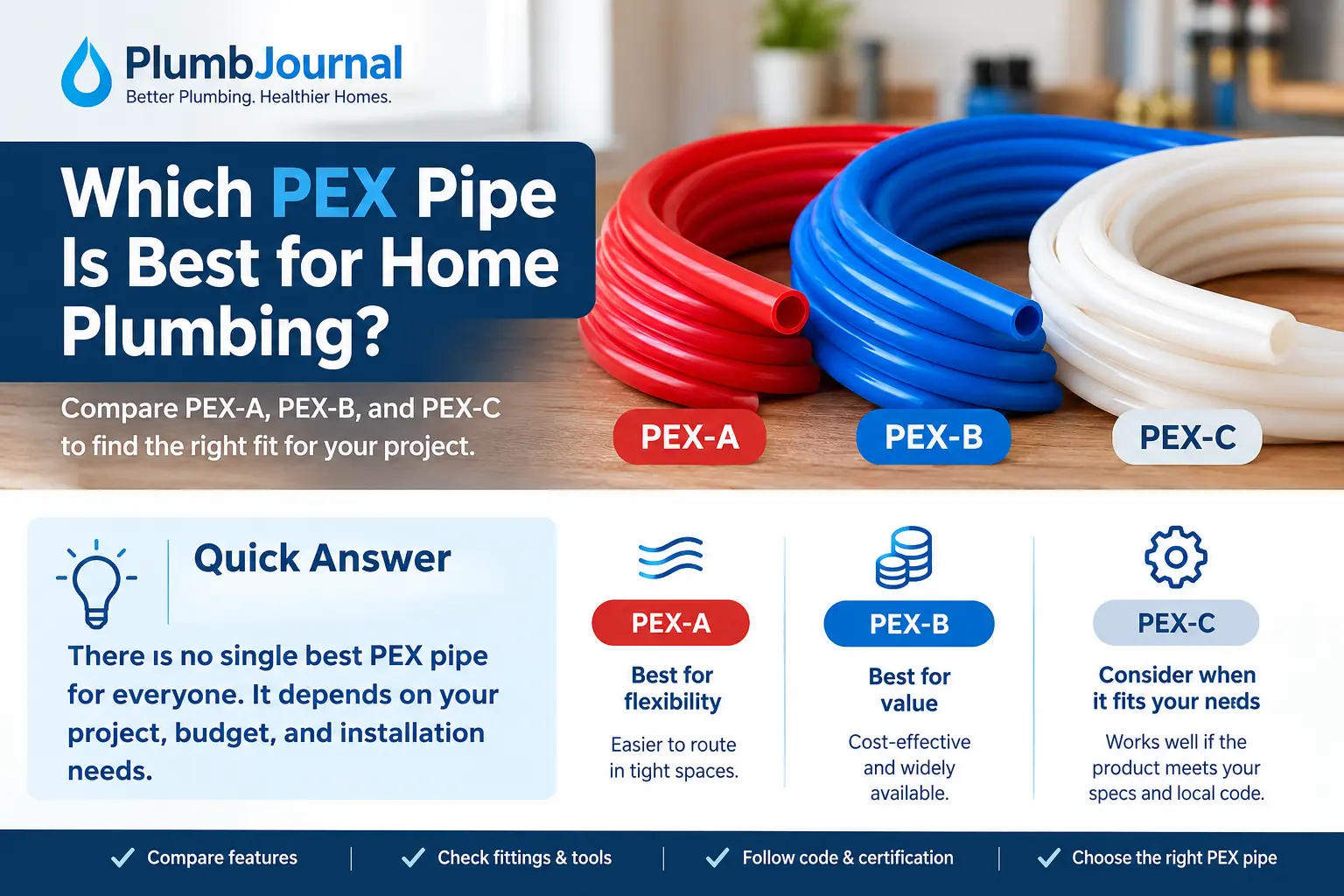
Choosing the best PEX pipe depends on your plumbing project, budget, and installation method. PEX-A is often the best choice for flexibility and tight spaces. PEX-B is a strong value choice for many home plumbing projects. PEX-C can also work well when the specific product meets your needs and local code.
Before you buy, compare more than the pipe price. Fitting compatibility, installation tools, temperature and pressure ratings, and product certification all matter. This guide explains how to choose the right PEX tubing for your home.
- Best for flexibility: PEX-A.
- Best for value: PEX-B is often a good starting point.
- Best for an existing tool setup: The PEX type approved for your chosen fitting system.
- Best for radiant floor heating: PEX tubing rated for the heating system, with an oxygen barrier when the system requires one.
There is no single winner for every job. Choose a listed product that suits the application and follows local plumbing code.
PEX-A vs. PEX-B vs. PEX-C: Quick Comparison
PEX-A, PEX-B, and PEX-C are types of cross-linked polyethylene tubing. The letters describe the manufacturing method, not a simple ranking of quality. All three types can be suitable for plumbing when the product is designed and approved for the intended use.
| Feature | PEX-A | PEX-B | PEX-C |
|---|---|---|---|
| Flexibility | Generally the most flexible | Generally stiffer than PEX-A | Depends on the product |
| Kink repair | Some kinks can be repaired if the manufacturer permits it | Usually requires cutting out the damaged section | Usually requires replacing the damaged section |
| Typical pipe cost | Often higher | Often lower | Varies by product and supplier |
| Common connection options | Approved expansion, crimp, clamp, or other compatible systems | Approved crimp, clamp, press, or other compatible systems | Approved systems listed for the product |
| Main advantage | Flexibility and easier routing | Value and broad availability | Can be a practical option when specifications and price fit |
These are general comparisons. Actual performance, permitted fittings, and repair methods depend on the specific product and manufacturer instructions.
What Is PEX-A Pipe?
PEX-A is manufactured using a peroxide-based cross-linking process. It is generally the most flexible of the three common PEX types. Its flexibility can make it easier to route through walls, around framing, and through tight plumbing spaces.
Advantages of PEX-A
- Its flexibility can reduce the number of fittings needed for some layouts.
- It works with compatible expansion fitting systems designed for approved tubing.
- Some products allow certain kinks to be repaired with controlled heat, following the manufacturer’s instructions.
- It can be useful for new installations and whole-house repiping.
Disadvantages of PEX-A
- It often costs more than PEX-B.
- Expansion connections may require a dedicated tool and compatible fittings.
- Its flexibility can make it harder to handle neatly without proper support.
When should you choose PEX-A? Consider it when the plumbing layout has many bends, limited access, or a strong need for flexible routing. Compare the full system cost before paying more for the tubing.
What Is PEX-B Pipe?
PEX-B is made through a silane-based cross-linking process. It is widely used in residential water-supply systems. It is generally stiffer than PEX-A, but that does not make it an inferior pipe.
Advantages of PEX-B
- It often costs less than PEX-A.
- It works with many common crimp and clamp connection systems when the products are compatible.
- It can be a practical option for new plumbing and whole-house repiping.
- Its price can make it attractive for larger projects that require long runs of tubing.
Disadvantages of PEX-B
- It is usually less flexible than PEX-A, depending on the product.
- It can be harder to route through tight spaces or around sharp turns.
- Some kinked sections must be cut out and replaced rather than repaired with heat.
When should you choose PEX-B? It is a strong option when you want a cost-effective plumbing system and can plan the pipe route without needing the extra flexibility of PEX-A.
What Is PEX-C Pipe?
PEX-C is manufactured using an electron-beam cross-linking process. It is another option for residential plumbing, but its flexibility, price, and installation requirements vary by product.
Advantages of PEX-C
- Some products offer competitive pricing.
- Approved products can be used in suitable residential plumbing applications.
- It may be a good fit when its ratings and connection system match the project.
Disadvantages of PEX-C
- It may be less readily available than common PEX-A and PEX-B products in some markets.
- Flexibility and installation features vary by manufacturer.
- You must confirm that the pipe and fittings are approved for the intended application.
When should you choose PEX-C? Consider it when a suitable product is available at a competitive price and its specifications, fittings, and approvals meet your needs. Do not select it based on the letter alone.
Which PEX Pipe Is Best for Different Projects?
The best pipe depends on the conditions at the job site. Use this table as a starting point, then check the product specifications and local code.
| Project or priority | What to consider | Why it matters |
|---|---|---|
| Whole-house repiping | Compare PEX-A and PEX-B system costs | Pipe, fittings, labor, and tools all affect the final price. |
| Tight spaces and many bends | Consider PEX-A | Its flexibility can make routing easier. |
| Budget-focused installation | Compare PEX-B products | Lower tubing cost may help reduce material expenses. |
| DIY plumbing | Choose a compatible pipe and fitting system | The right tool and connection method matter more than the PEX letter. |
| Radiant floor heating | Choose tubing rated for the heating system | Some systems require oxygen-barrier tubing to protect components. |
| Cold climates | Plan for freezing protection | No PEX type is freeze-proof. Installation and insulation still matter. |
PEX-A vs. PEX-B: Cost, Fittings, and Tools
PEX-A often has a higher purchase price, while PEX-B often costs less. However, the cheapest tubing does not always produce the lowest installed cost. The number of fittings, labor time, tools, and layout all affect the final budget.
Compare the complete plumbing system
- Tubing: Compare the price per foot for the same nominal size and application.
- Fittings: Check the cost and availability of elbows, tees, adapters, and valves.
- Tools: Expansion tools and crimp or clamp tools are not interchangeable in every system.
- Labor: A flexible pipe may simplify some routes, while other layouts make little difference.
- Repairs: Consider access to connections and the availability of replacement parts.
For more planning help, use our plumbing cost estimator or review the repipe cost calculator.
Can you use the same fittings with PEX-A and PEX-B?
Sometimes, but not automatically. Many PEX-A and PEX-B products can use compatible crimp or clamp systems. However, a fitting approved for one type of connection may not be suitable for another.
For example, ASTM F1960 cold-expansion fittings are designed for use with tubing approved for that system. Do not assume every PEX-B or PEX-C product is compatible with them. Check the fitting and tubing manufacturer’s instructions before making a connection.
Read our guide to PEX pipe fittings for more information about connection types and compatible components.
How to Choose Safe, Code-Compliant PEX Pipe
For drinking-water plumbing, do not choose a pipe based only on its color, price, or PEX type. Check the product’s markings, intended use, and certification.
- Confirm the application: Make sure the tubing is approved for potable water or the specific heating system.
- Check pressure and temperature ratings: They must suit the operating conditions of your system.
- Review product standards: Look for applicable standards, such as ASTM F876 for PEX tubing, where required.
- Verify drinking-water certification: NSF/ANSI/CAN 61 addresses health effects from products that contact drinking water. NSF/ANSI 14 covers plastic piping system components and related requirements.
- Follow local code: Requirements can vary by state, city, and adopted plumbing code.
- Protect the pipe: Follow instructions for support, bend radius, UV exposure, and protection from nails, screws, and physical damage.
For more background, consult the NSF guide to plastic piping certification and the applicable plumbing code in your area.
If you are new to PEX, start with our guide explaining what PEX pipe is and how it works.
Common Mistakes When Buying PEX Tubing
- Choosing by price alone: A low tubing price does not include fittings, tools, or labor.
- Assuming all fittings are compatible: Check the exact pipe and fitting specifications.
- Believing PEX-A is always better: PEX-B can provide excellent value for many installations.
- Using color as a quality test: Red and blue usually identify hot and cold lines, but color alone does not prove quality or suitability.
- Ignoring UV exposure: PEX products have limits on sunlight exposure. Follow the manufacturer’s storage and installation instructions.
- Assuming PEX cannot freeze: PEX can tolerate some expansion, but freezing can still cause damage to pipes and fittings.
- Skipping local code checks: A product must be approved for the application and allowed under the applicable code.
Frequently Asked Questions
Is PEX-A better than PEX-B?
PEX-A is generally more flexible and can be easier to route through tight spaces. PEX-B often costs less and works well for many residential plumbing jobs. Neither type is automatically better for every project.
Which PEX pipe lasts the longest?
You cannot reliably determine service life from the PEX-A, PEX-B, or PEX-C label alone. Product quality, ratings, installation, water conditions, and exposure all matter. Choose a listed product and follow the manufacturer’s requirements.
Is PEX-B good for whole-house repiping?
Yes. A suitable PEX-B product can be used for whole-house repiping when it meets local code and is installed with compatible fittings. Compare the full system cost before choosing.
Which PEX pipe is easiest for DIY plumbing?
The easiest option depends on your layout and tools. PEX-A can be easier to route around bends. PEX-B can work well with compatible crimp or clamp tools. Choose a connection system you can install correctly.
Can you mix PEX-A and PEX-B in one plumbing system?
Different PEX types may be joined in the same system when the tubing, fittings, and connection methods are approved for the combination. Check the manufacturers’ instructions and local code before mixing products.
Does the color of PEX pipe affect its quality?
No. Red and blue commonly help identify hot and cold water lines, while white and other colors may be used for different lines. Color alone does not establish quality, ratings, or intended use.
Can PEX pipes freeze and burst?
Yes. PEX can expand when water freezes, but the pipe or its fittings can still fail. Insulate vulnerable lines, prevent freezing where possible, and follow local requirements for cold-weather installations.
Final Verdict: Which PEX Pipe Is Best?
For most homeowners, PEX-A and PEX-B are the first two options worth comparing. Choose PEX-A when flexibility and easier routing justify the extra cost. Choose PEX-B when value is a priority and its installation requirements suit your project. PEX-C is also worth considering when a suitable product meets the same practical requirements.
Before buying, compare the pipe, fittings, tools, ratings, and installation costs as one system. Confirm drinking-water certification where needed and check your local plumbing code. The best PEX pipe is the one that fits your project and can be installed correctly.