PEX-A vs PEX-B vs PEX-C: Differences, Cost, and Which Is Best?
Choosing between PEX-A, PEX-B, and PEX-C can be confusing. All three types are made from cross-linked polyethylene, but they use different manufacturing methods. They can also differ in flexibility, fitting compatibility, and handling.
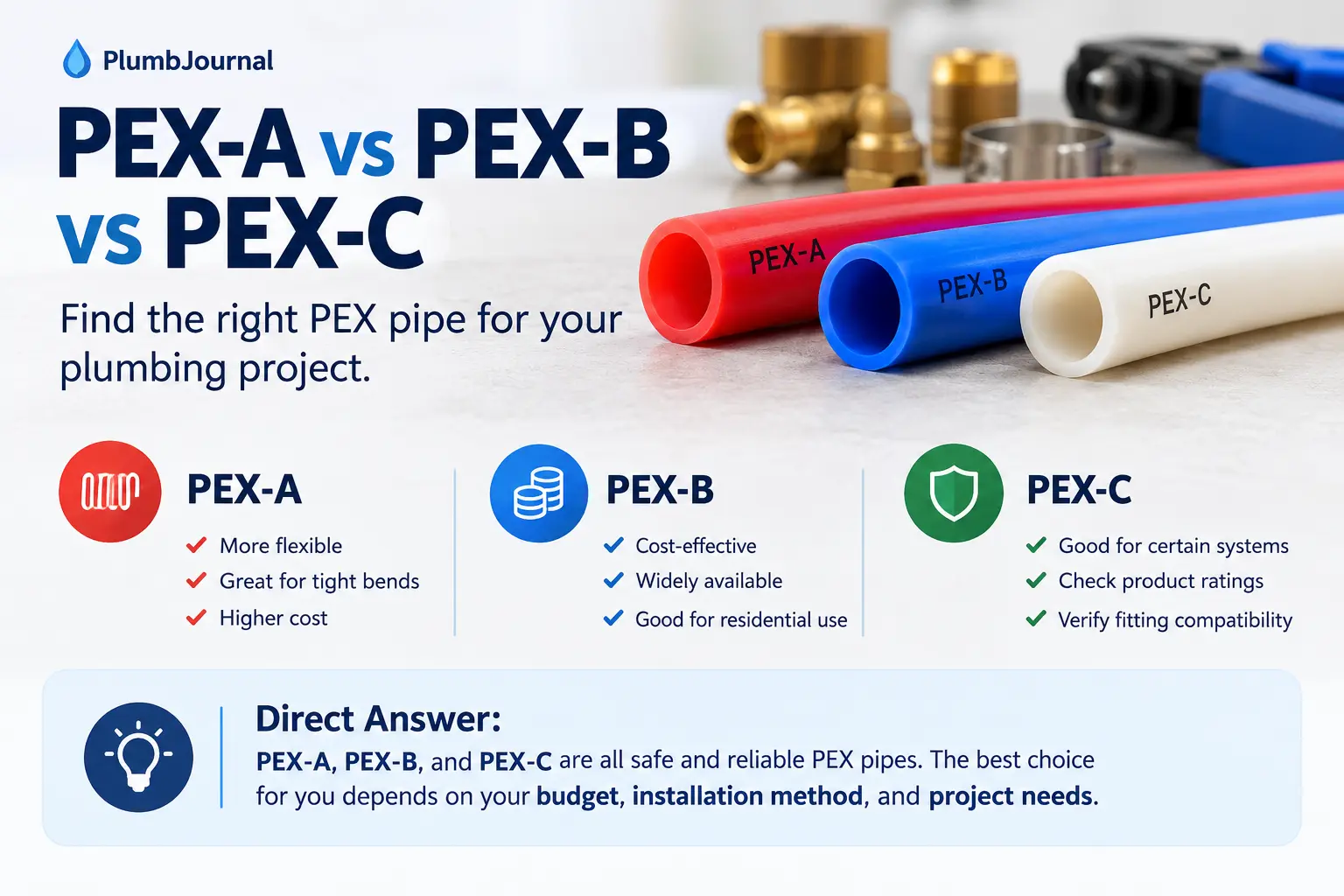
PEX-A is often the best choice for flexibility and tight bends. PEX-B is a popular, budget-friendly option for residential plumbing. PEX-C can also work well when its specifications meet the project requirements. However, no type is automatically the best for every job. The right choice depends on the product’s ratings, approved fittings, installation needs, and total cost.
In this guide, you will learn how PEX-A, PEX-B, and PEX-C compare. You will also learn which fittings work with each type, what affects their cost, and how to choose the right pipe for your home.
Key Takeaways
- PEX-A: Generally more flexible and useful for layouts that need tight bends.
- PEX-B: Often a cost-effective option for residential plumbing.
- PEX-C: Can work well when the product ratings and approved connection methods meet your needs.
- Fittings: Always verify compatibility between the tubing, fitting, ring or sleeve, and installation tool.
- Durability: Check product-specific temperature, pressure, UV, and chlorine-resistance ratings.
Bottom line: Choose the PEX system that fits your plumbing design, installation method, budget, and local code requirements.
PEX-A vs PEX-B vs PEX-C: Quick Comparison
| Feature | PEX-A | PEX-B | PEX-C |
|---|---|---|---|
| Manufacturing method | Peroxide (Engel) | Silane (moisture cure) | Electron-beam irradiation |
| Flexibility | Generally very flexible | Varies by product; often less flexible than PEX-A | Varies by product |
| Common connection methods | Expansion, crimp, clamp, and approved press systems | Crimp, clamp, and other approved systems | Crimp, clamp, and other approved systems |
| Kink repair | Some kinks may be repaired if the manufacturer allows it | Usually requires cutting out the damaged section | Usually requires cutting out the damaged section |
| Material cost | Often higher | Often lower | Varies by brand and availability |
| Tight bends | Often a good choice | May need more room or bend supports | Check the specified bend radius |
| Common applications | Water supply and heating systems | Water supply and heating systems | Approved plumbing and heating applications |
| Main selection factor | Flexibility and connection method | Cost, availability, and product ratings | Product specifications and availability |
Important: These are general tendencies, not guarantees. Product performance and fitting compatibility vary by manufacturer. Check the tubing markings and installation instructions before buying or installing any PEX system.
What Is the Difference Between PEX-A, PEX-B, and PEX-C?
The main difference is how the polyethylene is cross-linked during manufacturing. Cross-linking creates bonds between polymer chains. These bonds help the tubing handle heat, pressure, and normal plumbing conditions.
The letters A, B, and C describe the manufacturing process. They do not represent simple quality grades.
What Is PEX-A?
PEX-A uses the peroxide method, also called the Engel method. The cross-linking process takes place during production while the material is in a heated state.
PEX-A is generally known for its flexibility. It can bend around obstacles more easily than many stiffer tubing products. This can help reduce the need for extra elbows and fittings in some installations.
PEX-A is also commonly used with cold-expansion fitting systems. The tubing can expand during installation and then shrink back around an approved fitting. This process requires the correct pipe, expansion ring, fitting, and tool.
Advantages of PEX-A
- High flexibility for routing through walls and other tight spaces.
- Some accidental kinks may be repaired using the manufacturer’s approved method.
- Compatible with many approved expansion systems.
- Can reduce the need for extra fittings in suitable layouts.
Disadvantages of PEX-A
- It often costs more than comparable PEX-B tubing.
- Expansion tools can increase the initial installation cost.
- Its flexibility can make it harder to keep straight during some installations.
- Not every PEX-A product supports every fitting system.
PEX-A is worth considering when flexibility is a priority. However, compare the total system cost before choosing it over another type.
What Is PEX-B?
PEX-B uses the silane, or moisture-cure, method. The tubing is cross-linked after extrusion through a controlled process.
PEX-B is widely used in residential plumbing. Many products work with crimp rings and stainless steel cinch clamps. Some products also support specific expansion or press systems when approved by the manufacturer.
PEX-B is often less expensive than comparable PEX-A tubing. This can make it an attractive choice for homeowners and contractors working on larger projects.
Advantages of PEX-B
- Often offers a lower purchase price.
- Widely available in the US plumbing market.
- Works with many common crimp and clamp systems.
- Suitable for many hot- and cold-water supply applications when properly rated.
Disadvantages of PEX-B
- Many products are less flexible than comparable PEX-A tubing.
- Tight bends may require more space or approved bend supports.
- Kinked tubing often needs to be cut and repaired with an approved method.
- Some products may not support the expansion fittings you plan to use.
PEX-B is a strong option when cost, availability, and a compatible fitting system matter most. It can provide reliable service when the product is suitable for the application and installed correctly.
What Is PEX-C?
PEX-C uses electron-beam irradiation to cross-link the polyethylene after extrusion. The finished tubing must still meet the applicable performance requirements for its intended use.
PEX-C is less prominent in some US retail markets than PEX-A and PEX-B. Its flexibility, kink behavior, and available connection systems depend on the specific product.
Advantages of PEX-C
- Can be suitable for approved plumbing and heating applications.
- Offers another option when the required size and specifications are available.
- May be competitively priced in some markets.
Disadvantages of PEX-C
- Product availability may be more limited.
- Flexibility and handling vary by product.
- You must confirm the approved fitting and connection methods.
- You may have fewer brand or system choices in your local market.
PEX-C should not be rejected simply because it uses a different manufacturing method. Check its ratings, approvals, installation instructions, and price before making a decision.
PEX-A vs PEX-B: Which One Is Better?
PEX-A and PEX-B are the two types many homeowners compare first. Both can be suitable for residential plumbing, but they offer different installation trade-offs.
PEX-A is generally more flexible. This can make it easier to route through framing and around obstacles. Its ability to recover from certain kinks may also help reduce waste when the manufacturer permits repair.
PEX-B is often more affordable. It can work well with common crimp or clamp connections and is available from many plumbing suppliers.
For a simple plumbing project, PEX-B may offer better value. For a project with many bends or a preferred expansion system, PEX-A may be worth the extra cost.
Read our detailed PEX-A vs PEX-B comparison for a closer look at their differences.
Is PEX-A Worth the Extra Cost?
PEX-A may be worth the extra cost when its flexibility saves time or helps simplify the pipe layout. It can also make sense if you already own compatible expansion tools.
However, the more expensive pipe does not always produce the cheapest installation. A PEX-B system with affordable tubing, compatible fittings, and tools you already own may cost less overall.
Compare these items before deciding:
- Price per foot of tubing.
- Cost of fittings and rings.
- Tool purchase or rental cost.
- Number of connections needed.
- Labor and installation time.
- Availability of replacement parts.
The best value is the system that meets the project’s requirements at a reasonable total cost.
PEX Fittings: Expansion vs. Crimp vs. Clamp
Choosing the correct pipe is only part of the job. You must also select compatible fittings and tools.
PEX fittings connect tubing to valves, manifolds, fixtures, and other plumbing components. Common options include expansion fittings, crimp fittings, and clamp fittings.
PEX fitting compatibility depends on the exact tubing and connection system. Use this table as a starting point, then check the manufacturer’s approved combinations.
| Connection type | PEX-A | PEX-B | PEX-C |
|---|---|---|---|
| Cold expansion | Commonly supported by approved systems | Only when specifically approved | Verify product and system approval |
| Crimp fittings | Commonly available | Commonly available | Check product approval |
| Clamp or cinch fittings | Commonly available | Commonly available | Check product approval |
| Press or push-to-connect | Use only systems listed for the specific tubing and application. | ||
Safety note: This is a general guide, not a compatibility certification. Check the tubing and fitting manufacturers’ current instructions before installation.
Expansion Fittings
Cold-expansion systems use a special tool to expand the tubing and an approved expansion ring. The fitting is inserted into the expanded pipe. The tubing then contracts around the fitting.
This method is commonly associated with PEX-A because of its elastic memory. However, some PEX-B products are approved for specific expansion systems. Always confirm the exact tubing and fitting combination.
Crimp Fittings
Crimp systems use an insert fitting and a metal crimp ring. A special tool compresses the ring around the tubing and fitting.
Crimp connections are common in residential plumbing. They can be a practical choice when you want a straightforward system with widely available components.
Clamp or Cinch Fittings
Clamp systems use a metal clamp around the tubing and an insert fitting. A compatible clamp tool tightens the connection.
These systems can work with different PEX types when the specific components are approved for that use.
Press and Push-to-Connect Fittings
Some systems use press sleeves or push-to-connect fittings. These may offer different installation benefits, such as reduced tool requirements or faster connections.
Do not assume that every fitting fits every PEX pipe. The tubing, fitting, ring or sleeve, and tool must be approved for the chosen system.
For more details, see our guide to PEX pipe fittings.
Can You Use PEX-B Fittings on PEX-A Pipe?
In many cases, yes. PEX-A tubing can often be used with compatible crimp or clamp fittings designed for the correct tubing dimensions. Some products also support approved press systems.
However, you should not assume that every fitting marketed for PEX-B will work with every PEX-A product. Check the fitting’s standard, the tubing manufacturer’s instructions, and the connection system’s listing.
The reverse question is more important: Can you use PEX-B fittings on PEX-A pipe? If you mean ordinary crimp or clamp fittings, they may be compatible with both types when the system is approved. If you mean a cold-expansion fitting system, compatibility depends on the specific tubing and fitting manufacturer.
Never force a connection or mix components without confirming approval. A fitting that physically fits may still be unsuitable for the system.
PEX-A vs PEX-B vs PEX-C Cost
The cost of a PEX system depends on more than the price of the pipe. Tubing size, brand, fitting type, tool requirements, and local labor rates can all affect the final bill.
PEX-A often costs more per foot than comparable PEX-B tubing. However, the difference can change by brand, size, and supplier. PEX-C prices also vary, and local availability can affect its value.
What Affects PEX Plumbing Cost?
Before comparing PEX-A, PEX-B, and PEX-C prices, include these parts of the project budget.
- PEX tubing in the correct size and length
- Elbows, tees, couplings, adapters, and valves
- Compatible crimp rings, clamps, or expansion rings
- Installation tools or rental fees
- Manifolds and mounting components, if required
- Labor, permits, and inspection fees where applicable
- Extra tubing for waste, routing, and repairs
Budget tip: Compare the cost of a complete, compatible installation system instead of comparing tubing prices alone.
Do not compare a low-cost pipe with an expensive fitting system and assume the pipe itself determines the winner.
How to Estimate Your PEX Plumbing Cost
Start by measuring the approximate length of tubing needed for each run. Add the fittings, valves, manifolds, and other required parts. Then include tools, labor, and a reasonable allowance for waste.
Use our PEX plumbing cost estimator to help organize your project budget. For a larger replacement job, our repiping cost calculator can help you plan a broader estimate.
These estimates are starting points. Actual costs depend on the layout, access to pipes, local labor rates, permits, and the condition of the existing plumbing.
Which PEX Type Is Best for Your Project?
The right PEX type depends on where you will install it and which connection system you plan to use.
Best PEX for DIY Plumbing
PEX-B can be a good choice for DIY projects when its lower price and compatible crimp or clamp system meet your needs. Make sure you have the correct tools and understand how to inspect each connection.
PEX-A can also work well for DIY plumbing, especially when flexibility is important. However, expansion systems may require additional tool costs.
Best PEX for Whole-House Repiping
Both PEX-A and PEX-B can work for whole-house repiping when the products meet the required ratings and local code rules.
Compare tubing prices, the number of fittings, access to existing pipe runs, and labor. A flexible pipe may simplify some routes, while a lower-cost system may reduce the material budget.
Before starting, create a detailed repiping cost estimate and confirm the plan with a qualified plumber when needed.
Best PEX for Tight Spaces
PEX-A is often a good option for tight spaces because many products have a smaller minimum bend radius. This can help when routing pipe around framing and other obstacles.
Still, follow the bend radius listed by the manufacturer. If a bend is too tight, use an approved bend support or fitting instead of forcing the pipe.
Best PEX for Radiant Floor Heating
PEX-A, PEX-B, and PEX-C may be suitable for specific radiant heating systems if their ratings and approvals meet the design requirements.
Check the operating temperature, pressure rating, tubing size, loop design, and manifold compatibility. Some systems also require oxygen-barrier tubing to help protect metal components from corrosion.
Choose tubing based on the heating system’s specifications rather than the manufacturing letter alone.
PEX Pipe Sizes and Fitting Compatibility
PEX tubing comes in several nominal sizes. Common residential sizes include 3/8-inch, 1/2-inch, 3/4-inch, and 1-inch tubing.
The right size depends on the required flow, pipe length, pressure loss, number of fixtures, and plumbing design. A larger pipe is not automatically better for every application.
Remember that nominal size is not the same as the actual outside or inside diameter. PEX fittings must match the tubing dimensions and the connection system.
Before buying pipe or fittings, check:
- The nominal tubing size.
- The manufacturer’s printed dimensions and standards.
- The fitting’s listed tubing compatibility.
- The required tool and ring or sleeve.
- Local plumbing code requirements.
Read our guide to PEX pipe sizes for more information about common sizes and their uses.
You can also learn about different PEX connector types before choosing fittings for your project.
Durability, Chlorine Resistance, and Freeze Damage
PEX tubing is designed for specific plumbing and heating applications. However, no type should be treated as damage-proof.
Chlorine Resistance
Chlorine resistance depends on the specific tubing’s tested performance and rating. It is not determined by the PEX-A, PEX-B, or PEX-C label alone.
Check the printed tubing code and manufacturer’s technical data. Also confirm that the product is suitable for your water conditions and intended use.
Temperature and Pressure
PEX tubing has defined temperature and pressure limits. Its permitted pressure rating can change with operating temperature.
Never assume that two pipes have identical ratings simply because they share the same nominal size. Check the markings and technical documentation for the exact product.
Freeze Damage
PEX can expand to some extent when water freezes inside it, but that does not make it freeze-proof. Frozen water can still damage tubing, fittings, valves, and connected plumbing components.
Protect exposed pipes from freezing and follow local code requirements for insulation and installation.
Kinks and Repairs
PEX-A may allow certain kinks to be repaired using a manufacturer-approved method. PEX-B and PEX-C products often require the damaged section to be replaced.
Do not apply heat unless the manufacturer specifically permits it and provides instructions. Improper heating can damage the pipe and create a failure risk.
How to Check PEX Pipe Ratings Before Buying
The manufacturing type is only one part of product selection. Read the markings printed along the tubing before installation.
Look for the applicable ASTM standard, nominal size, pressure and temperature ratings, material designation code, and potable-water certification where required.
ASTM F876 covers PEX tubing requirements, including dimensions, pressure performance, UV resistance, and oxidative stability in chlorinated potable water applications. You can review the ASTM F876 specification for the scope of the standard.
For drinking-water installations, confirm that the product has the required listing or certification and is approved under local plumbing codes.
Also check the manufacturer’s installation guide. It should identify the approved fittings, connection methods, tools, and operating limits.
Common Mistakes When Choosing PEX
Avoid these common mistakes when comparing PEX-A, PEX-B, and PEX-C.
Choosing by the letter alone. The letter describes the manufacturing method. It does not replace the product’s tested ratings.
Buying incompatible fittings. Check the tubing, fitting, ring, and tool as a complete system.
Ignoring total project cost. A cheaper pipe may require different tools or more fittings. Compare the full installation cost.
Bending the pipe too tightly. Follow the manufacturer’s minimum bend radius and use approved supports where needed.
Ignoring water and temperature conditions. Check the product’s ratings for the intended application.
Assuming all PEX is freeze-proof. Protect the plumbing from freezing and inspect the system for damage after a freeze event.
Skipping local code checks. Make sure the selected tubing and connection method are allowed for your project.
Final Verdict: Which PEX Should You Choose?
PEX-A, PEX-B, and PEX-C can all be useful for plumbing when the tubing meets the requirements of the job.
Choose PEX-A when flexibility and an approved expansion system are important. Choose PEX-B when you want a cost-conscious option with compatible, readily available fittings. Consider PEX-C when the specific product meets your requirements and offers a suitable supply and fitting system.
Before making your final choice, compare the price, tubing ratings, fitting compatibility, installation method, and local code requirements. A properly selected and installed PEX system matters more than the letter printed on the pipe.