PEX Fitting Types
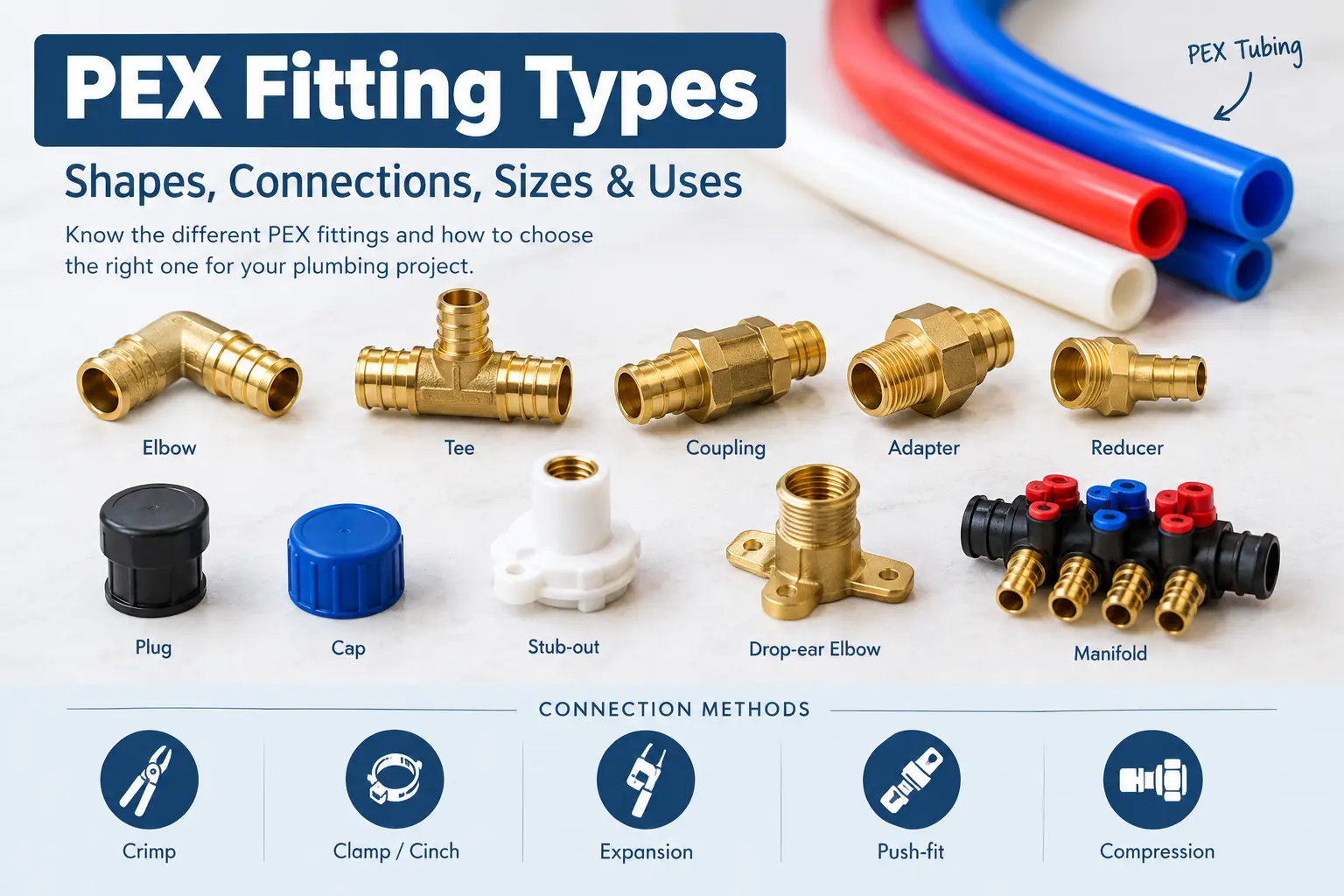
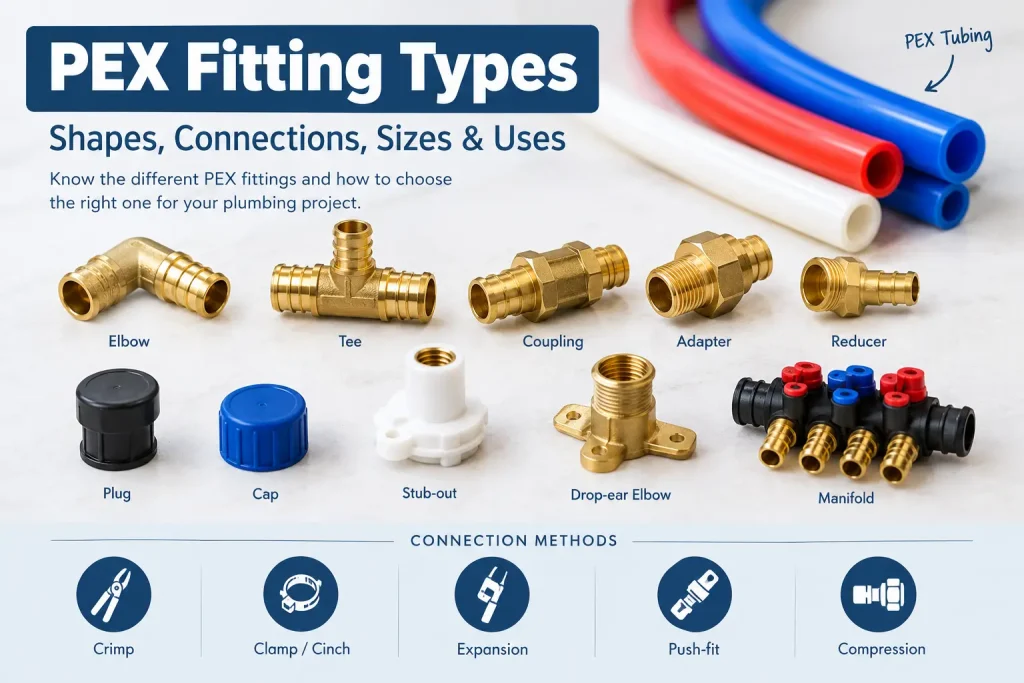
PEX fittings connect PEX tubing to other pipes, fixtures, valves, manifolds, or sections of PEX tubing. The most common PEX fitting types by shape include elbows, tees, couplings, adapters, reducers, plugs, caps, stub-outs, and manifolds.
But there is an important distinction that often causes confusion: a fitting’s shape is not the same thing as its connection method.
For example, a 90-degree elbow describes the fitting’s shape and job. That elbow could be made for a crimp, clamp, expansion, press, or push-fit connection, depending on the product and system.
So when choosing a PEX fitting, you need to consider four things: the fitting shape, connection method, tubing type, and size.
PEX Fitting Types at a Glance
| PEX fitting | What it does | Common use |
|---|---|---|
| Elbow | Changes the direction of the tubing | Turning a PEX line 45° or 90° |
| Tee | Creates a branch | Splitting one water line into two |
| Coupling | Joins two sections of tubing | Repairing or extending a PEX line |
| Adapter | Changes the connection type or material | Connecting PEX to threaded components |
| Reducer | Connects different sizes | Transitioning between PEX sizes |
| Plug | Closes an opening | Capping an unused connection |
| Cap | Closes the end of a pipe or fitting | Ending a PEX run |
| Stub-out | Provides a supported fixture connection | Sinks, toilets, and other fixtures |
| Drop-ear elbow | Provides a supported threaded outlet | Wall-mounted fixtures |
| Manifold | Distributes water to multiple lines | Home-run plumbing systems |
The easiest way to choose a fitting is to start with what you need the pipe to do, then choose the appropriate connection system.
PEX Fittings by Shape and Function
1. PEX Elbows
A PEX elbow changes the direction of a plumbing run without forcing the tubing into an unnecessarily tight bend.
Common options include:
- 90-degree elbows
- 45-degree elbows
- Elbows with threaded outlets
- Drop-ear elbows
- Different connection styles, such as crimp, expansion, press, or push-fit
A 90-degree elbow is useful when a line needs to make a sharp turn, while a 45-degree elbow creates a more gradual change in direction.
Remember that PEX is flexible, so an elbow is not required for every change of direction. The tubing’s allowable bend radius and the manufacturer’s installation instructions still matter.
2. PEX Tees
A PEX tee has three connection points and allows one plumbing line to branch into two.
For example, a tee can take one incoming cold-water line and split it into separate branches for two fixtures.
Tees are available in different sizes and connection configurations, including versions designed to transition to threaded or other pipe connections.
3. PEX Couplings
A coupling joins two sections of PEX tubing.
A coupling can be useful when:
- Extending an existing PEX line
- Repairing a damaged section
- Joining two pieces of the same-size tubing
- Connecting tubing after making a cut
The connection system still matters. A coupling may be designed for crimp, clamp, expansion, press, or another approved system.
4. PEX Adapters
PEX adapters are used when you need to transition from PEX tubing to another type of connection.
Common examples include:
- PEX-to-male-thread adapters
- PEX-to-female-thread adapters
- PEX-to-copper transitions
- PEX-to-fixture connections
- PEX-to-valve connections
An adapter is particularly useful when PEX needs to connect to a component that uses a threaded or different connection.
5. PEX Reducers
A reducing fitting connects tubing or components with different nominal sizes.
For example, a plumbing layout might require a larger supply line to transition to a smaller branch line.
Do not choose a reducer based only on what physically fits. Confirm that the fitting is approved for the tubing and application.
6. PEX Plugs and Caps
Plugs and caps are used to close off unused or terminated connections.
The exact product depends on where the closure is being made and which connection system is being used.
For temporary work, remodeling, or unused branches, choosing the correct termination fitting can make future changes easier.
7. PEX Stub-Outs
A PEX stub-out creates a stable connection point where PEX exits a wall or cabinet and connects to a fixture.
They are commonly used around:
- Sinks
- Toilets
- Faucets
- Other plumbing fixtures
Stub-outs can make the final fixture connection cleaner and provide better support than leaving flexible tubing unsupported.
8. Drop-Ear PEX Elbows
A drop-ear elbow combines an elbow with mounting ears that can be secured to a wall or other structure.
The outlet typically provides a threaded connection for a fixture or fitting.
These are useful for applications such as wall-mounted showerheads and other fixtures where the outlet needs to remain firmly positioned.
9. PEX Manifolds
A PEX manifold distributes water from a supply line to multiple individual branches.
Instead of branching repeatedly through tees, a home-run plumbing layout can send separate PEX lines from the manifold to individual fixtures.
Manifolds are available with different connection systems, so the manifold should match the tubing and connection system being used on the project.
PEX Fitting Types by Connection Method
The fitting’s shape tells you what the fitting does.
The connection method tells you how the PEX tubing attaches to it.
Common PEX connection methods include crimp, clamp/cinch, expansion, press, push-fit, and compression systems. The exact compatibility depends on the fitting, tubing, and manufacturer specifications.
Crimp PEX Fittings
Crimp fittings use a barbed or ribbed insert fitting and a metal crimp ring.
The basic connection involves:
- Sliding the crimp ring onto the PEX tubing.
- Inserting the fitting into the tubing.
- Positioning the ring over the fitting’s connection area.
- Compressing the ring with the appropriate crimp tool.
- Checking the completed connection according to the applicable installation requirements.
ASTM F1807 covers metal insert fittings used with PEX tubing and crimp rings, while ASTM F2159 covers plastic insert fittings. The PPI design guide also identifies the use of a go/no-go gauge with copper crimp-ring connections where applicable.
Clamp or Cinch PEX Fittings
Clamp, often called cinch, systems use a stainless-steel clamp around the PEX tubing and fitting.
The fitting itself can be similar to one used in a crimp system, but the ring is tightened with a clamp tool rather than a crimp tool.
This distinction is important when buying tools and replacement rings.
Expansion PEX Fittings
Expansion systems work by expanding the PEX tubing so that the fitting can be inserted. The tubing and compatible ring then contract around the fitting to form the connection.
Cold-expansion systems are associated with ASTM F1960 and are used with compatible PEX systems.
Do not assume that any PEX tubing can use any expansion fitting. Check the fitting and tubing manufacturer’s compatibility requirements before installation.
PEX Press Fittings
Press systems use a fitting with a sleeve that is compressed around the tubing using a compatible press tool.
Press fittings are designed as a system, so the fitting, tubing, sleeve, and tool must be compatible.
This method is different from crimping because the connection is completed by the specified press tool rather than compressing a separate copper crimp ring.
Push-to-Connect PEX Fittings
Push-fit fittings allow the tubing to be inserted directly into the fitting.
The fitting uses an internal gripping and sealing mechanism to hold the tubing in place. PPI’s current PEX design guide identifies ASSE 1061 as the applicable performance standard for push-fit fittings and notes that these fittings can use an O-ring or gasket to seal around the tubing.
Push-fit fittings can be convenient for repairs and accessible connections, but compatibility and installation requirements still need to be followed.
Compression Fittings
Compression fittings use mechanical components such as a nut, compression ring, and fitting insert to create the connection.
They are particularly relevant to certain transition and PEX-AL-PEX applications.
Always check the fitting manufacturer’s instructions because compression systems are not interchangeable with every type of PEX connection.
Are PEX Fittings Universal?
No. PEX fittings are not universally interchangeable.
A fitting needs to be compatible with the particular tubing and connection system.
Before buying a fitting, check:
- PEX type
- Tubing size
- Fitting type
- Connection method
- Applicable fitting standard
- Manufacturer’s compatibility information
- Intended application
This is especially important when working with PEX-A, PEX-B, PEX-C, or PEX-AL-PEX.
The PPI joining guide identifies different standards and joining methods for different fitting systems, while current manufacturer and supplier information also shows that connection systems have specific tubing requirements.
Can PEX-A and PEX-B Use the Same Fittings?
Sometimes, but not automatically.
PEX-A and PEX-B describe different manufacturing methods for PEX tubing. They can both be used with certain fitting systems, but a particular fitting must be listed or approved for the tubing and connection method.
For example, standard crimp and clamp systems are available for multiple PEX tubing types, while some expansion systems are specifically designed around compatible PEX-A tubing.
If you are unsure, read the markings on the tubing and check the fitting manufacturer’s specifications instead of relying on the PEX letter alone.
For more detail, see our guide to [PEX-A vs. PEX-B].
PEX Fitting Sizes
PEX fittings are commonly sold to match nominal PEX tubing sizes.
Common residential sizes include:
- 3/8 inch
- 1/2 inch
- 5/8 inch
- 3/4 inch
- 1 inch
- 1-1/4 inch
- 1-1/2 inch
- 2 inch
The exact sizes available depend on the fitting type and connection system.
Fitting Size vs. Connection Type
These are two separate specifications.
For example, a 1/2-inch PEX elbow tells you the nominal tubing size and fitting shape. It does not tell you whether the elbow uses crimp, clamp, expansion, press, or push-fit.
Always match the fitting to the tubing size and the connection system.
What Are PEX Fittings Made Of?
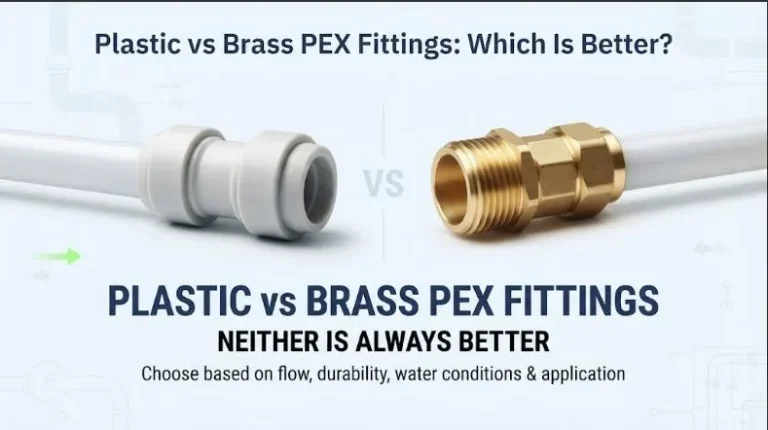
PEX fittings are available in different materials, including brass and engineered polymer/plastic.
Brass PEX fittings
Brass fittings are widely used in plumbing and are available in many fitting shapes and connection systems.
Polymer PEX fittings
Polymer fittings are lightweight and are available for several PEX connection systems.
Neither material should be judged in isolation. The important questions are whether the specific fitting is suitable for the application, compatible with the tubing, and installed according to the manufacturer’s instructions.
PEX Fitting Standards You May See
You may encounter ASTM or other standards printed on PEX fittings, packaging, or technical documentation.
Some commonly referenced standards include:
| Standard | General purpose |
|---|---|
| ASTM F1807 | Metal insert fittings for PEX tubing |
| ASTM F2159 | Plastic insert fittings for PEX tubing |
| ASTM F2098 | Stainless-steel clamp systems |
| ASTM F1960 | Cold-expansion fitting systems |
| ASTM F3347 | PEX press fittings |
| ASTM F3348 | Plastic PEX press fittings |
| ASSE 1061 | Push-fit fitting performance |
These standards are useful because they help identify the fitting system and its intended requirements.
However, a standard number alone should not replace the manufacturer’s installation instructions.
How to Choose the Right PEX Fitting
If you’re standing in the plumbing aisle wondering which fitting you need, start with the job—not the fitting brand.
Step 1: Determine what the fitting needs to do
Need to change direction?
Use an elbow.
Need to branch a line?
Use a tee.
Need to join two pieces?
Use a coupling.
Need to connect PEX to a threaded component?
Use the appropriate adapter.
Need to connect different sizes?
Use a reducer.
Need to close a line?
Use the appropriate plug or cap.
Need multiple dedicated water lines?
Consider a manifold.
Step 2: Identify the PEX tubing
Check the printing on the tubing for information such as:
- Manufacturer
- PEX designation
- Size
- Standard
- Product information
Do not rely only on tubing color or appearance.
You can also read our guide on [how to tell PEX-A from PEX-B].
Step 3: Choose the compatible connection system
Determine whether your installation uses:
- Crimp
- Clamp/cinch
- Expansion
- Press
- Push-fit
- Compression
Step 4: Match the size
A 1/2-inch fitting is not a substitute for a 3/4-inch fitting simply because both physically resemble each other.
Match the nominal fitting size to the tubing and application.
Step 5: Follow the fitting manufacturer’s instructions
This is the final check that prevents many installation mistakes.
Use the specified tool, ring, clamp, expansion ring, sleeve, insertion depth, and connection procedure for that particular system.
Common PEX Fitting Mistakes
Even simple PEX connections can cause problems when the wrong components are mixed.
Assuming every PEX fitting works with every PEX tube
It doesn’t. Compatibility is system-specific.
Confusing fitting shape with connection method
An elbow is a shape. Crimp is a connection method.
They are not competing fitting categories.
Buying the fitting before checking the tubing
Identify the existing PEX first, especially during repairs.
Using the wrong tool
A crimp fitting requires a crimping process. An expansion fitting requires an appropriate expansion tool. A press fitting requires the specified press system.
The tools are not interchangeable simply because the fittings look similar.
Ignoring fitting markings
Standards and manufacturer markings can provide important information about the intended system.
Mixing components from different systems without verification
A fitting that looks physically compatible may not be approved for the tubing or connection method.
Which PEX Fitting Do You Need?
Use this quick guide:
I need to turn the PEX line:
Use an elbow.
I need to split one line into two:
Use a tee.
I need to join two pieces of PEX:
Use a coupling.
I need to connect PEX to a threaded component:
Use an adapter.
I need to connect different PEX sizes:
Use a reducer.
I need to terminate a line:
Use a plug or cap.
I need a supported threaded outlet at a wall:
Consider a drop-ear elbow or appropriate stub-out.
I need separate PEX lines for several fixtures:
Consider a PEX manifold.
Then choose the connection method that is approved for your tubing and application.
PEX Fittings FAQs
What are the main types of PEX fittings?
The main physical fitting types include elbows, tees, couplings, adapters, reducers, plugs, caps, stub-outs, drop-ear fittings, valves, and manifolds.
PEX fittings can also be classified by connection method, including crimp, clamp/cinch, expansion, press, push-fit, and compression systems.
What is the most common PEX fitting?
There isn’t one fitting that is used for every plumbing situation. Elbows, tees, couplings, and adapters are among the common fitting shapes used in residential PEX plumbing.
The appropriate fitting depends on the layout and connection required.
What is the difference between a PEX elbow and a PEX tee?
An elbow changes the direction of a plumbing line, while a tee creates a branch.
Both can be manufactured for different PEX connection systems.
Can you use crimp fittings on PEX-A?
Compatible crimp fittings are available for PEX-A, but the specific fitting, ring, tubing, and installation method must be approved for use together.
Do not assume compatibility from the PEX-A label alone.
Can you use expansion fittings on PEX-B?
Some expansion systems have specific tubing requirements. Compatibility depends on the particular fitting and tubing system, so check the manufacturer’s specifications before using an expansion fitting on PEX-B.
Are PEX fittings available in brass and plastic?
Yes. PEX fittings are available in brass and engineered polymer/plastic versions. The correct choice depends on the fitting system, application, compatibility, and manufacturer’s specifications.
What size PEX fitting do I need?
Use a fitting that matches the nominal size of the PEX tubing and the required connection system. Common residential sizes include 1/2 inch and 3/4 inch, with larger and smaller sizes also available.
Bottom Line
The easiest way to understand PEX fitting types is to separate them into two categories.
First, choose the fitting by shape and function: elbow, tee, coupling, adapter, reducer, plug, stub-out, or manifold.
Then choose the connection method: crimp, clamp, expansion, press, push-fit, or compression.
Finally, verify the PEX type, size, fitting standard, compatibility, and manufacturer instructions before making the connection.
That approach prevents one of the most common PEX mistakes: choosing a fitting because it looks right without checking whether the entire fitting system is actually designed for the tubing you’re using.