
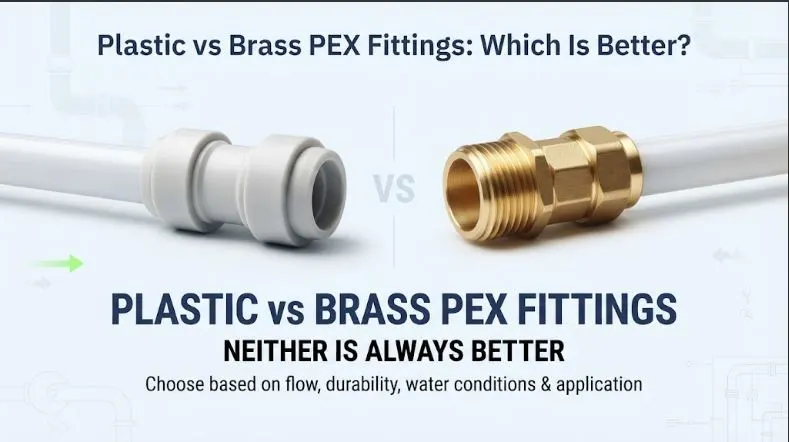
Plastic vs Brass PEX Fittings: Which Is Better?
Plastic and brass PEX fittings can both be reliable choices. The better option depends on the fitting design, connection method, water conditions, flow requirements, installation, and product certification—not simply whether the fitting is plastic or brass.
For most residential PEX plumbing, high-quality plastic fittings made from engineered polymers such as PPSU can offer excellent corrosion resistance and lower material cost. Brass fittings provide a rigid, mechanically robust connection and are still a popular choice among plumbers.
The important point is this: do not choose a PEX fitting by material alone.
Check the fitting’s connection system, pressure and temperature rating, compatibility with your PEX tubing, internal flow passage, potable-water certification, and manufacturer’s installation requirements.
This guide compares plastic vs brass PEX fittings in the areas that actually matter on a plumbing job.
Quick Comparison: Plastic vs Brass PEX Fittings
| Feature | Plastic / Polymer PEX Fittings | Brass PEX Fittings |
|---|---|---|
| Material | Often engineered polymer such as PPSU | Copper-zinc alloy |
| Corrosion resistance | Excellent | Depends on alloy and water chemistry |
| Dezincification | Not applicable | Possible with susceptible brass |
| Weight | Lightweight | Heavier |
| Mechanical rigidity | Good | Excellent |
| Cost | Usually lower | Usually higher |
| Flow | Depends on fitting design | Depends on fitting design |
| Drinking water | Safe when properly certified | Safe when properly certified |
| Crimp compatibility | Product-specific | Product-specific |
| Clamp / cinch compatibility | Product-specific | Product-specific |
| Expansion compatibility | Product-specific | Product-specific |
| Aggressive water | Strong advantage | Alloy selection matters |
| Physical abuse | Good, but product-dependent | Strong advantage |
| Best use | Corrosion resistance, lower cost, and many residential jobs | Mechanical robustness and traditional metal fittings |
What Are PEX Fittings?
PEX fittings are the components used to connect PEX tubing to other PEX tubing, valves, manifolds, fixtures, or other plumbing materials.
Common fitting shapes include:
- Elbows
- Tees
- Couplings
- Adapters
- Reducers
- Stub-outs
- Manifold connections
The fitting itself can be made from metal or an engineered polymer.
The connection method can also vary.
Common PEX connection systems include:
- Crimp
- Cinch or clamp
- Expansion
- Press
- Push-to-connect
- Compression
That distinction matters because fitting material and connection method are not the same thing.
For a broader introduction to PEX systems, see our guide to what PEX plumbing is.
What Are Plastic PEX Fittings Made Of?
When plumbers talk about plastic PEX fittings, they are usually not talking about ordinary household plastic.
Many PEX insert fittings use engineered polymers such as polyphenylsulfone (PPSU).
PPSU is a high-performance engineering thermoplastic designed for demanding plumbing applications. It is very different from the brittle plastic products that many homeowners picture when they hear the word “plastic.”
ASTM F2159 covers sulfone plastic insert fittings used with PEX and PE-RT tubing. The specification includes performance requirements such as hydrostatic burst testing, sustained pressure testing, thermocycling, excessive temperature-pressure testing, dimensional requirements, and insert-crush testing.
That is an important distinction.
A properly manufactured and certified polymer PEX fitting is an engineered plumbing component, not simply a cheap piece of generic plastic.
What Are Brass PEX Fittings Made Of?
Brass PEX fittings are metal insert fittings made primarily from copper and zinc alloys.
The exact alloy matters.
Modern plumbing fittings may use lead-free and dezincification-resistant brass alloys, depending on the manufacturer and application.
ASTM F1807 covers metal insert fittings used with PEX and PE-RT tubing in the applicable connection systems. The current ASTM specification covers metal insert fittings and associated crimp rings or alternate stainless-steel clamps and includes dimensional, material, workmanship, and performance requirements.
So “brass fitting” does not tell you everything you need to know.
Two brass fittings from different manufacturers can have different alloys, designs, flow passages, certifications, and performance characteristics.
Plastic vs Brass PEX Fittings: The Biggest Differences
1. Corrosion Resistance
This is one of the clearest advantages of polymer fittings.
Plastic
Engineered polymer fittings do not experience metal corrosion or dezincification.
That can make them attractive in water conditions where corrosion is a concern.
Brass
Brass is a durable plumbing material, but it can be affected by water chemistry.
One concern is dezincification.
Dezincification occurs when zinc is selectively removed from certain brass alloys. Over time, this can weaken the fitting and potentially contribute to failure.
That does not mean every brass PEX fitting will dezincify.
Modern plumbing products can use alloys designed to improve resistance to dezincification.
Winner for corrosion resistance: Plastic
If corrosion and water chemistry are major concerns, an appropriate certified polymer fitting can have a significant advantage.
2. Strength and Mechanical Rigidity
Brass has an obvious advantage when you need a rigid fitting.
A brass fitting feels solid when you handle it, and it generally tolerates physical abuse very well.
This can be useful around:
- Water heaters
- Equipment connections
- Exposed plumbing
- Mechanical connections
- Areas where the fitting may be bumped or stressed
Polymer fittings can also be strong and durable, but their performance depends on the particular material and design.
Winner for mechanical rigidity: Brass
But don’t confuse rigidity with overall plumbing-system reliability.
A properly selected polymer fitting can still provide long-term service when installed within its listed application.
3. Cost
Plastic PEX fittings are usually less expensive than brass fittings.
That difference becomes more important when a project requires dozens or hundreds of fittings.
For example, a whole-house repipe may use:
- Tees
- Elbows
- Couplings
- Adapters
- Fixture connections
- Manifold connections
Even a small difference per fitting can become meaningful across a large project.
For homeowners comparing total repiping costs, our Repipe Cost Calculator can help estimate the broader project cost.
Winner for material cost: Plastic
However, don’t select fittings based only on the cheapest price.
A low-cost fitting that is incompatible with your tubing or connection method is not a bargain.
4. Weight
Polymer fittings are significantly lighter than brass.
That matters most for large installations where a plumber may handle hundreds of fittings.
Less weight can also make installation and transportation easier.
Winner: Plastic
For a small residential repair, however, the weight difference usually isn’t important enough to determine the fitting choice.
5. Water Flow
This is where the comparison gets more interesting.
You may hear:
“Brass fittings have better flow.”
That statement is too broad.
Flow is determined by the fitting’s internal geometry and effective flow area, not simply by whether the fitting is metal or plastic.
The fitting creates a restriction inside the PEX tube.
Different designs can have different:
- Internal diameters
- Flow areas
- Wall thicknesses
- Internal geometries
- Pressure drops
Published engineering comparisons show that standard plastic insert fittings can have a smaller internal flow passage than some metal insert fittings. Other fitting designs, particularly engineered-polymer expansion fittings, can have substantially different flow characteristics again.
For example, one manufacturer comparison reported larger flow areas for its F1807 metal insert fittings than its F2159 polymer insert fittings in the same nominal sizes.
But this does not mean:
brass always flows better than plastic.
A different fitting design can produce a different result.
What to check if flow matters
Look for the manufacturer’s:
- Internal diameter
- Flow-area data
- Pressure-drop data
- Fitting Cv data, where provided
- Connection-system specifications
Winner for flow: It depends on the fitting design
This is one of the most important points in the entire comparison.
6. Pressure and Temperature
Do not assume that a fitting is suitable for an application simply because it is made from brass or polymer.
The specific product’s listing and manufacturer’s specifications control.
ASTM specifications for the relevant fitting categories include performance requirements for pressure and temperature. For example, ASTM F1807 and ASTM F2159 specifications describe fittings for SDR9 PEX systems in cold- and hot-water applications and include performance testing related to pressure and temperature.
Always check the actual fitting documentation before using it in:
- Hot-water systems
- High-pressure applications
- Hydronic systems
- Radiant heating
- Commercial plumbing
- Specialized applications
Key rule
Never choose a fitting because “brass is stronger” or “plastic can’t corrode.” Choose a fitting that is listed for the actual application.
7. Drinking-Water Safety
Both plastic and brass PEX fittings can be suitable for potable water.
The material alone does not determine whether a fitting is appropriate for drinking water.
Look for the applicable certification and product listing.
NSF-certified plumbing products can carry certifications addressing health effects, lead content, and applicable plumbing standards. NSF listings also identify fitting-system designations such as ASTM F1807, F2159, F1960, and F2098 for compatible PEX systems.
For potable water, look for appropriate certifications such as:
- NSF/ANSI/CAN 61
- NSF/ANSI/CAN 372
- Applicable product standards
- Applicable local plumbing-code requirements
Important
Do not assume:
Plastic = automatically safe
or:
Brass = automatically safe.
Instead:
Use a fitting that is certified and listed for potable-water use.
That is the more reliable way to choose.
Are Plastic PEX Fittings Safe?
Yes, properly manufactured, certified plastic PEX fittings can be safe for plumbing applications.
The word “plastic” by itself does not tell you whether a fitting is suitable.
Look at:
- The material
- The manufacturer
- The applicable ASTM standard
- Potable-water certification when required
- Pressure and temperature ratings
- PEX compatibility
- Installation instructions
ASTM F2159 specifically establishes performance requirements for sulfone plastic insert fittings, including pressure, thermocycling, temperature-pressure, dimensional, and assembly testing.
So the better question is not:
“Is plastic strong enough?”
It is:
“Is this specific polymer fitting certified and listed for my plumbing application?”
Do Plastic PEX Fittings Leak More Than Brass?
Not automatically.
A leak is often related to the entire connection rather than simply the fitting material.
Important factors include:
- Correct fitting selection
- Correct PEX tubing
- Correct connection method
- Proper tubing preparation
- Correct insertion depth
- Proper crimp or clamp installation
- Correct tool
- Proper tool calibration where applicable
- Damaged tubing
- Manufacturer instructions
A brass fitting installed incorrectly can leak.
A polymer fitting installed incorrectly can also leak.
The quality of the connection matters.
The practical rule
A properly matched and correctly installed fitting system is more important than simply choosing brass over plastic.
Plastic vs Brass PEX Fittings for Crimp Connections
Crimp is one of the most common PEX connection methods.
A crimp connection uses a fitting inserted into the PEX tube and a copper crimp ring compressed around the tubing.
ASTM F1807 covers metal insert fittings used with copper crimp rings or alternate stainless-steel clamps, while ASTM F2159 covers sulfone plastic insert fittings used with copper crimp rings or alternate stainless-steel clamps for the specified PEX/PE-RT applications.
Brass crimp fitting
Pros:
- Rigid
- Strong mechanical feel
- Widely available
- Familiar to many plumbers
- Can provide a larger flow passage in some designs
Cons:
- More expensive
- Heavier
- Can be affected by water chemistry depending on alloy
Plastic crimp fitting
Pros:
- Lower cost
- Lightweight
- Corrosion resistant
- No dezincification
- Suitable for many residential applications
Cons:
- Some designs have smaller internal flow passages
- Polymer material can be less tolerant of certain physical abuse than metal
- Must be selected and installed according to the manufacturer’s requirements
Plastic vs Brass PEX Fittings for Cinch or Clamp Connections
Cinch fittings use a stainless-steel clamp compressed around the PEX tubing and fitting.
Both polymer and metal insert fittings can be available for clamp-style systems.
The same rule applies:
Don’t assume compatibility from appearance.
Check the fitting and tubing manufacturer’s requirements.
The clamp, fitting, tubing, and installation tool work as a system.
Plastic vs Brass PEX Fittings for Expansion
Expansion systems are especially important when discussing PEX-A.
An expansion connection uses an expander tool to enlarge the PEX tubing and sleeve so the fitting can be inserted.
The tubing then contracts around the fitting.
ASTM F1960 is associated with cold-expansion PEX systems, while other expansion systems use their own listed components and requirements.
This is an area where fitting geometry can make a major difference in flow.
Engineering data from Uponor, for example, shows that its engineered-polymer F1960 fitting can have a larger flow area than a standard F2159 plastic insert fitting and can be comparable to or slightly different from its brass F1960 counterpart depending on size.
Important lesson
Do not compare “plastic expansion fitting” with “plastic crimp fitting” as though they are the same product.
Connection design matters.
Does PEX-A or PEX-B Change Which Fitting You Should Choose?
Yes.
Your PEX type matters because different PEX systems support different connection methods.
PEX-A
PEX-A is commonly associated with expansion connections.
Depending on the system and manufacturer, PEX-A can also be used with other approved fitting systems.
PEX-B
PEX-B is commonly used with crimp and clamp systems.
It does not have the same expansion behavior as PEX-A, so you should not assume that an expansion fitting system is interchangeable simply because the tubing has the same nominal size.
The rule
Match the fitting to the tubing and connection system—not simply to the nominal pipe size.
For a deeper comparison, see our guide to PEX-A vs PEX-B.
Plastic vs Brass PEX Fittings: Which Has Better Flow?
If maximum flow is important, compare the actual fitting design.
A standard insert fitting reduces the effective opening inside the PEX pipe.
That means two fittings labeled “1/2-inch PEX” can have different internal flow areas.
For example, published comparison data shows a difference between F2159 polymer insert fittings and F1807 metal insert fittings in internal diameter and open area. In one comparison, the reported 1/2-inch polymer fitting had a 0.315-inch inside diameter and 0.078 square inches of open area, compared with 0.350 inches and 0.096 square inches for the metal fitting.
But expansion fittings can change the picture considerably.
That’s why a better question is:
Which fitting system gives me the flow performance I need?
rather than:
Is brass better than plastic?
Why Fitting Geometry Matters More Than Many Homeowners Realize
The fitting sits inside the pipe.
That creates a bottleneck.
If a fitting has a smaller internal passage, water experiences more resistance through that section.
This becomes more important when a system has:
- Long pipe runs
- Multiple elbows
- Many tees
- Several fittings in series
- High fixture demand
- Small pipe sizes
- Low available pressure
A fitting with a larger flow passage can reduce pressure loss compared with a more restrictive design.
For a normal single-fixture residential branch, the difference may not matter much.
For a carefully designed high-flow system, it can matter considerably.
Which Is Better for Hard or Aggressive Water?
If water chemistry is a major concern, polymer fittings have a clear advantage because they do not undergo metal dezincification.
Brass selection becomes more important in these conditions.
Ask:
- Is the water acidic?
- Is the water aggressive?
- Is there a known corrosion problem?
- Is the brass fitting dezincification resistant?
- Is the product certified for the application?
General recommendation
If you have known aggressive water, a properly certified polymer fitting can be an attractive choice.
If you prefer brass, select a fitting specifically designed for the water conditions and application rather than assuming every brass alloy behaves the same way.
Which Is Better Around a Water Heater?
This requires more care than simply saying “use brass.”
A water-heater connection is exposed to hot water and can also experience movement, vibration, and mechanical stress.
The correct fitting should be:
- Rated for the operating temperature
- Rated for the pressure
- Listed for the application
- Compatible with the tubing
- Installed according to the manufacturer’s instructions
Brass can be attractive where rigidity is valuable.
But a polymer fitting that is specifically listed and rated for the application can also be suitable.
Best answer
Choose the fitting based on its listing and application rating, not material alone.
Which Is Better for a Whole-House PEX Repiping Project?
For a large repiping project, cost and fitting count become important.
Plastic fittings can reduce material costs, particularly when a project uses many connections.
They are also lightweight and resistant to metal corrosion.
Brass fittings cost more but provide excellent rigidity and mechanical strength.
Your decision should consider:
- Number of fittings
- Material budget
- Water chemistry
- Connection method
- Flow requirements
- Installer preference
- Product availability
- Local code
- Manufacturer system compatibility
For estimating the broader project, use the PlumbJournal Repipe Cost Calculator.
Plastic vs Brass PEX Fittings: Best Choice by Situation
| Situation | Better starting point | Why |
|---|---|---|
| Lowest fitting cost | Plastic | Usually lower material cost |
| Corrosion concern | Plastic | No metal corrosion or dezincification |
| Aggressive water | Plastic | Avoids metal-alloy corrosion concerns |
| Maximum rigidity | Brass | Rigid metal construction |
| Physical abuse | Brass | Generally more mechanically robust |
| Lightweight installation | Plastic | Much lighter |
| Large number of fittings | Plastic | Lower material cost can add up |
| Potable water | Either | Use properly certified products |
| Maximum flow | Depends | Compare actual internal flow area |
| PEX-A expansion | Either, if listed | Match the expansion system |
| PEX-B crimp | Either, if listed | Match the connection system |
| Outdoor exposure | Depends | Follow UV and manufacturer limits |
| Underground use | Depends | Verify application listing and code |
| Commercial/high-demand system | Depends | Engineering and flow data matter more |
Can You Use Plastic and Brass PEX Fittings in the Same System?
In many systems, you can have both polymer and brass components.
For example, a plumbing system might use:
- Polymer elbows
- Brass adapters
- Brass valves
- Polymer tees
- A brass manifold connection
But compatibility still matters.
You should not mix components simply because the sizes appear identical.
Verify:
- Connection method
- Tubing type
- Manufacturer requirements
- Product listing
- Pressure rating
- Temperature rating
- Application
The goal is a compatible system, not a collection of individually compatible-looking parts.
Can Plastic PEX Fittings Be Used Underground?
Sometimes, but don’t make a blanket assumption.
Underground applications can involve additional requirements involving:
- Burial
- Soil conditions
- Mechanical protection
- Corrosion
- Accessibility
- Local plumbing code
- Manufacturer approval
Always check the specific fitting’s installation instructions and listing before burying it.
The same applies to brass.
Neither “plastic” nor “brass” automatically means approved for every underground application.
Can Plastic PEX Fittings Be Used Outdoors?
UV exposure is an important consideration.
PEX and its fittings should not be treated as unlimited outdoor-exposure products simply because they are corrosion resistant.
Follow the manufacturer’s requirements for:
- Direct sunlight
- Storage
- Exposure time
- Protection
- Installation
If the fitting or tubing is going into an exposed outdoor location, verify that the complete system is suitable for that environment.
Plastic vs Brass PEX Fittings: Common Mistakes to Avoid
Mistake 1: Choosing by color
A white or black polymer fitting isn’t automatically better or worse than a brass fitting.
Color tells you very little about performance.
Mistake 2: Assuming all plastic fittings are cheap plastic
Quality polymer PEX fittings can be engineered from high-performance materials such as PPSU.
Mistake 3: Assuming all brass fittings are corrosion-proof
Brass can be affected by water chemistry, and alloy selection matters.
Mistake 4: Assuming brass always has better flow
Flow depends heavily on internal geometry.
Mistake 5: Ignoring the connection method
A fitting must be compatible with the connection system.
Mistake 6: Ignoring certification
Potable-water applications require the correct certified product.
Mistake 7: Mixing systems without checking compatibility
PEX-A, PEX-B, crimp, clamp, expansion, and press systems are not interchangeable simply because they use the same nominal pipe size.
Mistake 8: Choosing only by price
The cheapest fitting is not necessarily the best fitting.
What Should You Look for When Buying PEX Fittings?
Before buying a fitting, check these eight things.
1. Fitting material
Is it brass, PPSU, or another approved engineering polymer?
2. Connection method
Is it:
- Crimp?
- Clamp?
- Expansion?
- Press?
- Push-fit?
3. PEX compatibility
Does the manufacturer approve it for your PEX type?
4. Pressure rating
Does it meet the requirements of your system?
5. Temperature rating
Is it suitable for cold water, hot water, or hydronic service?
6. Potable-water certification
If you’re using it for drinking water, verify the applicable certification.
7. Internal flow passage
If flow is important, compare actual flow data.
8. Manufacturer instructions
Always follow the manufacturer’s installation requirements.
ASTM F1807 vs ASTM F2159: What Is the Difference?
This is useful terminology to understand when shopping for PEX fittings.
ASTM F1807 covers metal insert fittings used with PEX/PE-RT systems in the applicable applications.
ASTM F2159 covers sulfone plastic insert fittings used with PEX and PE-RT tubing for the applicable connection systems.
The standards are not simply saying:
“Brass is good.”
or:
“Plastic is good.”
They establish requirements for fitting materials, dimensions, workmanship, assembly, and performance testing.
ASTM’s current F1807 specification includes metal insert fittings and copper crimp rings or alternate stainless-steel clamps and describes performance requirements for the fitting assembly.
ASTM F2159 establishes requirements for sulfone plastic insert fittings and includes testing for burst pressure, sustained pressure, thermocycling, excessive temperature and pressure, dimensions, and the assembled crimp joint.
Why this matters
Seeing the appropriate standard on a fitting gives you more useful information than simply seeing “brass” or “plastic.”
What About NSF Certification?
For potable-water applications, look for the appropriate certification for the product.
NSF listings demonstrate how PEX systems can be certified with specific fitting-system designations and requirements for health effects and lead content.
Two terms you may encounter are:
NSF/ANSI/CAN 61
This addresses health effects associated with drinking-water system components and materials.
NSF/ANSI/CAN 372
This addresses lead-content requirements for plumbing products.
The exact certification depends on the product and application.
Practical rule
Don’t ask:
“Is brass safe?”
Ask:
“Is this exact fitting certified for my intended potable-water application?”
So, Are Brass PEX Fittings Better Than Plastic?
Not universally.
Brass has clear advantages in mechanical rigidity and can be an excellent choice where a strong, rigid fitting is desirable.
Plastic has clear advantages in corrosion resistance, weight, and usually cost.
But the most important differences often come from the specific fitting design and connection system.
A high-quality polymer expansion fitting can have very different flow characteristics from a standard polymer crimp fitting.
Likewise, one brass fitting can have different flow and corrosion characteristics from another brass fitting.
So, Are Plastic PEX Fittings Better Than Brass?
Again, not universally.
Plastic can be the better choice when:
- Corrosion resistance is important
- Water chemistry is aggressive
- You need many fittings
- Lower material cost matters
- Weight matters
- The specific polymer fitting is properly certified and listed
Brass can be the better choice when:
- Mechanical rigidity is important
- The fitting is exposed to physical stress
- You prefer a rigid metal connection
- The specific brass fitting provides the flow characteristics you need
- The alloy and certification are appropriate for the water conditions
Our Verdict:
Choose plastic/PPSU when corrosion resistance, lower cost, and lightweight installation are your priorities. Choose brass when mechanical rigidity and robustness are more important. But when flow, potable-water safety, or specialized applications matter, choose based on the specific fitting design and certification—not material alone.
