
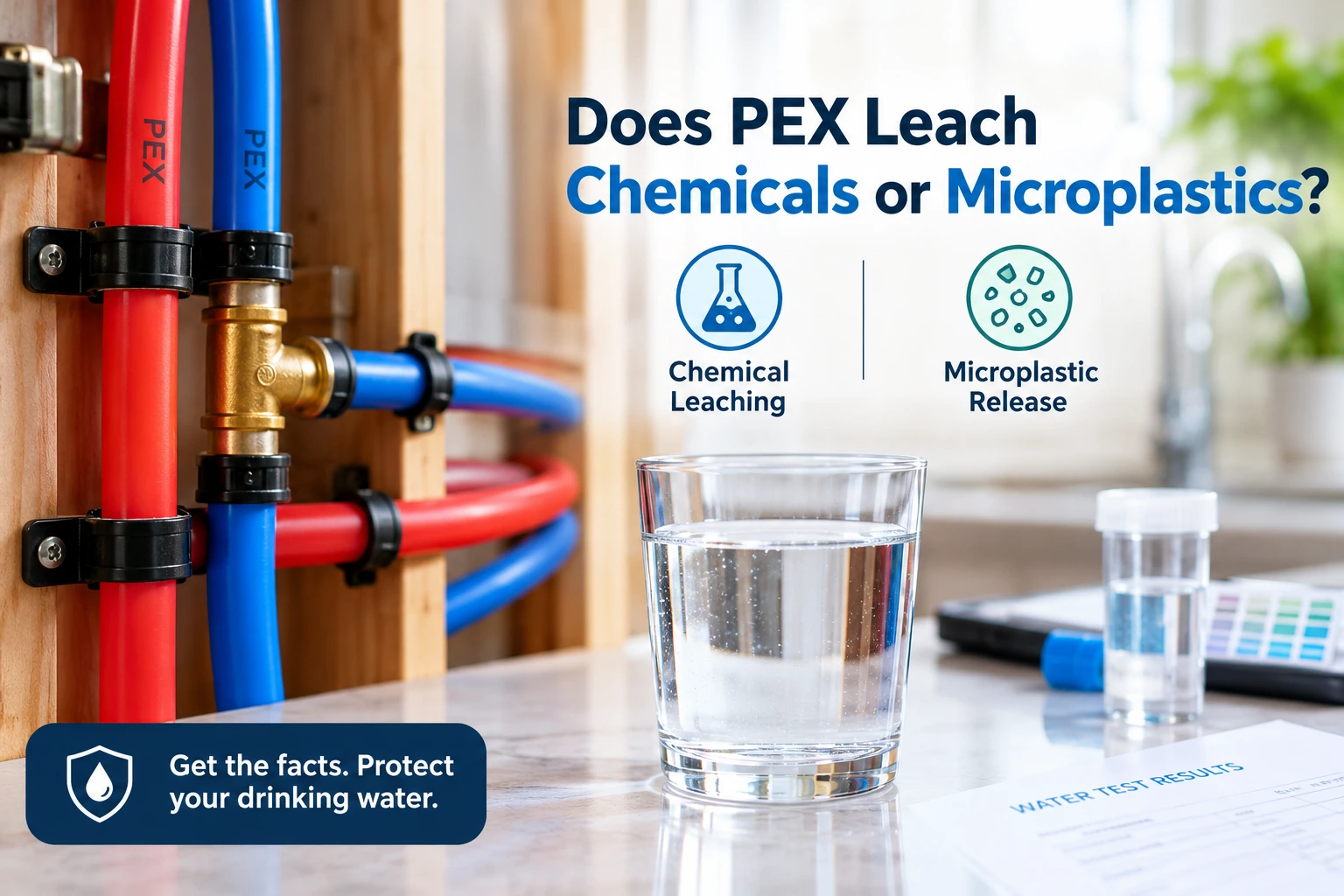
Does PEX Leach Chemicals or Microplastics Into Drinking Water?
PEX pipes can release small amounts of chemicals into water under certain conditions. Research has detected organic compounds migrating from PEX (cross-linked polyethylene) plumbing into water. However, finding a chemical does not automatically mean the water is unsafe to drink. The amount released and the level of exposure matter.
Microplastics are a separate concern. Although researchers have found microplastics in drinking-water systems, the available evidence does not yet establish how many microplastic particles, if any, typical residential PEX pipes release into drinking water over time.
For homeowners, the best approach is to choose PEX products approved for potable water, check their drinking-water certification, and follow the manufacturer’s installation and flushing instructions.
What Chemicals Can PEX Pipes Release?
PEX is a flexible plastic tubing material used for hot- and cold-water plumbing. Manufacturers make it by cross-linking polyethylene to improve its properties for plumbing applications. You can learn more in our guide to what PEX pipe is and how it works.
Like other materials that contact drinking water, PEX can release small amounts of substances into the water that flows through it. Researchers call this process chemical leaching or chemical migration.
A 2014 study published in Water Research examined six PEX brands sold in the United States. Researchers identified several organic compounds associated with the tested plumbing systems. Other studies have also investigated chemical migration from PEX, including how water temperature and stagnation affect water quality.
These findings show that chemical migration can occur. They do not prove that every PEX product releases the same chemicals or that all detected compounds reach harmful levels.
Which substances have researchers detected?
Research on PEX and related plumbing materials has investigated various volatile and nonvolatile organic compounds. The substances detected can differ by product, manufacturing process, water chemistry, and testing method.
It is important to understand three things when reading these studies:
- Detection is not the same as danger. A chemical may be present at a level too low to cause a meaningful health risk.
- Concentration matters. Researchers need to measure how much of a substance enters the water.
- Exposure matters. Risk depends on the substance, the amount consumed, and how often exposure occurs.
Some laboratory studies use extraction methods or exposure conditions that differ from normal household use. Their findings can help identify possible contaminants, but they should not automatically be treated as measurements of what a homeowner drinks every day.
For a useful interpretation, look for studies that identify individual chemicals, measure their concentrations, and compare the results with appropriate health-based criteria.
Can PEX Pipes Release Microplastics?
Microplastics are tiny plastic particles, generally defined as particles smaller than 5 millimeters. They can enter water through several pathways, including environmental contamination, plastic materials, and water distribution systems.
Because PEX is a plastic plumbing material, it is reasonable to ask whether particles can detach from its inner surface and enter drinking water. However, chemical leaching and microplastic release are not the same process.
Chemical leaching occurs when substances migrate out of a material and dissolve or disperse into water. Microplastic release involves physical particles separating from the material.
Evidence that PEX releases chemicals does not, by itself, prove that it releases microplastics. Likewise, finding microplastics in tap water does not identify PEX pipes as their source.
A 2024 review in Science of the Total Environment discussed microplastics and associated chemicals in drinking water. It covered different sources and pathways but does not establish a typical microplastic release rate for residential PEX plumbing.
What does the evidence tell us?
Researchers need more direct testing to determine whether PEX pipes release microplastics under realistic household conditions.
Useful studies would examine different PEX formulations, pipe ages, water temperatures, flow conditions, and periods of stagnation. They would also need reliable methods to identify and count particles while preventing contamination from laboratory equipment.
Until more product-specific evidence is available, it is not accurate to claim either that PEX pipes definitely release harmful amounts of microplastics or that they never release particles.
Is PEX Safe for Drinking Water?
PEX can be suitable for potable-water plumbing when the specific product meets the applicable requirements and is installed correctly. Its suitability should not be judged by the word “plastic” alone.
In the United States and Canada, NSF/ANSI/CAN 61 is a key health-effects standard for products that contact drinking water. It evaluates whether contaminants migrating from covered products meet applicable health-based acceptance criteria.
Certification is useful because it provides a more reliable basis for evaluating a plumbing product than broad claims about plastic safety. However, it does not mean that absolutely no substance can ever migrate from a product under every possible condition.
What about studies that raise health concerns?
A 2023 study published in Environmental Advances investigated chemical migration from PEX, changes in microbial growth, and developmental effects in zebrafish exposed to test water. The researchers reported findings that support further investigation into PEX-related water quality.
These results deserve attention, but they need careful interpretation. Laboratory and animal studies can identify potential hazards and guide future research. They do not, on their own, establish that people drinking water from properly certified residential PEX plumbing will experience the same effects.
NSF has also discussed limitations in some PEX studies, including differences between experimental extraction conditions and standardized drinking-water testing. This highlights why test methods, measured concentrations, and exposure levels matter.
The most balanced conclusion is that chemical migration from PEX is documented, while the health implications depend on the substances and concentrations involved. Certification to the relevant standard helps evaluate a product’s suitability for drinking-water contact.
Does PEX-A, PEX-B, or PEX-C Leach More Chemicals?
PEX-A, PEX-B, and PEX-C describe different manufacturing methods used to cross-link polyethylene. They are not direct safety ratings.
The manufacturing process can influence a pipe’s material properties and potentially affect which substances migrate into water. However, the available evidence does not support a universal rule that one PEX type always leaches fewer chemicals than the others.
Product formulation, additives, manufacturing controls, water chemistry, temperature, and testing conditions can all affect the results.
| PEX type | How it is made | What to know about chemical leaching |
|---|---|---|
| PEX-A | Typically uses the peroxide method | Do not assume it always releases fewer chemicals. Check the specific product’s certification. |
| PEX-B | Typically uses the silane method | Performance and chemical migration depend on the product and testing conditions. |
| PEX-C | Typically uses electron-beam irradiation | The manufacturing method alone does not establish drinking-water safety. |
If you are comparing tubing options, read our guide to PEX-A vs. PEX-B. Choose products intended for potable water and verified for the relevant requirements rather than relying on the PEX category alone.
What Factors Can Affect Chemical Leaching From PEX?
Chemical migration is not always constant. Several factors can influence how much material enters the water.
1. New pipes and initial use
New plumbing may release different amounts of certain compounds than plumbing that has been in use for months or years. A five-year study of PEX-A plumbing found that the migration of volatile organic compounds decreased rapidly during the first months of observation.
This does not mean every new PEX system follows the same pattern. It does show why the age of the pipe and the timing of water sampling matter.
Follow the manufacturer’s instructions for flushing newly installed plumbing before using it for drinking water.
2. Water temperature
Temperature can affect the movement of substances from a pipe into water. A 2023 laboratory study reported greater organic-carbon release from PEX at elevated water temperatures under its test conditions.
That finding does not mean all chemicals increase at the same rate or that normal hot-water use automatically creates a health hazard. It means temperature should be considered when evaluating test results.
3. Water stagnation
Water that remains in a pipe for several hours can have a different chemical profile from freshly flowing water. The longer contact time may affect the migration of some substances.
A study of PEX-A plumbing found that stagnation time influenced measured concentrations. However, the effect varies with the material, water conditions, and compound being studied.
4. Water chemistry and pipe formulation
Water pH, disinfectants, temperature, and other water-quality factors may influence interactions between plumbing materials and water. Pipe formulation and manufacturing differences can also affect migration.
For these reasons, one study cannot automatically predict the performance of every PEX product in every home.
What Does NSF/ANSI/CAN 61 Certification Mean?
NSF/ANSI/CAN 61 is a health-effects standard for products and materials that come into contact with drinking water. It evaluates contaminants that may migrate from those products into the water.
The standard does not mean a product has zero chemical migration. Instead, testing assesses whether relevant contaminants meet the applicable health-based criteria.
When selecting PEX tubing, use this checklist:
- Confirm that the tubing is intended for potable-water applications.
- Check the manufacturer’s documentation for applicable certifications.
- Verify the exact brand and product listing in the certifier’s official directory.
- Confirm that the fittings and other water-contact components are suitable for drinking water.
- Follow local plumbing codes and the manufacturer’s installation instructions.
You can use the NSF product certification resources to begin checking product information. Look for the actual product listing rather than relying only on a logo in a sales description.
Certification is an important part of product selection, but it does not replace proper installation, maintenance, or investigation of a specific water-quality problem.
How Can You Reduce Potential Water-Quality Problems With PEX?
You do not need to assume that every PEX installation is unsafe. Instead, focus on practical steps that help protect drinking-water quality.
Choose suitable products. Use tubing and fittings designed for potable water and compliant with applicable local requirements.
Flush new plumbing as directed. Follow the manufacturer’s instructions and any guidance provided by your plumber. Do not assume that a universal flushing time applies to every system.
Pay attention to unusual taste or odor. A plastic-like smell or taste does not identify a specific chemical or prove that the water is dangerous. However, a persistent change deserves investigation.
Check the water source. If several taps are affected, contact your water utility or a qualified plumber. The issue may involve the supply, plumbing components, stagnant water, or another source.
Arrange appropriate testing when needed. If the concern persists, consult a qualified drinking-water laboratory or local health authority about suitable sampling and testing. The correct test depends on the suspected contaminant.
If you have a specific concern about a new installation, ask the installer which tubing and fittings were used and request their product documentation.
PEX vs. Copper: Which Is Better for Drinking Water?
PEX and copper are both widely used for residential plumbing, but neither should be judged by material type alone.
PEX is flexible and often requires fewer fittings along a run. Copper is a metal pipe that has a long history of use in water distribution. Both materials can interact with water, and the condition of the system, water chemistry, product quality, and installation all matter.
| Factor | PEX | Copper |
|---|---|---|
| Material | Cross-linked polyethylene | Copper metal |
| Flexibility | Flexible; can reduce the number of fittings needed | Rigid tubing in common residential installations |
| Potential water-quality concern | Migration of certain organic compounds; PEX-specific particle release needs further study | Metal release can occur under some water conditions |
| Product selection | Verify potable-water suitability and applicable certification | Verify applicable requirements and suitable materials |
| Installation | Requires compatible fittings and tools | Requires appropriate joining methods and tools |
There is no universal winner for every home. The better choice depends on the water chemistry, local plumbing requirements, installation conditions, budget, and the specific products used.
For a broader comparison, see our guide to PEX vs. copper: which is better for plumbing?. You can also review our guide to common PEX pipe fittings when planning a system.
Frequently Asked Questions
Does PEX leach chemicals into drinking water?
Yes. Research has detected organic compounds migrating from PEX into water. The substances and concentrations vary, and detecting a compound does not automatically mean that exposure is harmful.
Can PEX pipes release microplastics?
It remains uncertain how much, if any, microplastic material typical residential PEX pipes release under normal household conditions. Finding microplastics in drinking water does not establish that PEX plumbing is the source.
Is PEX safe for drinking water over the long term?
PEX products that meet the applicable requirements for potable-water use can be suitable for residential plumbing. Choose properly certified products and follow installation instructions. Long-term safety should be evaluated using relevant product testing and exposure evidence rather than assumptions about all plastic pipes.
Does PEX-A leach less than PEX-B?
There is not enough evidence to say that PEX-A always leaches less than PEX-B. The specific product, formulation, water conditions, and testing method matter.
Should I flush new PEX pipes before drinking the water?
Follow the manufacturer’s instructions and your plumber’s guidance for flushing a new system. Flushing can replace stagnant water, but it should not be treated as proof that every possible contaminant has been removed.
Why does water from new PEX pipes smell like plastic?
Some plumbing materials can affect water taste or odor, especially during initial use. However, smell alone cannot identify a chemical or establish whether water is safe. If the odor persists after the recommended flushing procedure, contact your plumber or water utility.
Does hot water increase chemical leaching from PEX?
Temperature can affect migration. Laboratory research has found increased organic-carbon release at elevated temperatures under certain conditions. The effect on individual chemicals varies, so these findings should not be interpreted as proof that all hot water carried through PEX is unsafe.
Is copper safer than PEX for drinking water?
Neither material is automatically safer in every situation. PEX may release certain organic compounds, while copper can release metals under some water conditions. Product suitability, water chemistry, installation, and maintenance all affect water quality.
Final Verdict
PEX pipes can release chemicals into drinking water, and scientific studies have documented this migration under tested conditions. However, the presence of a chemical does not automatically mean the water poses a health risk. The concentration, exposure level, and relevant safety criteria are essential.
The evidence on microplastics specifically released by PEX pipes in typical homes is less conclusive. More direct testing is needed before making broad claims about how many particles residential PEX systems release.
For homeowners, the practical choice is straightforward: select PEX tubing and fittings intended for potable water, verify applicable certification, follow installation and flushing instructions, and investigate persistent water-quality changes.
The bottom line: Make plumbing decisions using product-specific evidence and established drinking-water standards, not blanket claims that all plastic pipes are either completely safe or inherently dangerous.